When does daylight saving time end in 2026?
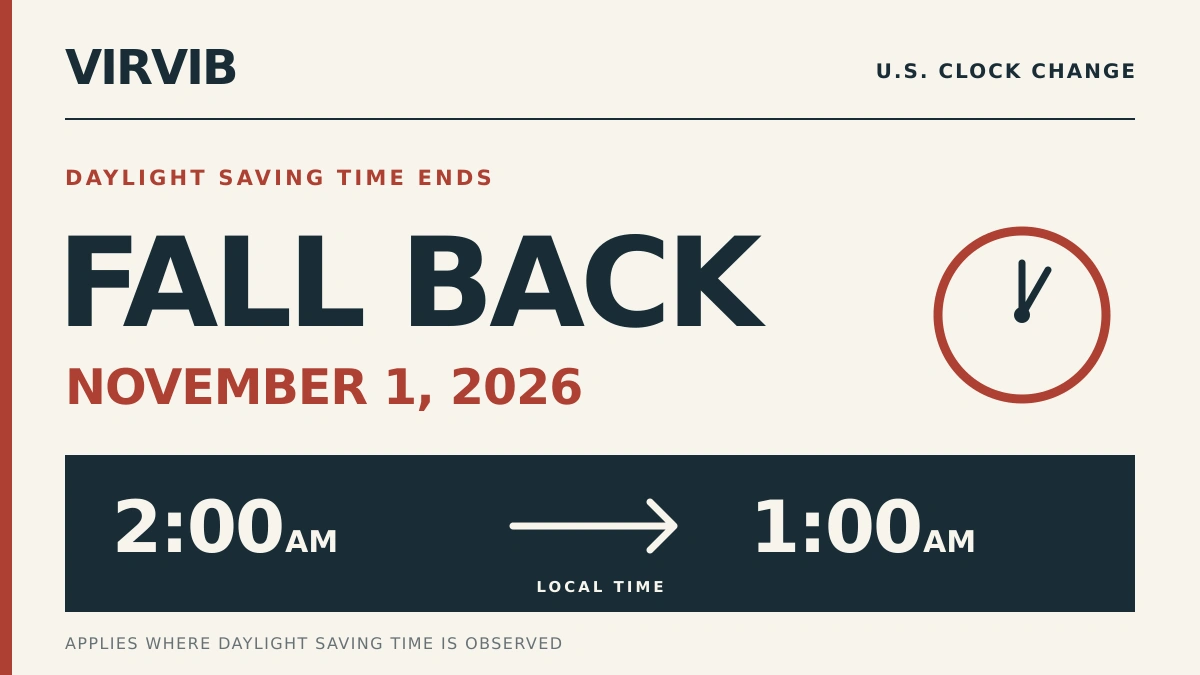
Daylight saving time ends in most of the United States on Sunday, November 1, 2026, at 2 a.m. local time. Clocks move back one hour, from 2 a.m. to 1 a.m. The National Institute of Standards and Technology lists that date in its official 2026 schedule.
The change falls overnight after Halloween, between Saturday, October 31, and Sunday morning. It happens at 2 a.m. in each observing time zone, rather than at one simultaneous moment across the country.
The answer for the United States is November 1, not October 25. NIST lists the 2026 U.S. daylight saving period as March 8 through November 1, with both transitions at 2 a.m. local time. That distinction matters when a clock-change headline circulates without identifying the country. A date used elsewhere should not be applied to a U.S. appointment or journey.
The Google Trends link accompanying this update is a route to U.S. trending-search information for the daylight saving time query. VIRVIB could not retrieve a verified live search count or position from that page. We therefore do not describe the topic as the number-one search, attach a search-volume estimate or infer a growth percentage. The date and clock instructions in this article come from timekeeping sources, rather than from the popularity of the query.
Sources: NIST — official 2026 daylight saving time schedule ↗ · Google Trends — U.S. trending searches, daylight saving time query ↗ · NIST — daylight saving time rules ↗
Do U.S. clocks change on October 25?
The October 25 clock change applies to the United Kingdom, which returns to Greenwich Mean Time at 2 a.m. that Sunday. The UK government's calendar and the U.S. NIST schedule show different dates.
For people in U.S. locations that observe daylight saving time, the autumn change is November 1. If a headline says the clocks change this weekend, check which country it describes before adjusting an alarm or planning a call.
Sources: NIST — official 2026 daylight saving time schedule ↗ · GOV.UK — 2026 clock-change dates ↗
Which states and territories do not change their clocks?
Hawaii and most of Arizona do not observe daylight saving time. The U.S. Department of Transportation also lists American Samoa, Guam, the Northern Mariana Islands, Puerto Rico and the U.S. Virgin Islands as places that do not make the seasonal switch.
Arizona needs a closer look when planning travel. NIST identifies Navajo Nation areas as observing daylight saving time. Use the destination's own local time instead of assuming every stop in Arizona follows the same seasonal rule.
Sources: U.S. Department of Transportation — places that do not observe daylight saving time ↗ · NIST — local time rules, exceptions and time-zone offsets ↗
What happens to the hour between 1 and 2 a.m.?
The hour repeats when clocks return to standard time. In New York, for example, 1:30 a.m. Eastern Daylight Time comes before the change and 1:30 a.m. Eastern Standard Time comes after it. Those labels identify two different moments.
If you are arranging an overnight pickup or shift handover during that hour, confirm which occurrence is intended. A date and an unqualified '1:30 a.m.' may leave the appointment ambiguous.
Sources: NIST — local time rules, exceptions and time-zone offsets ↗
Why a New York–London call shifts for one week
The gap between the two countries' change dates affects calendar conversions. Using the official schedules and time-zone offsets, VIRVIB calculated that a 1 p.m. appointment in New York falls at 5 p.m. in London on Monday, October 26. On Monday, November 2, the same New York appointment falls at 6 p.m. in London.
These examples are time-zone calculations, not changes to an event's schedule. For recurring meetings, keep the event tied to its named city or time zone and check the converted time for the actual date.
Sources: NIST — official 2026 daylight saving time schedule ↗ · NIST — local time rules, exceptions and time-zone offsets ↗ · GOV.UK — 2026 clock-change dates ↗
Will your phone change automatically?
Automatic adjustment depends on the device and its settings. Apple says its devices can handle daylight saving changes through Date & Time settings. For an iPhone, open Settings, then General, then Date & Time, and check the automatic time setting. Also check that the phone is using the correct time zone.
Apple recommends an internet connection and current software. Its support page explains location-based time-zone settings and what to do if the displayed time remains wrong. Check the clock after the change before relying on an early alarm.
Sources: Apple Support — automatic time and time-zone settings ↗
What to check before Sunday morning
Review any clock or timer that you set manually, including a kitchen clock, car display or standalone alarm. NIST notes that some radio-controlled clocks need a recent time signal and the correct time-zone setting to adjust as expected.
For a flight, train, work shift or event near the change, reopen the provider's current booking or schedule. Confirm the date, departure location and stated local time. For an international call, use the date-specific conversion rather than a time difference remembered from the previous week.
Sources: NIST — official 2026 daylight saving time schedule ↗
Has the U.S. stopped changing clocks?
The official NIST schedule checked for this article still lists November 1 as the 2026 end date. A proposal to change the system does not by itself change that published schedule.
The Department of Transportation explains that states may exempt themselves from daylight saving time under state law, but they cannot independently choose permanent daylight saving time. Places that observe it must follow the federally set transition dates.
Sources: NIST — official 2026 daylight saving time schedule ↗ · U.S. Department of Transportation — Uniform Time Act guidance ↗
When does daylight saving time return in 2027?
Under the current U.S. rule, daylight saving time resumes on the second Sunday in March. In 2027, that is March 14. Observing locations move clocks forward from 2 a.m. to 3 a.m. local time.
Sources: NIST — local time rules, exceptions and time-zone offsets ↗
Prepared with AI assistance. Source-based reporting checked on 2026-10-25. This article does not update automatically. Read our editorial standards.