How the Botox billing case reached a 15-year sentence

A California doctor has been sentenced to 15 years in federal prison in a Medicare fraud prosecution involving more than $45 million in Botox claims, moving a case that produced a jury verdict in May into the punishment and asset-recovery stage. The Justice Department announced the sentence on October 30, saying it had been imposed the previous day. That places the sentencing on October 29, rather than the announcement date circulating in news coverage.
The defendant, Violetta Mailyan, operated Healthy Way Medical Center in Glendale. Her conviction covered nine counts of wire fraud and three counts of obstructing a criminal investigation of health care offenses. MyNewsLA independently reported the Thursday sentencing and identified U.S. District Judge Hernan Vera as the sentencing judge. The new development is the actual prison sentence, not a new indictment or a new finding of guilt.
The distinction matters because earlier government announcements described possible statutory maximum penalties and an anticipated sentencing date. Those were prospective descriptions. The October announcement reports what the court subsequently imposed. This article relies on the government's published account and independent local reporting; it does not claim access to a sentencing transcript, an interview with the defendant or a current appeal filing.
The prosecution concerned the gap between services represented on Medicare claims and what actually happened. Botox can have a legitimate medical use for documented chronic migraines. The government said the claims in this case included injections never given, cosmetic treatment presented for reimbursement, and treatment for patients who lacked the relevant referrals. The conviction therefore should not be read as a finding that all Botox treatment or every claim for it is fraudulent.
In its May 19 account of the trial, the Justice Department described an investigation that began with a referral from its Health Care Fraud Section's Data Analytics Team. Analysts identified Mailyan as an unusually high recipient of Medicare Botox payments. A high billing total can prompt scrutiny, but it is not itself a criminal verdict. Here, investigators followed the payment pattern with evidence about clinic operations, travel, beneficiary circumstances and medical documentation.
The department said trial evidence included thousands of purported injections on days the clinic was closed, representing more than $19 million in claims. It also described claims submitted for periods when Mailyan was away on vacation and for a beneficiary who was in federal prison. These are findings described in the prosecution's public trial account, rather than examples drawn from patient records reviewed by VIRVIB.
The obstruction counts explain why the case was about more than inaccurate billing entries. Prosecutors said Mailyan altered patient records and supplied falsified material to investigators after a grand jury subpoena. The May announcement described fabricated consent forms and backdated claims. In the October account, the department again described forged beneficiary signatures. The jury's obstruction verdict addressed conduct during the investigation as well as the underlying fraud.
The indictment, conviction and sentence are separate milestones. The department announced the superseding indictment in December 2025, when the charges were allegations. Its May release reported the jury’s verdict after a six-day trial. The October announcement supplies the punishment. Describing all three stages as if they happened this week would obscure both the presumption of innocence before conviction and the significance of the new sentencing development.
Sources: DOJ — October 30 sentencing announcement ↗ · DOJ — May 19 trial verdict and seized Cybertruck photograph ↗ · MyNewsLA — independent local sentencing report ↗ · DOJ — December 18, 2025 superseding indictment announcement ↗
What the three financial figures mean
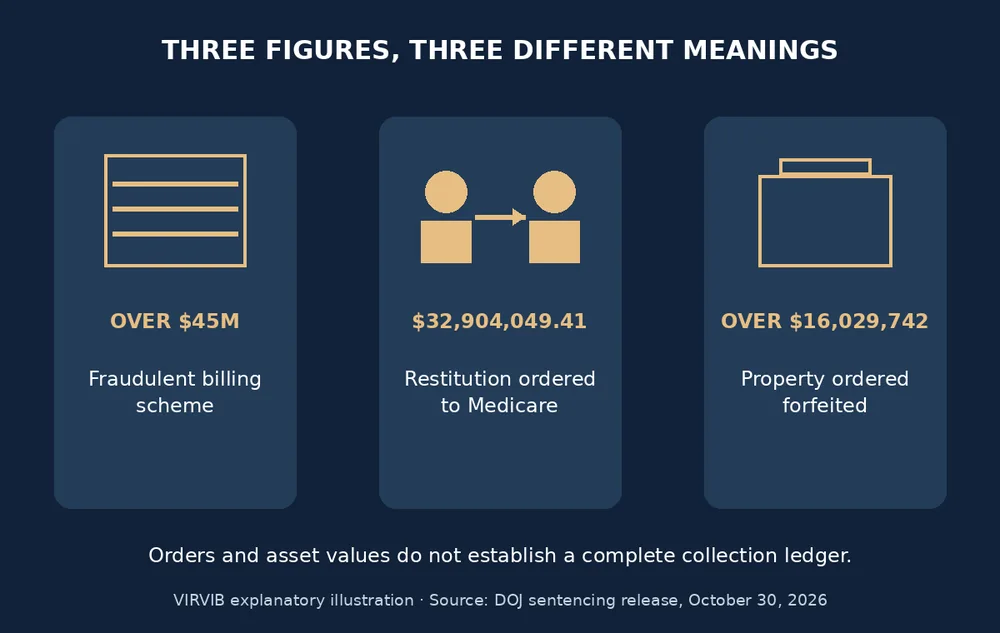
Three dollar amounts need to remain separate when reading this case. More than $45 million describes the fraudulent billing scheme in the Justice Department's announcement. The court also ordered $32,904,049.41 in restitution to Medicare and the immediate forfeiture of property valued at more than $16,029,742. Those figures describe different legal and accounting categories; they are not three interchangeable measures of money already returned.
Restitution is a court order to reimburse a victim for losses caused by a crime. Forfeiture concerns property taken because of its connection to unlawful conduct. The Justice Department's victim-compensation guidance explains that forfeited assets can sometimes be used to compensate victims through legally authorized procedures. It also explains that identifying, forfeiting and selling assets can take time. An order is consequently not the same thing as confirmation that every dollar has been collected and paid out.
Adding the restitution and forfeiture figures together and calling the result a new estimate of Medicare's loss would blur those categories. Equally, subtracting the announced property value from restitution would not establish a remaining balance without information about how the assets are realized and credited. The public sentencing announcement provides the orders, but it does not supply a complete collection ledger. No such balance is asserted here.
The property side drew attention because of the purchases described at trial. The government identified two Tesla vehicles, including a Cybertruck, California real estate and collectible goods. Its published evidence includes a crossbow described as a seventeenth-century object bought for $12,000. The photograph accompanying this report shows the actual Cybertruck identified in DOJ’s May announcement. It is an archival case image, not a picture of the October sentencing. Private phone photographs and auction-catalog images are not reproduced here because their separate reuse rights have not been established.
Sources: DOJ — October 30 sentencing announcement ↗ · DOJ — May 19 trial verdict and seized Cybertruck photograph ↗ · DOJ — forfeiture and victim compensation FAQ ↗
What Medicare beneficiaries can check
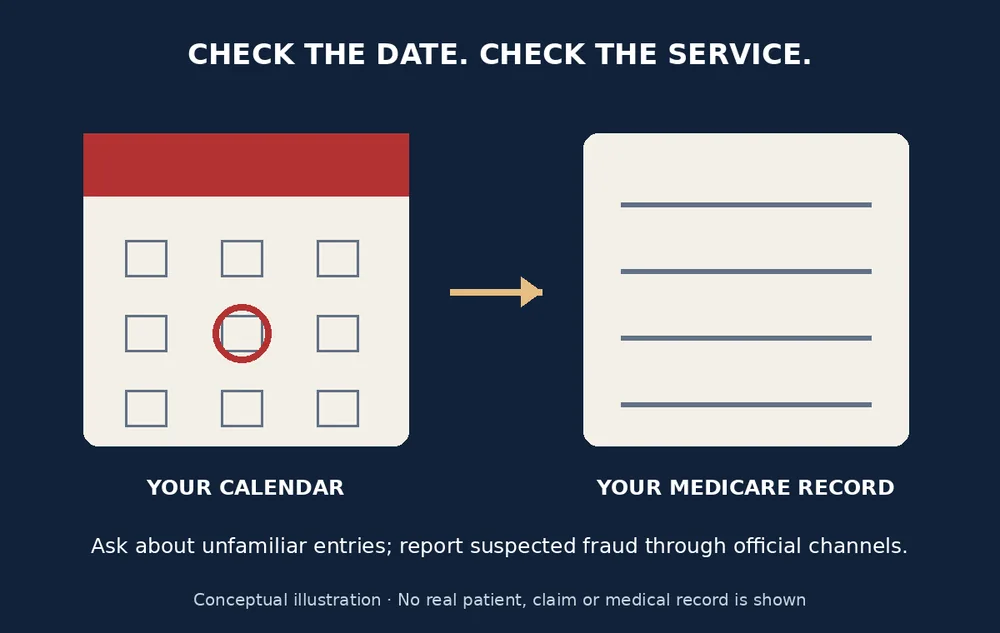
The practical lesson for beneficiaries is about checking records, not diagnosing fraud from a headline. Medicare's official guidance recommends comparing the dates and services on statements with a personal calendar. A service listed for a day when someone did not receive it is a reason to ask questions. People can also review processed Original Medicare claims through a secure Medicare.gov account rather than waiting for paper statements.
An unfamiliar entry should be checked with the provider's office, Medicare says. A billing mistake and an intentional false claim are different possibilities, and a beneficiary does not need to make a criminal finding before raising a concern. Keeping the statement, the service date and the provider details together makes it easier to explain the discrepancy without posting private health information publicly.
For suspected fraud, Medicare lists 1-800-MEDICARE, or 1-800-633-4227, and the HHS Office of Inspector General's online reporting route. HHS separately lists 1-800-HHS-TIPS, or 1-800-447-8477. These are official reporting channels, not a compensation application for this prosecution. The sentencing announcement identifies Medicare as the restitution recipient; it does not announce a general payout program for readers.
Medicare also advises protecting the Medicare number and other identifying information. Its guidance warns against accepting gifts or money in exchange for free medical care and recommends checking provider receipts for mistakes. These safeguards apply generally, regardless of whether a person ever visited the Glendale clinic. The Mailyan sentence establishes a specific criminal outcome, while the reporting guidance gives beneficiaries a way to question their own records without assuming that every irregularity is proof of the same scheme.
Sources: Medicare — reporting fraud and checking records ↗ · HHS — official Medicare fraud reporting guidance ↗
Why this story is in the editionGoogle Trends U.S. RSS checked October 31 included the query “violetta mailyan” with linked local sentencing coverage. No rank or search volume is asserted. Latest edition searched for Mailyan, Botox and Healthy Way; no duplicate found.
Prepared with AI assistance. Source-based reporting checked on 2026-10-31. This article does not update automatically. Read our editorial standards.