What the Vatican confirmed about Leo’s U.S. vote
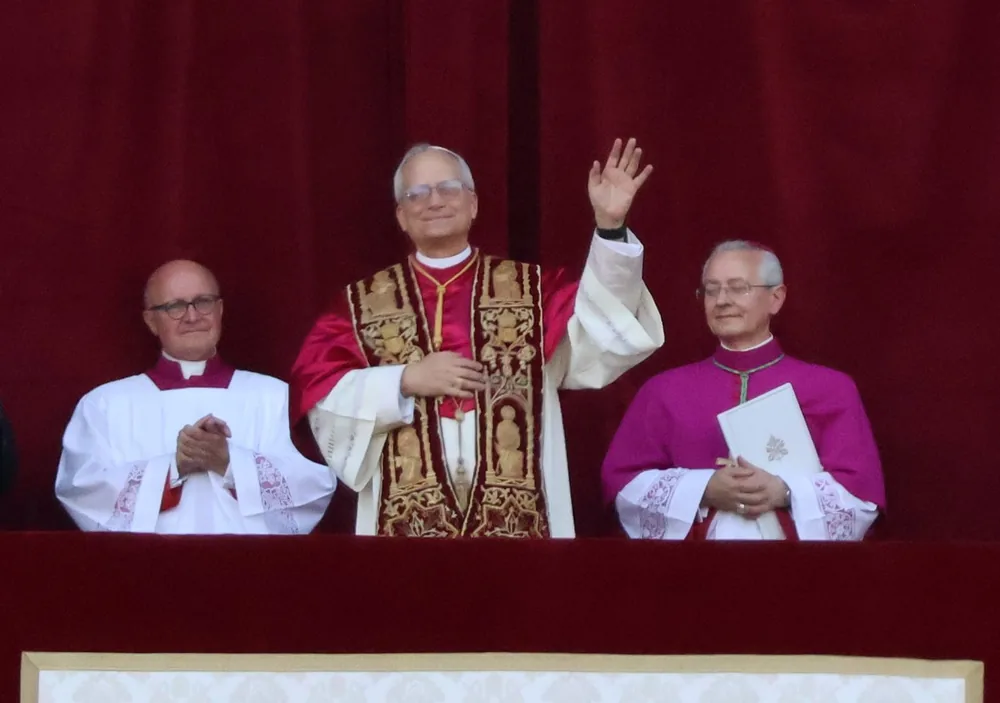
Pope Leo XIV has submitted a mail-in ballot for the U.S. midterm elections, the Vatican confirmed on October 30, 2026. The announcement identifies a continuing act of citizenship by the Chicago-born pontiff ahead of the November 3 election. It confirms participation without disclosing a candidate choice, party endorsement or the contents of the ballot.
Vatican News published the Holy See Press Office’s account on Friday. The statement said Leo had exercised his voting rights as an American whenever eligible and had submitted his mail-in ballot in Chicago, continuing that practice. It also said he participated in eligible elections while living in Peru. His stated belief was that citizens have both a right and a duty to take part in democratic processes.
Reuters independently reported the confirmation and noted that the Vatican did not identify the candidates he supported. The Associated Press described the vote as a first for a pope in a U.S. general election.
His American connection long predates the papacy. The Vatican’s official biography identifies him as Robert Francis Prevost, born September 14, 1955, in Chicago, and records his election as pope on May 8, 2025. It calls him the first pope from the United States and the first Augustinian pope. His ministry included years in Peru before his responsibilities at the Vatican, making his overseas residence part of a much longer international career.
The announcement leaves practical details unstated. It does not describe how the ballot traveled, provide a delivery record or say that an election authority has accepted it for counting. The applicable voting rules explain how those stages normally work; they do not independently document what happened to this particular ballot.
Sources: Vatican News — Holy See Press Office confirmation, October 30 ↗ · Reuters — independent confirmation and undisclosed candidate choices ↗ · Associated Press — independent report of the U.S. general-election first ↗ · Vatican — official biography of Leo XIV ↗
Why living abroad does not by itself prevent a U.S. vote
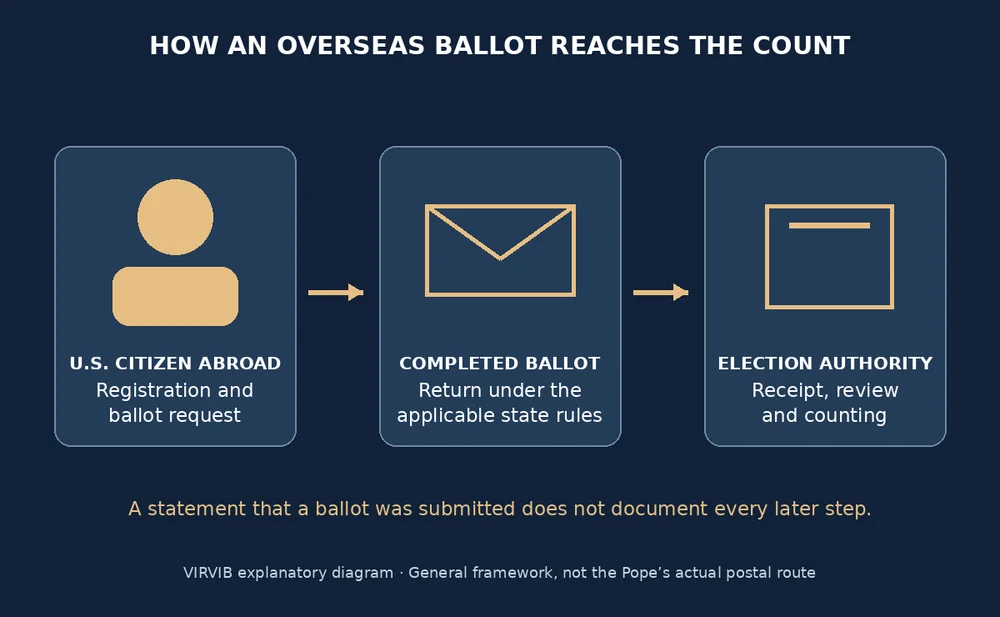
U.S. elections already have a legal framework for citizens outside the country. The Justice Department explains that the Uniformed and Overseas Citizens Absentee Voting Act, enacted in 1986 and commonly called UOCAVA, protects absentee participation in federal elections by covered military voters, eligible family members and American citizens residing overseas. Living outside the United States is therefore a circumstance the law addresses directly, rather than an automatic bar to participating.
Federal protections and state administration work together. DOJ says most states and territories also have their own laws covering participation in state and local elections. That distinction matters when discussing a ballot that can contain different levels of office. Protection for federal elections should not be silently expanded into a claim that every overseas voter is eligible for every contest on a state’s full ballot.
The federal framework includes the Federal Post Card Application, which allows eligible people to register and request an absentee ballot together, and a Federal Write-In Absentee Ballot that can serve as a backup under applicable conditions. DOJ also describes a right to a free tracking system showing whether the appropriate election official received a ballot. These are features of the broader system, not evidence that Leo used a particular federal form or backup ballot.
Nationality raises a separate question because the pope also holds a foreign public office. The State Department’s published guidance says serving in certain foreign-government positions can be a potentially expatriating act under the Immigration and Nationality Act. It also says that the relevant employment results in expatriation only when undertaken voluntarily with the intention of relinquishing U.S. citizenship. Holding a foreign position should not be compressed into a blanket statement that American nationality is automatically lost.
The same guidance treats policy-level foreign offices with particular care. It says the department generally actively reviews cases involving a foreign head of state, head of government or foreign minister, because they can raise complex international-law questions. That general policy is not an individual nationality decision about Leo. The article does not infer that a particular departmental review occurred, was waived or reached a particular result from the voting announcement alone.
For absentee administration, the Illinois chapter of FVAP’s guide separates a voter’s Illinois voting residence from a current mailing address. The place where someone receives mail abroad is not simply substituted for the jurisdiction administering the American ballot. The guide also distinguishes overseas categories according to matters including intent to return. The Vatican statement does not supply the information needed to assign the pope to one of those categories.
Sources: U.S. State Department — foreign public office and nationality guidance ↗ · U.S. Department of Justice — UOCAVA provisions and administration ↗ · FVAP — original 2026–2027 Illinois voting guide ↗
What Illinois deadlines reveal — and what remains private
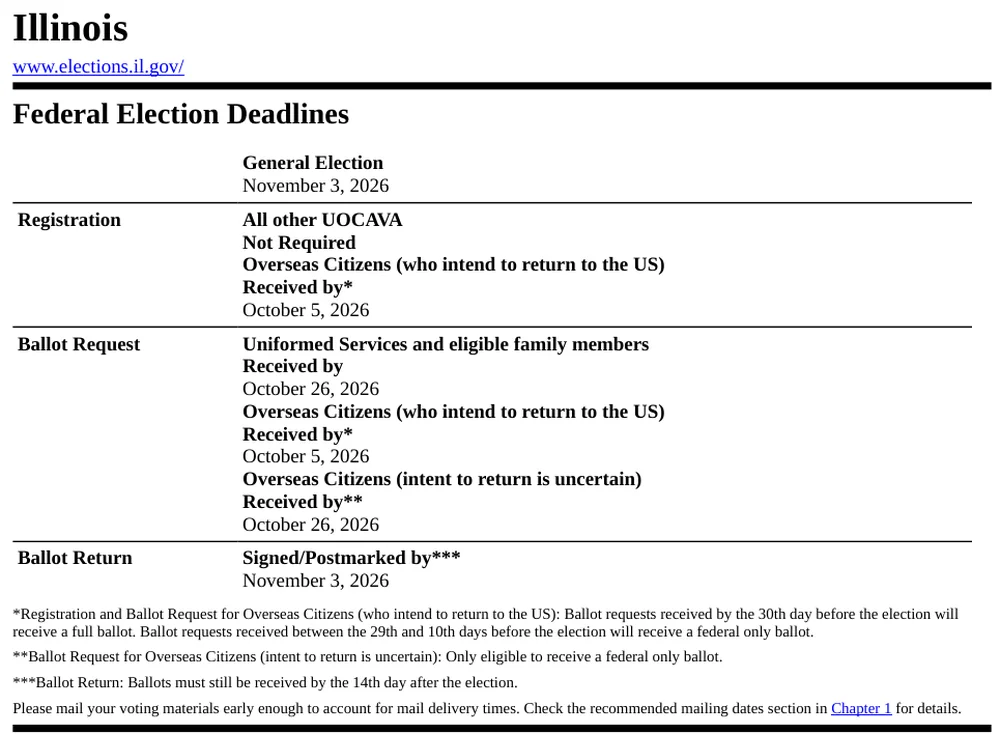
Election Day in Illinois is Tuesday, November 3, 2026. The federal FVAP 2026–2027 Illinois guide lists a ballot-return deadline of being signed or postmarked by that date, with a footnote requiring receipt by the fourteenth day after the election. That later date is November 17. Current Illinois election information, including a county-government calendar, corroborates the November 3 and November 17 dates. An election-night total and the completion of every eligible mail-ballot count are consequently different milestones.
Request deadlines are another part of the process. The FVAP guide sets out different categories and dates for overseas voters, and explains when a voter receives a full ballot rather than a federal-only one. The state’s general vote-by-mail page also notes that additional provisions apply to military and overseas citizens. Readers should therefore avoid applying a domestic mail-ballot application date to every person overseas or assuming that one deadline describes registration, requesting, returning and receiving a ballot alike.
The distinction is relevant to the pope’s announcement because a statement from the sender and a receipt recorded by the election authority answer different questions. DOJ’s description of ballot tracking concerns receipt by the appropriate official. It does not make the voter’s selections public.
The guide also describes safeguards against counting two ballots from one person. If an eligible voter submits the federal backup and subsequently returns the state absentee ballot, and both arrive by the deadline, it says only the state ballot will be counted. That rule explains why the existence of a backup procedure should not be represented as permission to have two votes counted. There is no claim here that Leo used that procedure.
Party labels require similar precision. The Illinois guide says a voter must specify a party ballot for a primary election, while party affiliation is not required when requesting an absentee ballot for the general election. A statement that someone participated in an election does not identify the candidate selected. The Vatican’s confirmation contains no such selection, and this article does not infer one from the pope’s religious office, citizenship or location abroad.
The verified development is the Vatican’s public confirmation of a submitted U.S. midterm ballot. The broader significance lies in a familiar election mechanism being used by an unusually prominent American abroad. The next public milestone is the November 3 election and the administration of eligible ballots under the relevant deadlines.
Sources: U.S. Department of Justice — UOCAVA provisions and administration ↗ · FVAP — original 2026–2027 Illinois voting guide ↗ · Illinois State Board of Elections — 2026 vote-by-mail information ↗ · Clay County, Illinois government — 2026 election and ballot-receipt dates ↗ · Illinois Legal Aid Online — current independent 2026 election FAQ ↗
Why this story is in the editionGoogle Trends U.S. RSS checked October 31 included a broad “us” entry whose linked news items concerned the pope’s midterm ballot. This does not establish a Pope Leo query ranking or search volume. Selected for the independently corroborated Vatican announcement and its U.S. civic context.
Prepared with AI assistance. Source-based reporting checked on 2026-10-31. This article does not update automatically. Read our editorial standards.