October 31: Newsom warns judges, without identifying a pending warrant
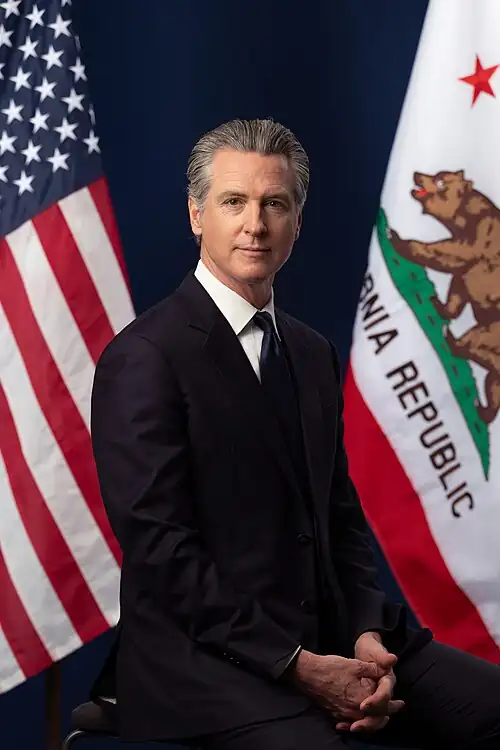
Governor Gavin Newsom sent a letter on October 31 to the chief judges of California’s four federal district courts, warning about possible search warrants for ballots, election records or voting technology before certification. He explicitly said he was unaware of any currently pending warrant application. The verified development is his warning, not evidence that a new warrant has been issued or ballots seized.
Newsom urged scrutiny of potential applications and enclosed a September resource from UC Berkeley’s Edley Center on Law & Democracy. He argued that California’s custody and retention safeguards already preserve evidence and that removing materials needed for counting could interfere with the election. Those are the governor’s arguments, not findings adopted by the recipient judges. Reuters independently reported the letter and its qualification about pending requests.
The letter follows the two October 30 rulings explained below. It does not expand either order, cancel criminal investigations or change voting deadlines. The next substantive evidence would be an actual application, judicial order or documented action. Readers should distinguish that possibility from the civil request already denied and the separate restrictions on threats against election workers.
Sources: Governor of California — October 31 letter and original release ↗ · Gavin Newsom — full October 31 letter to chief district judges ↗ · Reuters — independent October 31 report of Newsom letter ↗
October 30: emergency ballot request denied on appeal
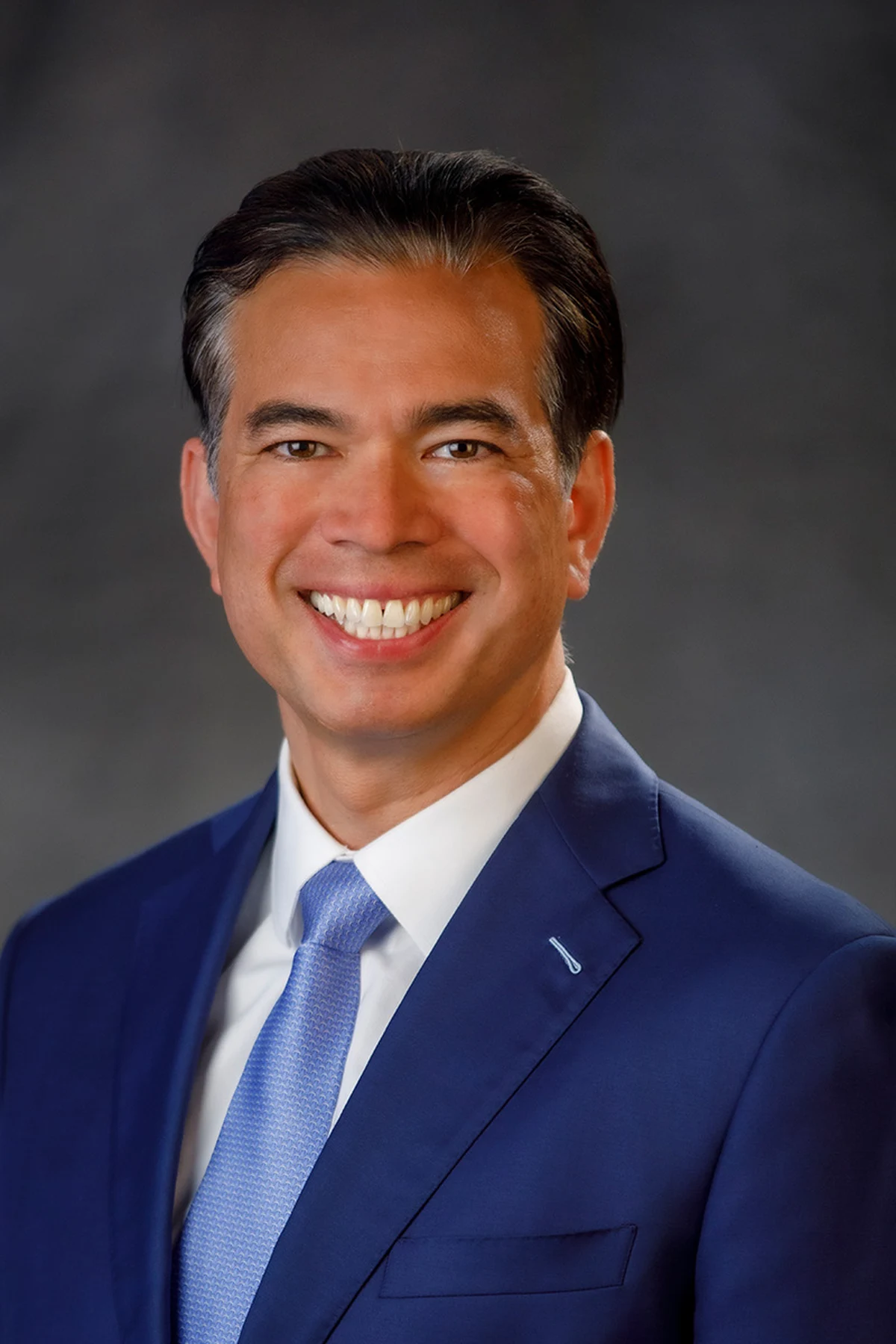
The Ninth Circuit on October 30, 2026 denied the Justice Department’s emergency request to make California set aside mail ballots associated with a disputed list of approximately 20,000 registered voters. The 2–1 ruling rejected an injunction pending appeal; it did not complete a trial on each voter’s eligibility. Later Friday, a different federal judge issued a temporary order restricting federal threats against election workers. These are separate rulings in separate cases, with different operational effects.
The appellate majority, Judges Mark J. Bennett and Gabriel P. Sanchez, concluded that the federal government had not met the demanding standard for the intervention it sought during an ongoing election. The published order, No. 26-7231, emphasizes the Elections Clause, California’s established procedures and the risk that abrupt changes would disrupt counting or disenfranchise eligible voters. It assumes standing and a cause of action without deciding those questions at this emergency stage.
Judge Patrick J. Bumatay dissented. He argued that federal courts could provide relief to protect federal voting law and lawful votes, and challenged the majority’s assessment of the practical obstacles. His position is part of the published decision, not the controlling outcome. The majority denied the emergency motion. The order should therefore not be summarized as either unanimous approval of California’s approach or a final determination that every person on the federal list is eligible.
The appellate action follows U.S. District Judge David O. Carter’s October 28 denial of a temporary restraining order. The government appealed after that written ruling. This differs from its earlier effort to obtain appellate intervention before Carter ruled, which the Ninth Circuit dismissed for lack of jurisdiction on October 26.
The dispute began before this week’s hearing. According to the court’s chronology, federal officials delivered a list and demands to Los Angeles County election chief Dean Logan on October 13. They requested a review within 48 hours, segregation of ballots associated with people whose citizenship had not been confirmed, and a halt to signature verification or tabulation for those ballots. California Secretary of State Shirley Weber received the demands without an accompanying list that day.
The Justice Department sued on October 15 after California and the county rejected its proposed instructions. Its original announcement described the case as an effort to prevent noncitizen participation in federal elections and protect lawful votes. The government’s central allegation was that federal analysis had identified people likely to be noncitizens on California’s registration records. That was an investigative assertion, rather than a judicial determination of each person’s citizenship or conduct.
Carter heard oral arguments on October 27 and denied the temporary restraining order the following day. California Attorney General Rob Bonta welcomed the outcome in an October 28 statement and said the state would continue seeking dismissal. That statement describes California’s position in the litigation. The court order itself supplies the legal reasoning, including the judge’s concern that a late change could deprive eligible citizens of their votes.
Sources: U.S. District Court — October 28 order denying temporary restraining order, Dkt. 149 (PDF hosted by California DOJ) ↗ · U.S. Justice Department — October 15 lawsuit announcement and federal allegations ↗ · California Attorney General — October 28 response to the ruling ↗ · Ninth Circuit — original October 30 order and dissent, No. 26-7231 ↗ · Associated Press — independent report on both October 30 rulings ↗ · California Attorney General — party response to October 30 appellate ruling ↗
Why the list and the proposed legal remedy failed this test
The October 28 order describes several stages in the federal matching process. Homeland Security Investigations acquired a voter file, and U.S. Citizenship and Immigration Services personnel compared profiles with immigration information, supplemented them using third-party analytics, screened against other federal records and conducted manual reviews. Federal officials presented those steps as safeguards supporting their confidence in the resulting list. Carter nevertheless found the explanation inadequate to justify the requested intervention.
The weaknesses he identified were specific. The government had not disclosed sufficiently detailed matching rules, confidence thresholds, error rates or validation against a reliable benchmark. The order also questioned the unexplained reduction from a July allegation concerning approximately 190,000 registrations to the October list of about 20,000 people. Those changing figures are allegations at different stages of the investigation, not a measured total of unlawful votes.
Los Angeles County’s review found that 7,035 of the more than 20,000 records had addresses in the county, the order says. A preliminary sample also included canceled and inactive registrations. Neither an address match nor a historic registration status settles present citizenship. The narrower point is that the statewide list could not simply be treated as a verified inventory of active Los Angeles voters requiring identical action.
The headline number also does not establish how many people returned a ballot. Reuters reported that the department had not indicated how many flagged individuals had actually submitted one. Registering, receiving a ballot, returning it, having an envelope processed and having a vote included in results describe different events. Converting a list of suspected registrations into a claim of 20,000 illegal votes would erase those distinctions and assert something the evidence reviewed here does not establish.
The government’s legal theory was separate from the matching problem. It argued that California’s approach impaired enforcement of the federal criminal prohibition on noncitizen voting and diluted lawful votes. At this preliminary stage, Carter found the department unlikely to establish standing or a cause of action for the civil remedy it sought. He reasoned that continuing election administration did not prevent federal prosecutors from pursuing an individual violation supported by evidence.
The judge also concluded that the requested remedy would likely conflict with federal voting protections, including the National Voter Registration Act’s restriction on systematic removals during the 90 days before a federal election. The government characterized segregation as temporary rather than removal. Carter rejected that distinction in practical effect, pointing to the absence of a workable verification process and the risk that ballots would remain excluded. These are the district judge’s findings in denying urgent relief, and remain subject to further litigation.
An October 31 filing adds a distinct evidentiary challenge. In CHIRLA and Pedro Trujillo’s District of Columbia lawsuit, plaintiffs submitted UCLA analysts Matt Barreto and Michael Rios’s review of the government-produced list. Their declaration reports that 8,880 of 20,930 names, approximately 42%, could not be matched to the California voter file they used. They also reported at least 22 full matches with CHIRLA’s naturalized-citizen members and clients, using names, birth dates and exact addresses. Associated Press independently reported the filing.
These are the plaintiffs’ experts’ findings, not a court ruling that 42% of the list are citizens or that the remaining names are noncitizens. Failure to match a registration does not itself determine citizenship. The analysts said the supplied file lacked voter identification numbers that could improve matching precision.
The supplemental brief addresses CHIRLA’s standing to sue, linking alleged errors to harm to its members and operations. It does not itself grant an injunction or replace the separate California rulings. VIRVIB reviewed the public filings, not the underlying private voter databases.
Sources: U.S. District Court — October 28 order denying temporary restraining order, Dkt. 149 (PDF hosted by California DOJ) ↗ · Reuters — October 29 independent report on the ruling and new appeal ↗ · U.S. Justice Department — October 15 lawsuit announcement and federal allegations ↗ · CHIRLA and Pedro Trujillo — October 31 supplemental standing brief, Dkt. 43 (party filing, not a ruling) ↗ · UCLA analysts — October 31 declaration, Dkt. 43-1, paragraphs 8–16 and 26 (plaintiffs’ evidence) ↗ · Associated Press — independent October 31 reporting on the list analysis ↗
What the decision means for election administration and voters
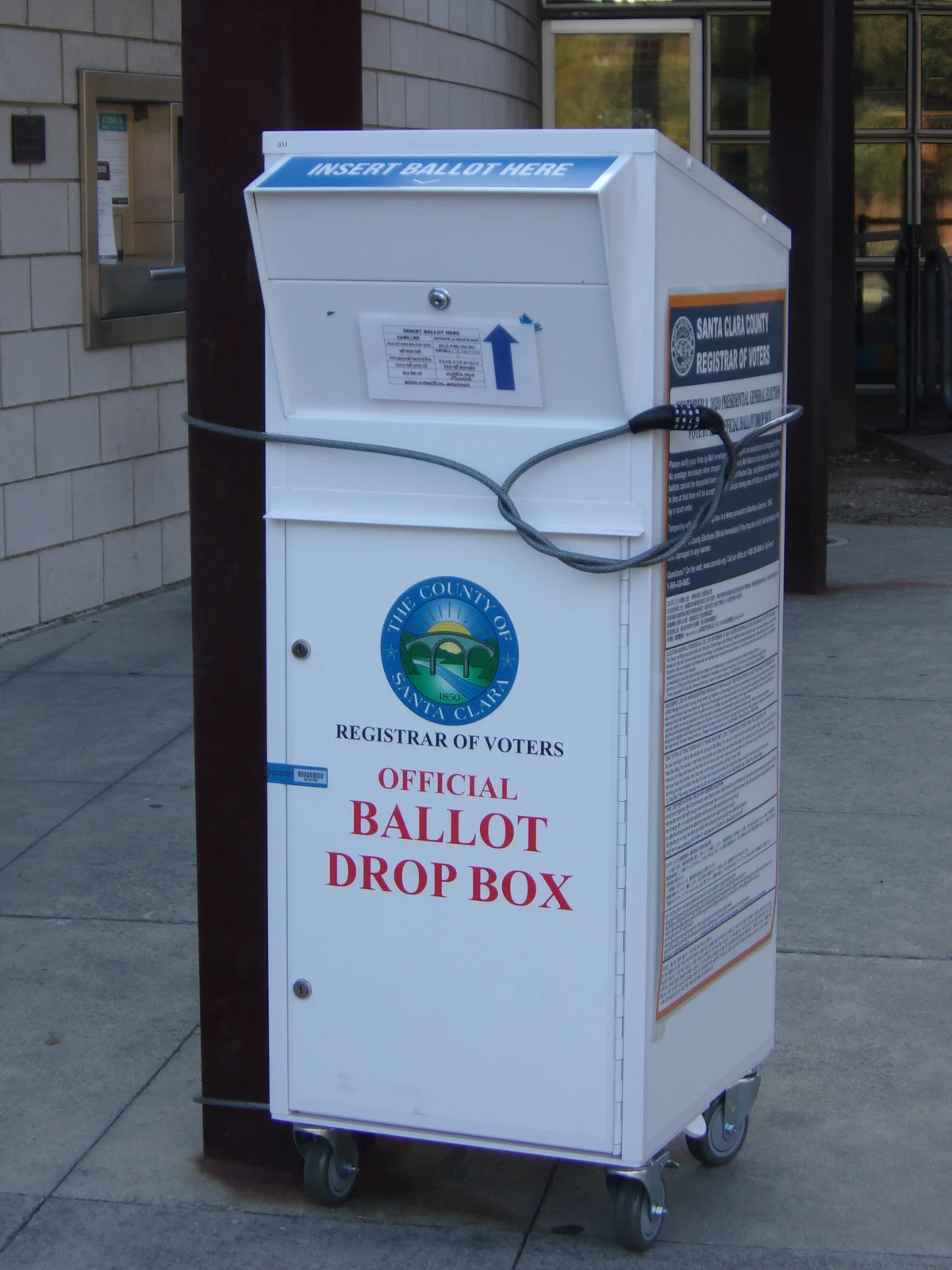
The operational issue is more complicated than instructing workers to place envelopes in a different pile. The order recounts Los Angeles County’s evidence that its existing system had no function for setting aside designated voters’ ballots. Implementing the request would require changes to multiple software programs and devices, a documented new procedure and staff training during the busiest part of election preparation.
That evidence also explains why timing affected the legal analysis. Carter said the federal government’s months-long delay undermined its claimed emergency. He invoked the principle that lower federal courts ordinarily should avoid changing election rules immediately before an election, particularly when voting has already begun. The order evaluated the proposed disruption alongside the risk of excluding eligible voters, including naturalized citizens incorrectly identified through outdated or mismatched records.
The decision does not authorize noncitizens to vote in federal elections. Carter expressly identified individual criminal prosecutions under the applicable federal statute as an available enforcement route, and noted California’s procedures for canceling registrations when ineligibility is established. His objection concerned the requested mass civil intervention and the evidence supporting it. Readers should therefore distinguish a dispute over government powers and procedures from the separate question of whether a particular person committed an offense.
For eligible California voters, the Secretary of State’s election information remains the practical starting point. Election Day is November 3, with polling places open from 7 a.m. to 8 p.m. local time. The state says online registration closed October 19, while conditional registration remains available in person through Election Day. County election offices provide the appropriate local details about locations, eligibility requirements and ballot-return options.
The Secretary of State also says mailed ballots must be postmarked by November 3 and advises anyone mailing on Election Day to obtain a manual postmark inside the post office. Official ballot-tracking information is available through California’s Where’s My Ballot service. Those administrative instructions are more useful than assuming a headline about litigation changes the deadline or creates a new individual documentation requirement.
The October 30 appellate ruling now supplies the next verified result: the federal government did not obtain its requested emergency injunction. The underlying dispute and any later review remain separate from that immediate denial. California’s ordinary voting instructions should not be replaced by assumptions drawn from a litigation headline.
Sources: U.S. District Court — October 28 order denying temporary restraining order, Dkt. 149 (PDF hosted by California DOJ) ↗ · California Secretary of State — official November 3 election information and deadlines ↗ · California Secretary of State — official ballot-tracking service ↗ · Ninth Circuit — original October 30 order and dissent, No. 26-7231 ↗
A separate order protects election workers from specified threats
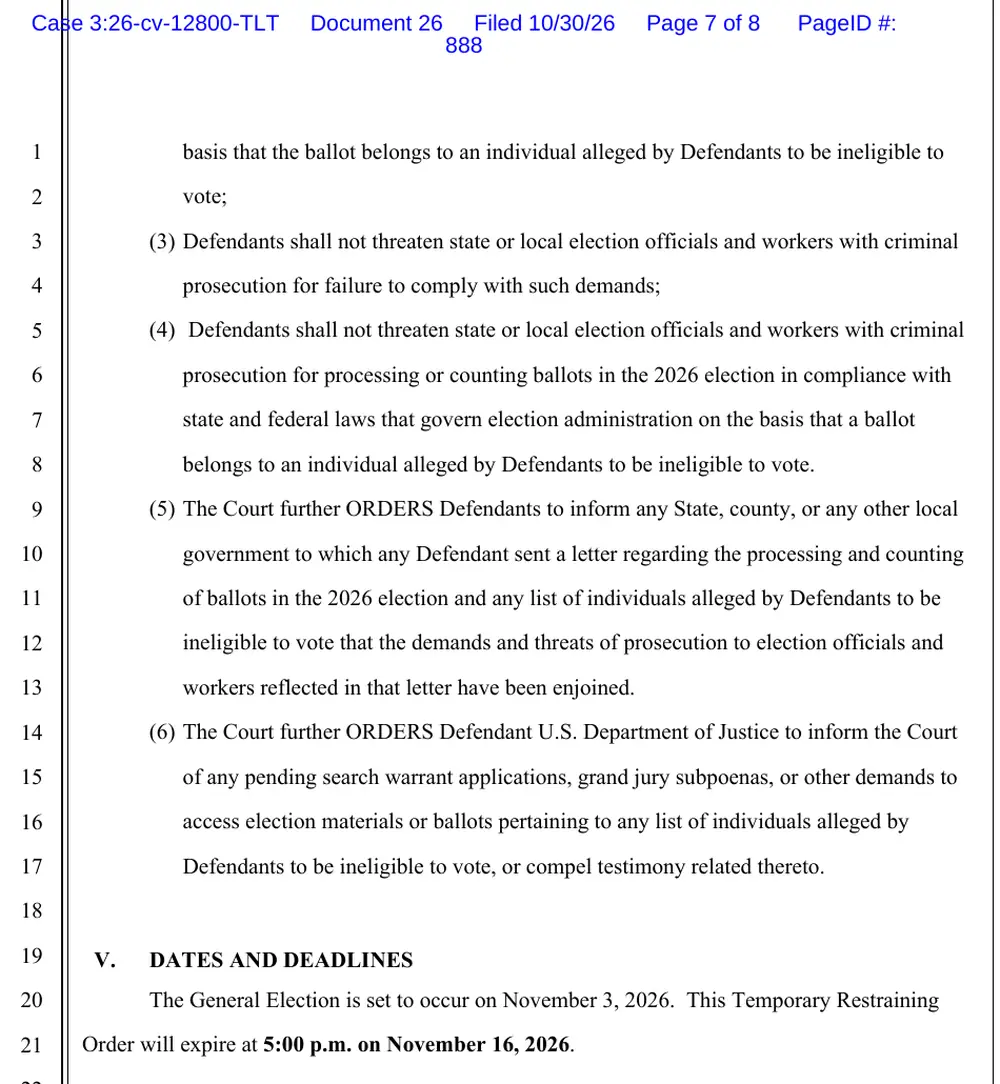
In a separate lawsuit, SEIU v. U.S. Department of Justice, Judge Trina L. Thompson issued an eight-page temporary restraining order on October 30. The plaintiffs are SEIU, AFSCME, the League of United Latin American Citizens and the NAACP. The defendants include DOJ, DHS, Attorney General Todd Blanche and Homeland Security Secretary Markwayne Mullin. Reuters independently reported the ruling early on October 31; the order itself was filed on October 30.
Its operative language bars federal defendants from threatening, intimidating or coercing election workers into halting ballot processing solely because federal officials allege a registered voter is ineligible. It also prohibits demands to remove specific voters from rolls, refuse them ballots, segregate their ballots or otherwise not count them on that basis. Workers may not be threatened with prosecution for rejecting those demands or for processing and counting ballots in compliance with the applicable election laws.
The condition concerning allegations of ineligibility is important. The order does not decide the citizenship of everyone on a federal list. It restrains specified federal pressure tactics directed at election administrators. Thompson found the plaintiffs likely to prevail under the Voting Rights Act’s prohibition on intimidation and discussed the states’ constitutional role in election administration. Those are preliminary findings supporting emergency relief, not a final trial verdict on every claim.
Federal defendants must also notify governments that received the challenged letters that the demands and prosecution threats have been enjoined. DOJ must inform the court of pending search-warrant applications, grand-jury subpoenas or other demands for election materials or related testimony connected to lists of allegedly ineligible voters. Disclosure to the judge is not the same as a blanket cancellation of every criminal investigation. Reuters reported that DOJ had no immediate comment on the ruling.
The order sets a November 2 deadline for the federal response to the preliminary-injunction request, an optional plaintiffs’ reply on November 5 and a hearing on November 13. The temporary order is scheduled to expire at 5 p.m. on November 16. These are the dates in the October 30 document, not predictions of a future ruling. The next developments to watch are the parties’ submissions and any subsequent order changing or extending the restrictions.
Sources: U.S. District Court — October 30 SEIU temporary restraining order, Document 26 ↗ · Reuters — independent report of restrictions on prosecution threats ↗ · Associated Press — independent report on both October 30 rulings ↗ · Protect Democracy — plaintiffs’ case page and documents ↗
Why this story is in the editionGoogle Trends U.S. RSS and current reporting checked November 1, 2026 UTC. Queries included WNBA players, Verizon and flash-flood warnings. The linked Verizon earnings release is dated October 26, not a new November 1 announcement. Selected a corroborated substantive development in existing California coverage after reviewing the 507-article catalog; no query rank or search volume claimed.
Prepared with AI assistance. Source-based reporting checked on 2026-11-01. This article does not update automatically. Read our editorial standards.