Alaska seeks dismissal as DOJ presses for ballot separation
Alaska's election defendants asked a federal judge on October 31 to dismiss the Justice Department's Senate-election lawsuit with prejudice. Their new reply argues that separating ballots would not establish whether voters confused Daniel J. Sullivan with Republican incumbent Dan S. Sullivan. It distinguishes storing marked ballots separately from trying to identify voters' intentions, which officials say ballot secrecy prevents. The filing sharpens the state's response to DOJ's urgent request before the November 3 election. It is an argument for dismissal, not a court decision. The Associated Press independently reported the state's Saturday filing.
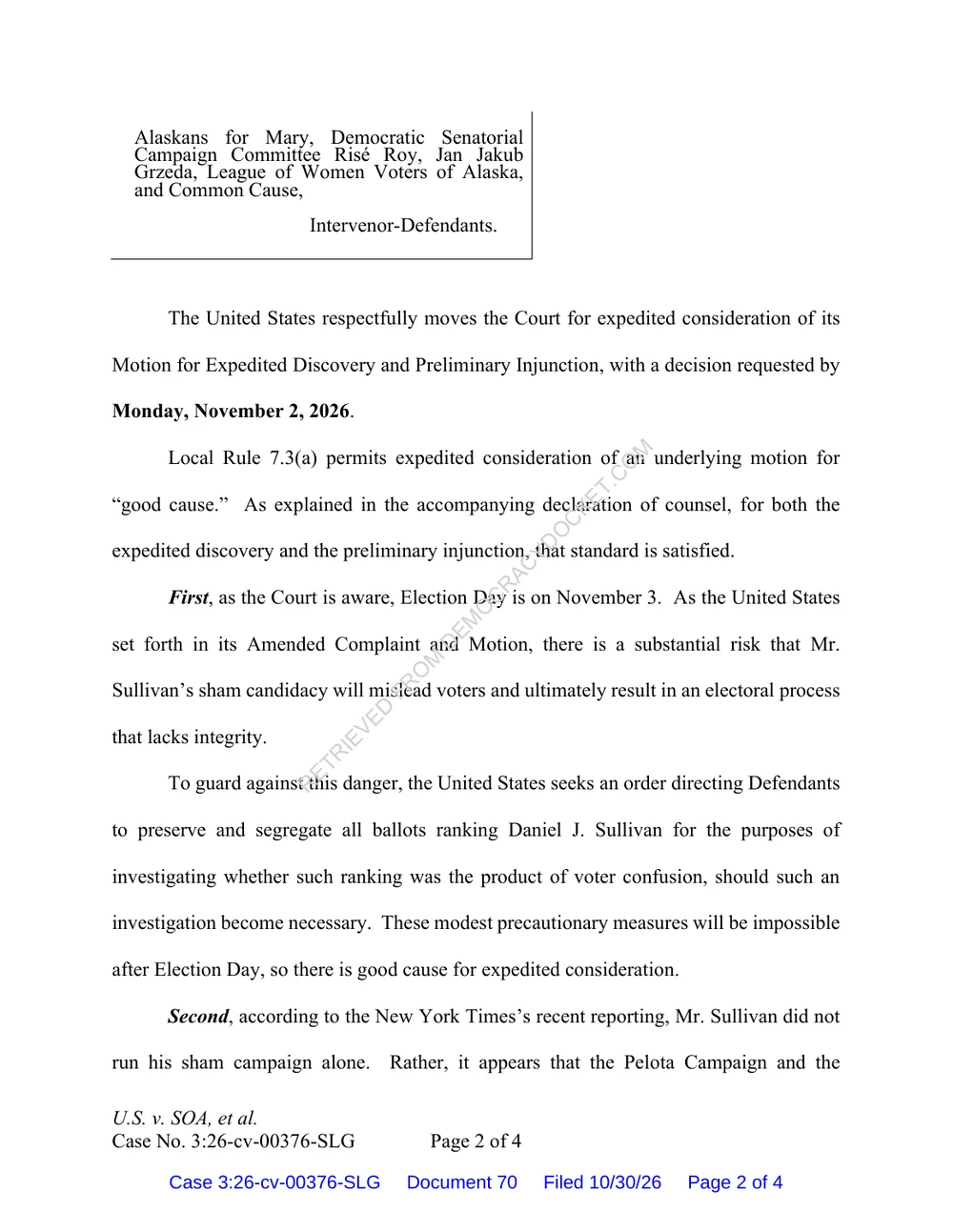
The Justice Department asked Judge Sharon L. Gleason on October 30 to order Alaska election officials to preserve and separate ballots ranking Daniel J. Sullivan, the candidate whose name resembles the incumbent's. Its request for accelerated consideration seeks a decision by Monday, November 2, one day before the general election. The filing does not itself authorize election workers to separate votes or change a result.
The government's motion covers ballots that rank Daniel J. Sullivan, rather than only ballots listing him first. It also requests accelerated discovery concerning recruitment-related communications involving Alaskans for Mary and the Democratic Senatorial Campaign Committee. DOJ alleges that the candidacy was organized to confuse voters and help Democrat Mary Peltola. Those allegations remain contested. The motion's proposed timetable would give the court very little time to consider relief affecting an election already underway through early and absentee voting.
The accompanying memorandum argues that federal election-integrity interests justify precautionary action. It invokes the National Voter Registration Act and federal supremacy, contending that Alaska cannot disregard a candidacy the department describes as deceptive. It also acknowledges that state courts required Daniel J. Sullivan's inclusion on the ballot. DOJ therefore seeks intervention in the handling of ballots and potential certification, rather than simply renewing the earlier state effort to exclude him.
Reuters independently reported the October 30 preliminary-injunction request. DOJ has moved from requesting relief in a complaint to seeking an order on an urgent schedule. The October 31 reply answers that escalation. No order granting the requested ballot segregation was identified in the court materials reviewed for this November 1 update; the parties' requests should not be confused with an instruction to poll workers.
Sources: DOJ — October 30 expedited-consideration motion, ECF 70 (original filing) ↗ · DOJ — October 30 injunction memorandum, ECF 66 (original filing) ↗ · Reuters — October 30 preliminary-injunction request ↗ · Alaska defendants — October 31 reply seeking dismissal, ECF 76 (original filing) ↗ · Associated Press — October 31 state reply, via ABC News ↗
Alaska says preservation already happens and secrecy matters
Alaska's election defendants opposed the rush in a filing dated October 30. They argue that the court should first decide whether the lawsuit survives pending dismissal motions. Their response also rejects the premise that ballots face imminent destruction: federal-election ballots are retained for twenty-two months. Preservation, on their account, is already an obligation, not a new emergency requiring a pre-election injunction.
The same response raises a separate objection to segregation during voting. Officials say ballots are mixed in ballot boxes and that identifying every ballot ranking Daniel J. Sullivan during the voting process would conflict with ballot secrecy and change how voting works. They also argue that a marked ballot cannot explain why someone chose a candidate. That is a consequential distinction: the presence of a ranking can be recorded, but a voter's unexpressed intention cannot simply be read from it.
The October 31 reply makes the distinction more explicit. Officials argue that physical separation after voting would accomplish nothing because the rankings remain readable wherever ballots are stored. Intercepting ballots before voters place them in machines, by contrast, would intrude on secrecy. The reply says ballots carry no voter names and are commingled, making it impossible to match a ballot to its voter and ask whether a ranking was mistaken. The state also argues that the NVRA and the added Supremacy Clause theory supply no valid basis for this lawsuit.
In their October 29 motion to dismiss the amended complaint, the state defendants challenge the government's authority under the NVRA, which they describe as a voter-registration law rather than a mechanism for policing candidate motives or certifying a preferred outcome. They also challenge standing and the possibility of meaningful relief. Their argument is that hypothetical future confusion, dependent on an election result that has not occurred, cannot justify the requested federal intervention. These are the defendants' legal positions, not holdings by the judge.
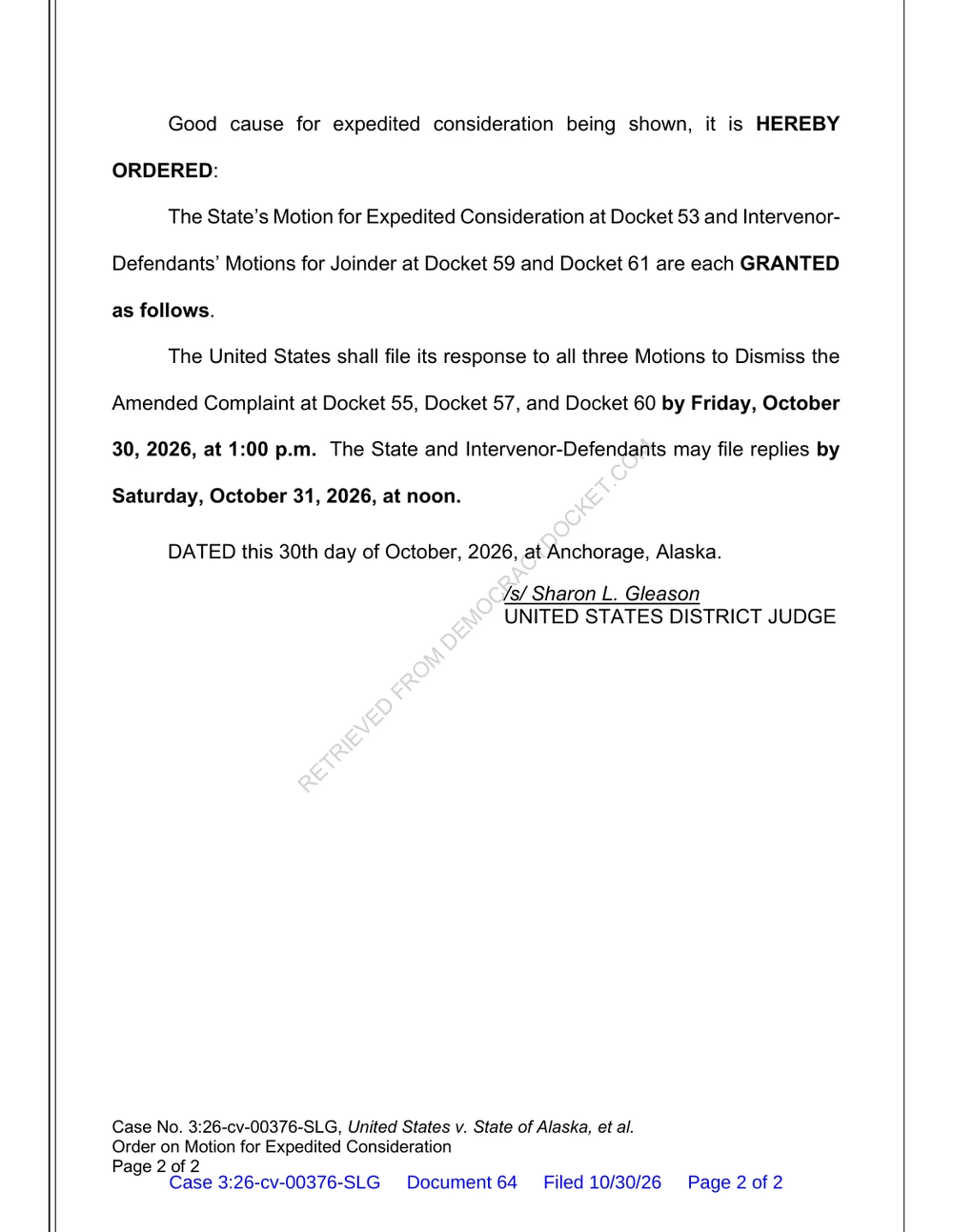
Gleason's October 30 order accelerated briefing on the motions to dismiss. It required the federal response that afternoon and permitted replies by noon on October 31. The order specifies those dates and times without stating a time zone. The state's reply is now in the reviewed record. The scheduling order concerns dismissal briefing; it does not grant the separate request to segregate ballots. A ruling on the pending motions remains the next consequential procedural step.
Sources: Alaska defendants — October 30 opposition to expedition, ECF 72 ↗ · Alaska defendants — October 29 motion to dismiss amended complaint, ECF 55 ↗ · District court — October 30 dismissal-briefing order, ECF 64 ↗ · Alaska defendants — October 31 reply seeking dismissal, ECF 76 (original filing) ↗
Two candidates, disputed allegations and a separate criminal inquiry

The underlying civil lawsuit was filed October 22. DOJ's October 29 amended complaint adds a federal-preemption claim and describes the circumstances in which it wants certification blocked. Its proposed trigger includes the incumbent losing and a hypothetical reassignment of votes for Daniel J. Sullivan that, after the ranked-choice process, would instead produce an incumbent victory. That is the government's proposed test. It is not Alaska's current method for determining what voters intended.
The complaint asks for an investigation before certification of an outcome meeting that definition. A hypothetical calculation is not proof that the votes were mistaken, nor is a lawsuit evidence that a candidate committed a crime. The distinction is especially important where the dispute concerns two actual people with similar names. Senator Dan S. Sullivan is the incumbent; Daniel J. Sullivan Jr. is a different candidate. Photographs of the senator should not be mistaken for photographs of his similarly named rival.
Alaska's official general-election candidate listing distinguishes the incumbent as Dan S. Sullivan, a registered Republican, and lists Daniel J. Sullivan Jr. separately. Mary Peltola and Gerald L. Heikes are also listed in the Senate contest, along with certified write-in candidates. The state's sample-ballot guidance explains that candidate positions rotate across districts. Readers should consult their own official sample ballot rather than assume that a candidate will occupy an identical position on every version.
The Associated Press reported separately that U.S. Attorney Michael Heyman confirmed a criminal investigation on October 30. AP said he declined to identify its targets or the potential crimes under examination. That criminal inquiry is distinct from the civil requests concerning ballot handling and certification. Local reporting by KTOO from Peltola's October 29 Juneau rally recorded her denial of involvement in recruiting the other Sullivan. Reporting a denial does not resolve the allegations, just as reporting an investigation does not establish guilt.
Sources: DOJ — October 29 amended complaint, ECF 43 ↗ · DOJ — original October 22 complaint ↗ · Associated Press — October 30 ballot request and separate criminal investigation ↗ · KTOO — October 29 rally and Peltola’s denial, published October 30 ↗ · Alaska Division of Elections — official 2026 general-election candidate listing ↗ · Alaska Division of Elections — sample ballots and rotation guidance ↗
Voting, counting and certification have different dates
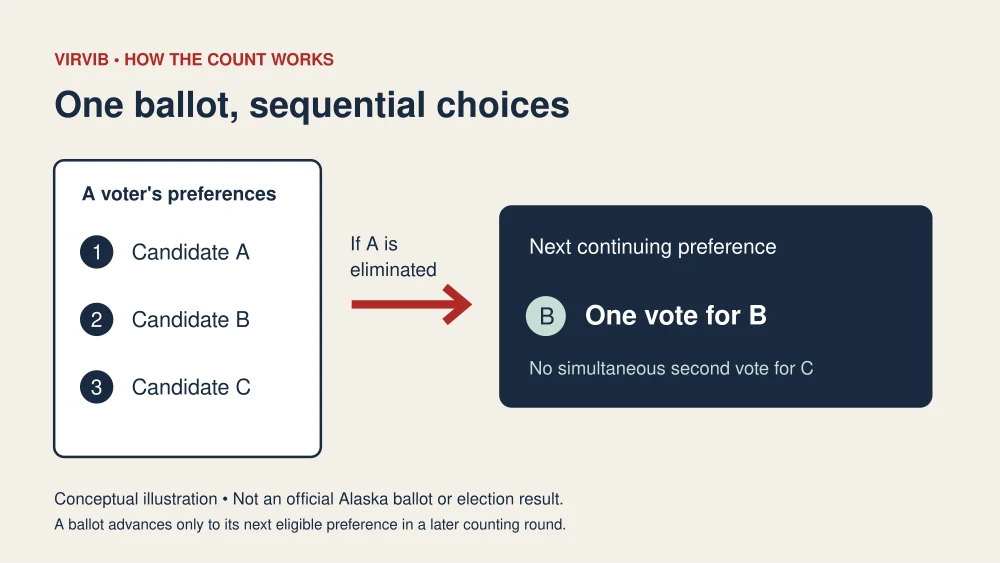
Alaska's Division of Elections lists the general election for Tuesday, November 3. Its ranked-choice guidance says voters may rank as many or as few candidates as they wish; they do not have to support every name on the ballot. First-choice totals begin the count. If no candidate has the required majority, the lowest candidate is eliminated and ballots move to the next eligible preference expressed by their voters. A second preference is not an instruction to count the same ballot twice at once.
The state's 2026 results page says ranked-choice tabulations will not be available until November 18, after eligible ballots have been reviewed and counted. Its calendar lists November 13 as the receipt deadline for qualifying domestic mailed ballots and November 18 for qualifying overseas mailed ballots, with an Election Day postmark required. November 25 is the target for certification. The division labels that a target, so it should not be presented as an unconditional guarantee of a final result that day.
Those dates explain why an incomplete election-night tally and the later certification process answer different questions. A candidate's apparent position in initial returns does not by itself establish the result after all eligible ballots and any required ranked-choice rounds. Likewise, the normal interval for counting timely mailed ballots is part of the published election process; its existence is not evidence that ballots are being added unlawfully.
For readers following the litigation, three records now matter: any ruling on dismissal, any order actually granting or denying emergency relief, and the division's official counting notices. The October 30 and 31 filings establish a concrete dispute over authority, ballot handling and the ability to infer voter confusion. They do not establish who will win the Senate seat. Until the court acts, the department's requested intervention and Alaska's objections should remain clearly identified as opposing positions in a pending case.
Sources: Alaska Division of Elections — ranked-choice guidance ↗ · Alaska Division of Elections — 2026 general-election results and tabulation notice ↗ · Alaska Division of Elections — election and certification calendar ↗
Why this story is in the editionGoogle Trends U.S. Trending Now, past 24 hours, reviewed November 1 alongside national news. Several visible trends were already covered. This substantive development updates existing Alaska litigation coverage; no claim that this case holds a particular search rank or volume.
Prepared with AI assistance. Source-based reporting checked on 2026-11-01. This article does not update automatically. Read our editorial standards.