What the Quad announced in Atlanta
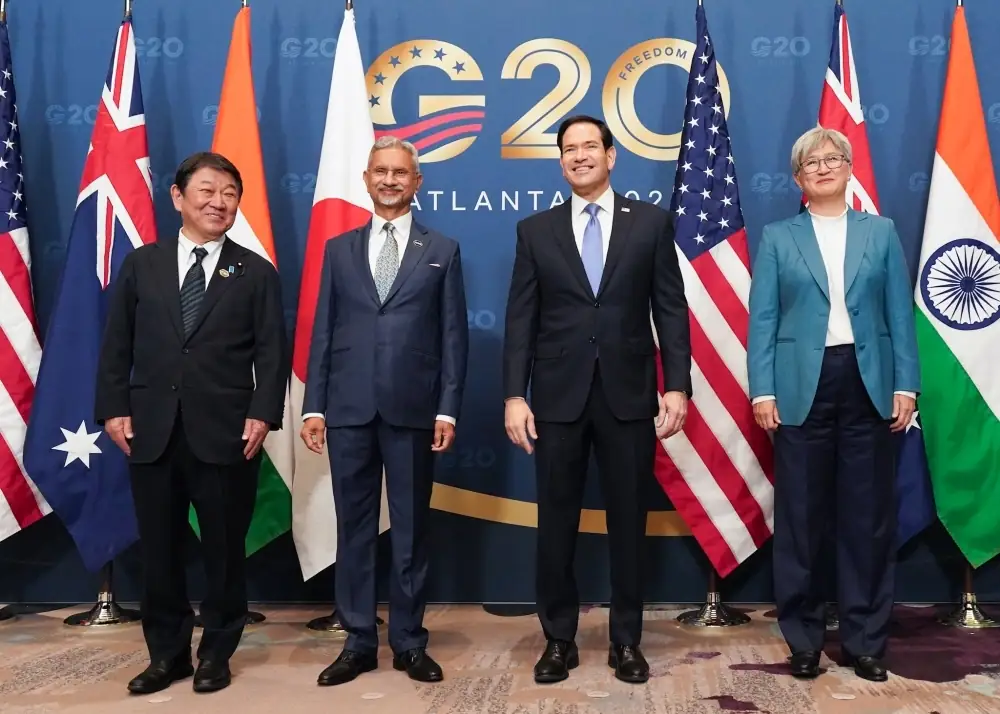
Secretary of State Marco Rubio met his Australian, Indian and Japanese counterparts in Atlanta on October 31, 2026, as the four countries put economic security at the center of their Indo-Pacific cooperation. The most concrete announcements included an intention to provide more than $85 million in technical and financial assistance for access to trusted AI-related technology, alongside a separate U.S. commitment of $10 million for critical-minerals recovery infrastructure in India and ASEAN countries. These are commitments described in a diplomatic release, not evidence that the full amounts have already been spent.
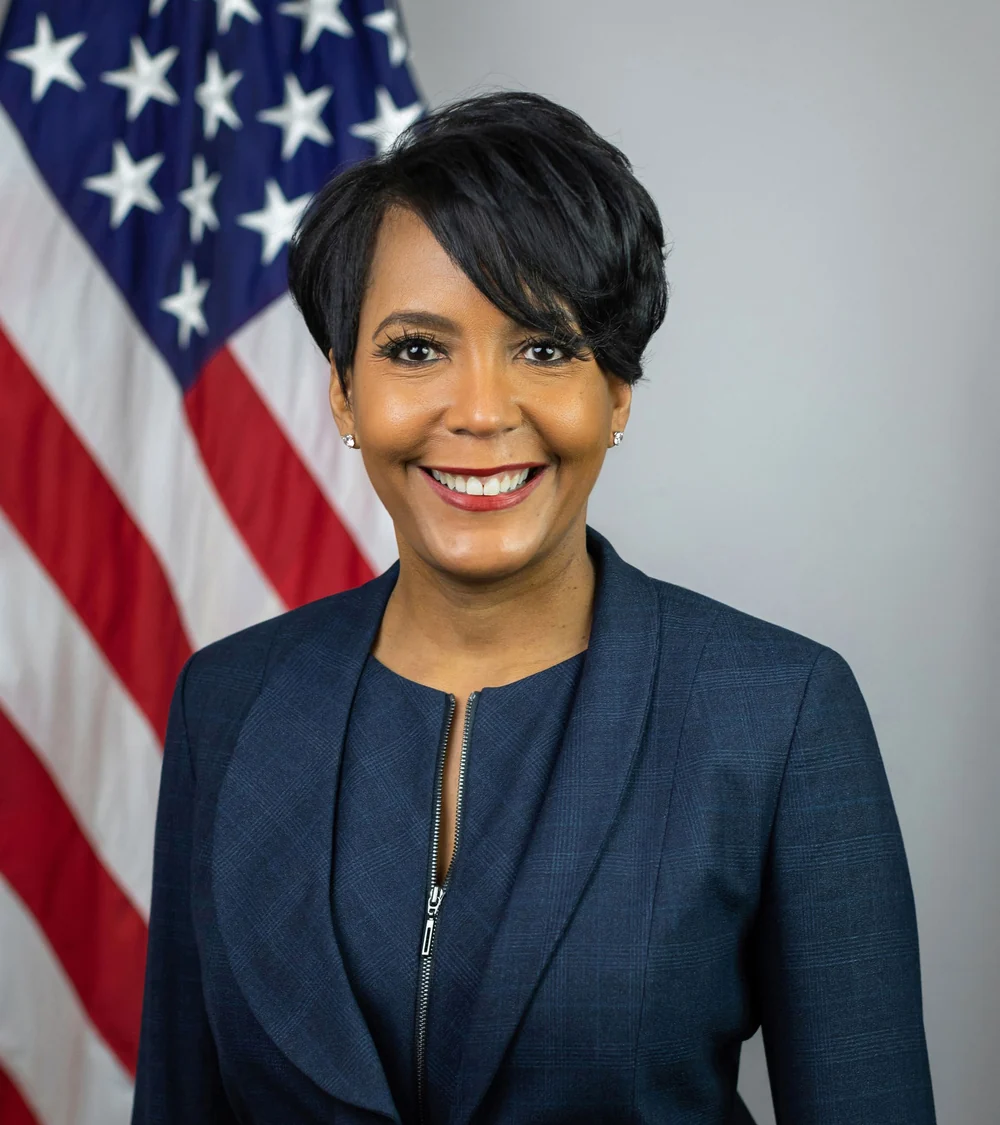
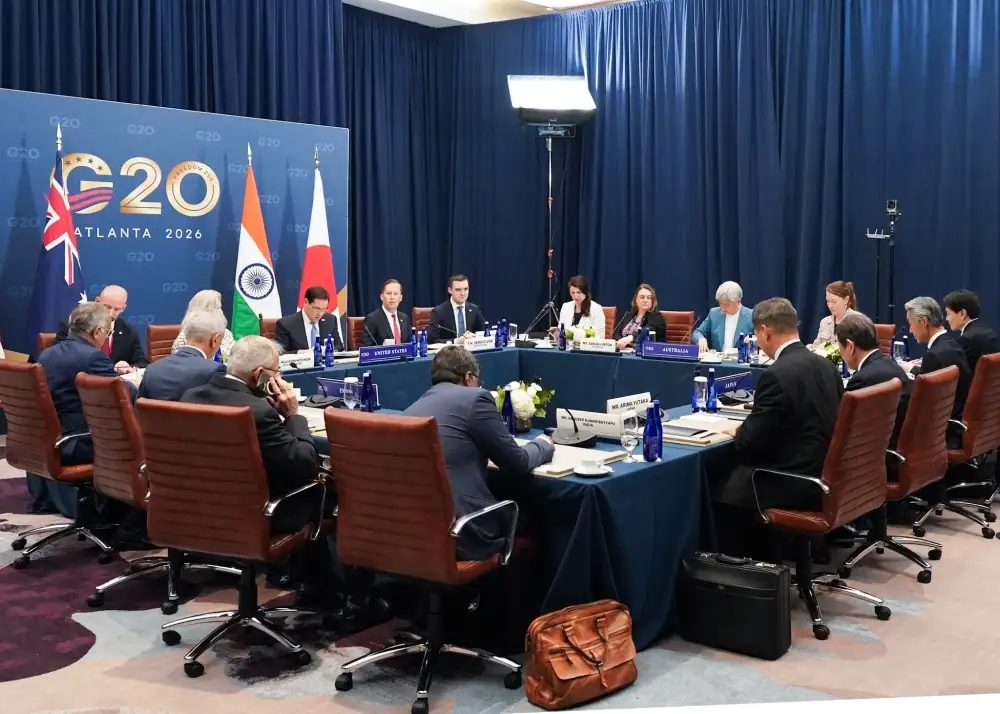
Japan’s Foreign Ministry identifies the participants as Rubio, Penny Wong, S. Jaishankar and Toshimitsu Motegi. Its account says the meeting began shortly after 9 a.m. local time and lasted approximately 40 minutes. It was the ministers’ third meeting this year, following discussions in May and July. The timing matters: this was a working ministerial session on the margins of the G20 gathering, rather than a summit of the four national leaders.
Reuters independently reported the Atlanta meeting and preparations for a possible leaders’ gathering in Manila during the November 15–18 ASEAN meetings. That prospective event remains a next step, rather than an outcome already achieved. The Japanese account likewise says the ministers looked forward to another leaders’ summit without announcing that it had taken place. Readers should distinguish the officials who met on Saturday from the leaders who may meet next month.
The Quad itself is a diplomatic partnership among the United States, Australia, India and Japan. Australia’s foreign-affairs department describes its work across maritime security, economic resilience, technology and emergency response. It traces the partnership’s origins to cooperation after the December 2004 Indian Ocean tsunami and emphasizes engagement with regional institutions, including ASEAN. That history helps explain why an agenda often associated with strategic competition also includes commercially useful infrastructure and disaster preparedness.
Before traveling, Wong’s October 29 statement connected the Atlanta discussions to disruption of energy supplies and the resulting pressure on fuel, food and other essentials. For a U.S. audience, that provides the practical question behind the diplomacy: can cooperation make essential supply networks more dependable? Saturday’s announcements establish intentions and areas of work. Whether they deliver measurable benefits will depend on subsequent projects and implementation.
Sources: Japan Foreign Ministry — October 31 meeting account ↗ · Quad — original October 31 joint release ↗ · Reuters — independent reporting, October 31 ↗ · Australia DFAT — Quad partnership and history ↗ · Penny Wong — October 29 Atlanta visit announcement ↗
Why critical-minerals recovery is part of the plan
The minerals announcement builds on an existing framework rather than starting the Quad’s supply-chain work from scratch. In the May 26, 2026 Quad Critical Minerals Initiative Framework, the four governments said they intended to mobilize up to $20 billion in government and private-sector support through new and existing efforts. That figure is a broader mobilization goal, not a cash grant approved for one recipient, and should not be added mechanically to Saturday’s separate commitments.
The May framework covers mining, processing and recycling. It identifies tools ranging from loans and guarantees to equity participation, insurance and commercial arrangements. It also calls for cooperation on permitting practices, geological information and the recovery of materials from electronic waste and scrap. The distinction between finance and production is consequential: arranging support for a project does not immediately produce a usable mineral supply, and different financial instruments do not represent the same public expenditure.
The U.S. Geological Survey’s 2026 Mineral Commodity Summaries supplies useful context for the recycling emphasis. Its discussion of 2025 activity describes new facilities recovering materials from battery scrap and mixed-metal waste, including printed circuit boards. It also identifies China as a dominant producer of many mineral materials and documents export restrictions affecting a range of commodities. Those findings explain the interest in additional supply routes without establishing that any individual Quad project can replace an existing supplier immediately.
The report is also a reminder that recycling is a collection-and-processing business, not simply a statement that discarded electronics contain valuable material. Facilities must recover the relevant inputs and move them into usable production chains. Reading the May framework alongside the USGS account points to a practical implementation test: whether proposed investment is followed by functioning collection networks and processing capacity. A financing announcement alone does not answer that question.
Energy security follows a similar logic. The Quad’s May 26 energy statement emphasized diversified supplies, uninterrupted commercial flows and the protection of maritime routes, including the Strait of Hormuz. It specifically recognized that disruptions to oil, gas and petrochemical markets affect downstream products such as fertilizer. That earlier statement makes clear that economic resilience concerns ordinary industrial inputs as well as advanced technology. The minerals and energy initiatives address different vulnerabilities, and neither should be presented as a guarantee of lower American retail prices.
Sources: Quad — original October 31 joint release ↗ · Quad — May 26 critical-minerals initiative framework ↗ · USGS — Mineral Commodity Summaries 2026, version 1.3 ↗ · Quad — May 26 energy-security statement ↗
AI access, digital resilience and the next evidence to watch
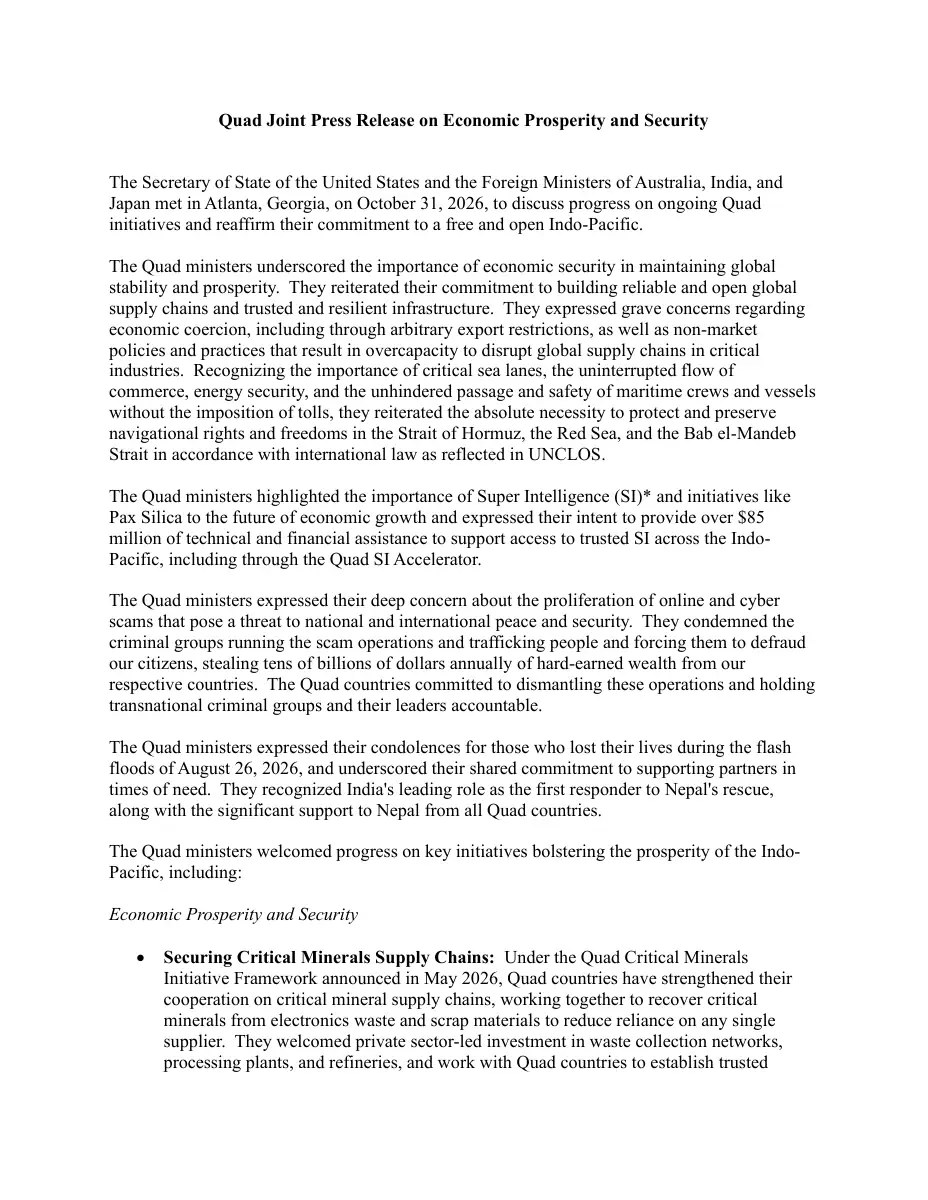
The technology pledge needs careful reading. The October 31 joint release uses the term Super Intelligence, marked with a footnote explaining that Australia, India and Japan use artificial intelligence for that expression. The terminology does not establish that the countries have created a new system with demonstrated superhuman capabilities. The announced assistance concerns access to trusted technology; the release does not itself document completed deployment for every intended beneficiary.
The wider digital agenda has a physical foundation. Australia launched its Cable Connectivity and Resilience Centre on July 29, 2024, describing a role in technical assistance, training, research and policy support for Indo-Pacific partners. That announcement said undersea cables carry more than 95 percent of international data traffic. Dependable connectivity is therefore relevant to the practical use of digital services, even when the headline concerns software rather than cables. The centre is an existing initiative, not a facility newly opened at Saturday’s meeting.
Online fraud is another real-world measure of digital security. The Quad release condemned transnational scam operations and the trafficking of people forced to conduct them. Separate U.S. evidence demonstrates why this is a consequential issue: the FBI’s April 6, 2026 announcement of its 2025 Internet Crime Report said IC3 received approximately 453,000 cyber-enabled fraud complaints reporting more than $17.7 billion in losses. Those are complaint-based figures for 2025, not a tally of losses caused by the Atlanta initiatives or a measurement of their effectiveness.
The FBI also reported 22,364 complaints involving artificial intelligence, with losses approaching $893 million. It described tactics including voice clones, fake profiles and convincing fabricated videos. Those categories illustrate the challenge facing a trusted-technology agenda: broader access and greater security are related goals, but access alone does not prove that fraud has been prevented. The data cannot establish that every reported loss came from the same criminal networks discussed by the ministers.
The next useful evidence will be more specific than another broad declaration. Project announcements can identify participating organizations, funding terms and delivery schedules; later reporting can show what has actually been built or provided. The prospective leaders’ summit offers another opportunity to clarify those details. For now, Atlanta has produced documented commitments on AI access and minerals recovery, supported by a longer-running program of economic cooperation. Their ultimate value remains a question of execution, rather than a result already demonstrated by the announcement.
Sources: Quad — original October 31 joint release ↗ · Reuters — independent reporting, October 31 ↗ · Australia — July 29, 2024 cable-centre launch ↗ · FBI — April 6, 2026 internet-crime findings ↗
Why this story is in the editionGoogle Trends U.S. RSS was reviewed October 31, 2026, including election and international-news interest. This topic was selected from new verified reporting, not claimed to appear in the feed or hold a particular rank or search volume.
Prepared with AI assistance. Source-based reporting checked on 2026-10-31. This article does not update automatically. Read our editorial standards.