A new lawsuit targets the decision to build

The District of Columbia and Virginia sued the National Park Service and Interior Department on October 31, asking a federal court to prevent construction of President Donald Trump's proposed 250-foot triumphal arch at Memorial Circle. The 46-page filed document identifies November 5 as the earliest possible construction date. That is a proposed timetable described in litigation, not confirmation that work has begun or that every necessary approval has been obtained.
The complaint, filed as case 1:26-cv-03838 in the U.S. District Court for the District of Columbia, names the agencies and two officials in their official capacities: Interior Secretary Doug Burgum and Jessica Bowron, the official exercising the delegated authority of the NPS director. Attorneys General Brian Schwalb and Jay Jones represent the two plaintiff governments. Their central request is to preserve the site while the legality of the project is reviewed.
Their argument begins with congressional authority. The governments contend that the Commemorative Works Act and a separate federal public-grounds statute require specific authorization for a structure of this kind at this location. They say no adequate authorization exists. They also invoke height restrictions, environmental review and historic-preservation procedures. These are pleaded legal claims. Filing them does not establish that the project violates those statutes.
The underlying laws make the distinction between design approval and statutory authority important. Section 8903 of Title 40 requires specific legal authorization for commemorative works on the federal lands covered by the statute. Section 8106 separately addresses structures on federal reservations, parks and public grounds in the District. Whether the proposed arch falls within the plaintiffs' interpretation, and whether the government has sufficient authority, are questions for the litigation rather than conclusions supplied by the complaint itself.
The Associated Press independently reported the new suit and said Judge Tanya Chutkan consolidated it with an earlier challenge brought by veterans and an architectural historian. AP also reported the White House's defense of the project as a landmark honoring veterans and providing a gateway to Arlington National Cemetery. The administration's stated commemorative purpose and the governments' legal objections concern the same proposal, but they answer different questions: why its sponsors want it built, and what legal steps they must take before building it.
Sources: District of Columbia and Virginia — original October 31 complaint, ECF 1, case 1:26-cv-03838 ↗ · Associated Press — new lawsuit, consolidation and White House response ↗ · 40 USC 8903 — authorization of commemorative works ↗ · 40 USC 8106 — structures on federal public grounds ↗
Why a traffic circle is also a historic landscape
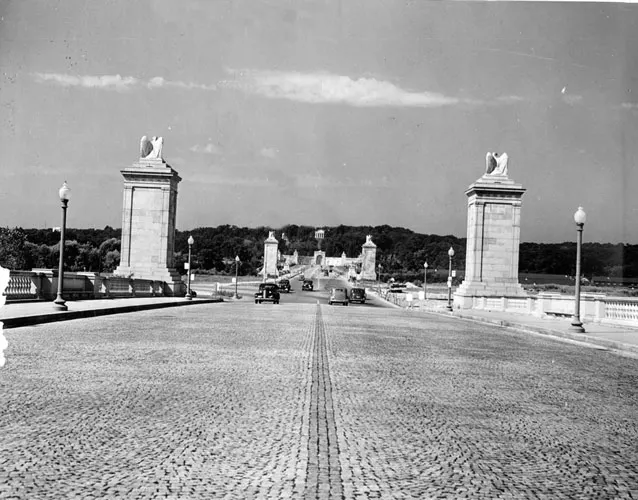
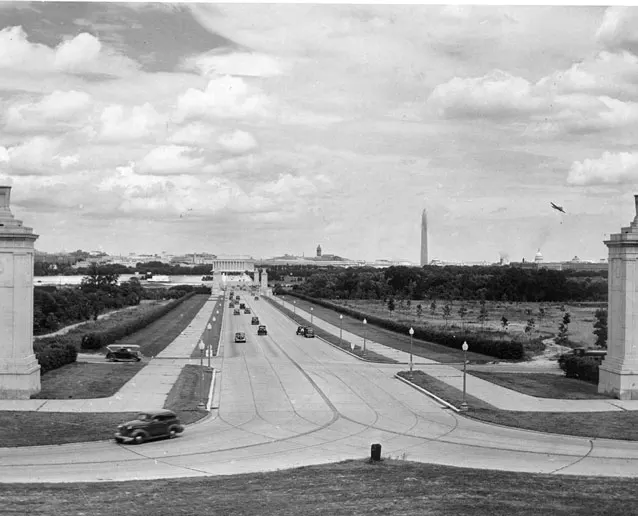
Memorial Circle is not an empty plot detached from the surrounding city. The National Park Service describes the Memorial Avenue corridor as a mile-long composition connecting Arlington Memorial Bridge, Memorial Circle, Memorial Avenue Bridge, Memorial Avenue and the entrance to Arlington National Cemetery. Its account explains the planned visual connection between the Lincoln Memorial and Arlington House. That older federal landscape history helps explain why a new vertical structure at the circle raises questions beyond its own footprint.
The government's historical account predates this lawsuit: the NPS article was last updated in October 2021. Its photographs show the corridor in the late 1930s, including a view before Memorial Circle was constructed. Those images document the evolution of the setting. They are not pictures of the proposed arch, current construction or an October 2026 protest. The distinction matters when visual material is used to explain a dispute about a landscape that has itself changed over time.
The new complaint describes a concrete structure faced with granite or marble, topped with sculptural figures and surrounded by a paved plaza. Citing federal project submissions, it says the interior would include ticketing and security, gallery space and an observation deck. These descriptions identify the proposal challenged by the plaintiffs; they should not be mistaken for a completed building or a guarantee of the final configuration.
The two governments focus on the connections that pass through the site. They say construction would restrict traffic, create substantial truck movements and require changes to surrounding roads. The complaint cites project materials describing a construction period of approximately two to three years. The governments argue that disruption would impose costs on their agencies and interfere with travel between Washington and Virginia. Those are projected effects and disputed legal injuries, not a report of traffic conditions already caused by construction.
Environmental and emergency-service concerns extend the argument. The complaint alleges risks involving stormwater, pollution and the coordination of emergency responses. It challenges the adequacy of federal consultation and review, including the treatment of historic views. The governments are asking the court to examine whether the process properly considered those effects. A lawsuit's description of potential harm is evidence of what the plaintiffs allege, rather than an independent measurement of future damage.
VIRVIB analysis: the site's several roles make the dispute unusually practical. A monument can be considered as architecture, a destination for visitors, an intervention in an existing historic composition and a project beside operating transport links. Evaluating one of those roles does not automatically resolve the others. The documentary record is useful precisely because it separates the proposed design from the movement of people, vehicles and water around it.
Sources: District of Columbia and Virginia — original October 31 complaint, ECF 1, case 1:26-cv-03838 ↗ · NPS — Memorial Avenue Corridor cultural landscape and archival photographs ↗
What the court is being asked to do next
The complaint requests a declaration that the federal decisions advancing the arch are unlawful, preliminary and permanent injunctions against construction and site preparation, and the setting aside of federal approvals and environmental findings. It also asks that the existing condition of Memorial Circle be maintained pending compliance with applicable law. The requested relief is broad, but it remains requested relief. The complaint is neither a restraining order nor a final judgment.
ABC News independently reported that the governments sought emergency relief ahead of the expected November 5 planning decision and that construction could begin that day if the relevant approval were granted. That conditional timing is central to the urgency. It does not mean a commission vote has already happened. Readers should look for an actual decision and its terms before treating the proposed start date as an instruction for work to proceed.
There is also a dispute over the project's purpose. ABC reported that sworn declarations from the defense and homeland-security secretaries had been filed in the earlier litigation to support the administration's national-security argument. NPR's October 31 report distinguished such claims from military elements appearing in the latest plans. Those accounts should not be converted into a claim that an operational military installation already exists at Memorial Circle. The controversy concerns the justification and design of a proposed structure.
The plaintiff governments' account of harm also has a procedural role: it explains why they contend that they are entitled to sue. They identify costs and responsibilities of their own, rather than relying solely on disagreement with a monument's appearance. Whether those claims establish standing, whether emergency relief is warranted and whether the agencies acted lawfully are separate issues. A decision on one would need to be read carefully before being described as a resolution of all three.
For now, the verified development is the October 31 filing and the mounting legal effort to prevent work before judicial review. No construction-stopping order was identified in the material reviewed for this report. The next consequential records are any emergency ruling, the agencies' responses and the planning commission's actual action. Those documents can change what happens at the site; neither an announced ambition nor the existence of a lawsuit can substitute for them.
Sources: District of Columbia and Virginia — original October 31 complaint, ECF 1, case 1:26-cv-03838 ↗ · ABC News — October 31 independent reporting and conditional timetable ↗ · NPR via GPB — October 31 reporting on lawsuit and competing purposes ↗
Why this story is in the editionGoogle Trends U.S. past-24-hour list and current national news reviewed November 1. Recently covered topics were deduplicated against 509 articles. This article follows a newly filed national legal story; no claim of a particular search rank or volume.
Prepared with AI assistance. Source-based reporting checked on 2026-11-01. This article does not update automatically. Read our editorial standards.