Spain train crash: 68 deaths confirmed as investigators examine the sequence
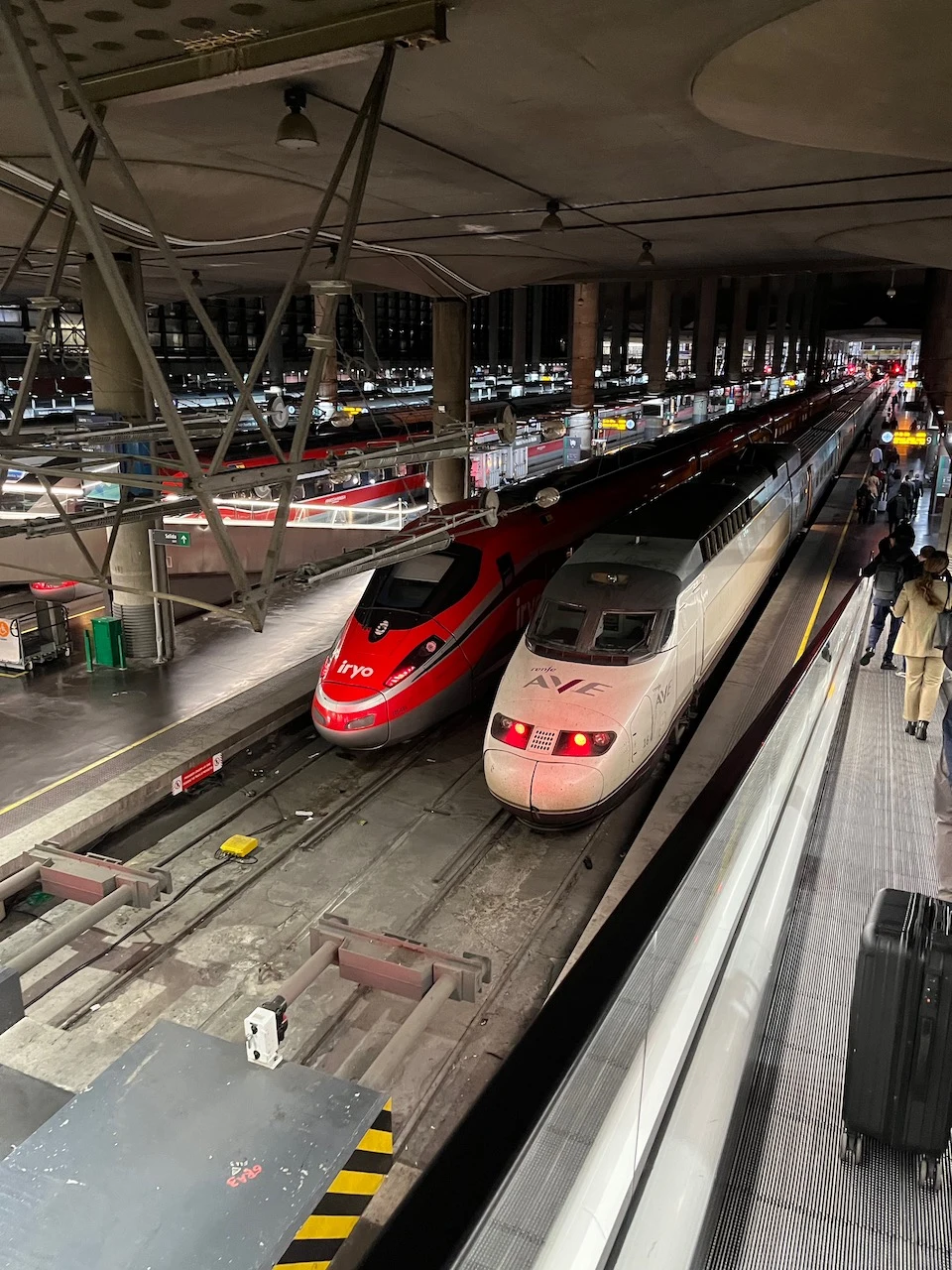
At least 68 people were killed in the October 28 collision between Renfe and Iryo high-speed trains near Urda in Spain’s Toledo province, according to an updated Castilla-La Mancha emergency-service statement. The regional government described the toll as provisional and reported more than 100 injured people of varying severity. Spain has declared three days of official mourning, while the Madrid–Andalusia high-speed corridor remains disrupted. This article updates the earlier account at its original address.
The higher death toll is corroborated by EFE and ABC News. In a late-evening Europa Press report published at 10:15 p.m. Spanish time on October 28, regional president Emiliano García-Page said the figure remained 68 and warned that further victims might be found when carriages were moved. The number should therefore be understood as the verified minimum in those updates, rather than a completed accounting of everyone aboard.
Infrastructure manager Adif locates the rear-end collision at kilometer 118, between Mora y Orgaz and Urda, on the route from Madrid to Seville. Renfe places the collision at 8:53 a.m. on Wednesday. These details establish the location, direction and approximate time without requiring a reconstruction from photographs of the wreckage. The two operators’ names also distinguish this collision from a derailment involving a single train.
Transport Minister Óscar Puente has provided a preliminary account of the events before impact. EFE reports that he described a failure of the LZB safety system at about 8:30 a.m., followed by an instruction from Adif’s control center for the Renfe train to resume its journey. RTVE’s chronology places that instruction at approximately 8:36 a.m. and says the Iryo train ahead remained stationary. Those are attributed accounts from the initial inquiry, not final findings assigning legal responsibility.
According to the minister’s account reported by EFE, the Renfe train traveled roughly 25 kilometers before the impact. The central question is why movement was authorized while another train occupied the line and what restrictions should have applied. This report does not convert estimates of possible speed into a measured impact speed. Nor does it identify a particular employee as responsible before the evidence and investigative findings establish that conclusion.
VIRVIB analysis: the failure of a protective system and the decisions made after that failure are separate parts of the investigation. A complete explanation must connect the technical condition, the instructions actually issued and the trains’ subsequent movements. Establishing one part of that sequence does not automatically establish the others. The minister’s account is a substantial development beyond the first collision bulletin, but it remains subject to examination.
Sources: Castilla-La Mancha 112 — updated provisional toll and emergency resources ↗ · EFE — collision report and minister’s preliminary account ↗ · ABC News — independently reported casualty and investigation update ↗ · Europa Press — October 28, 22:15 report of García-Page’s update ↗ · Adif — dated network bulletin and assistance points ↗ · RTVE — October 28 chronology of the preliminary account ↗ · Renfe — family assistance, alternatives, changes and cancellations ↗
Emergency response, family assistance and October 29–31 mourning
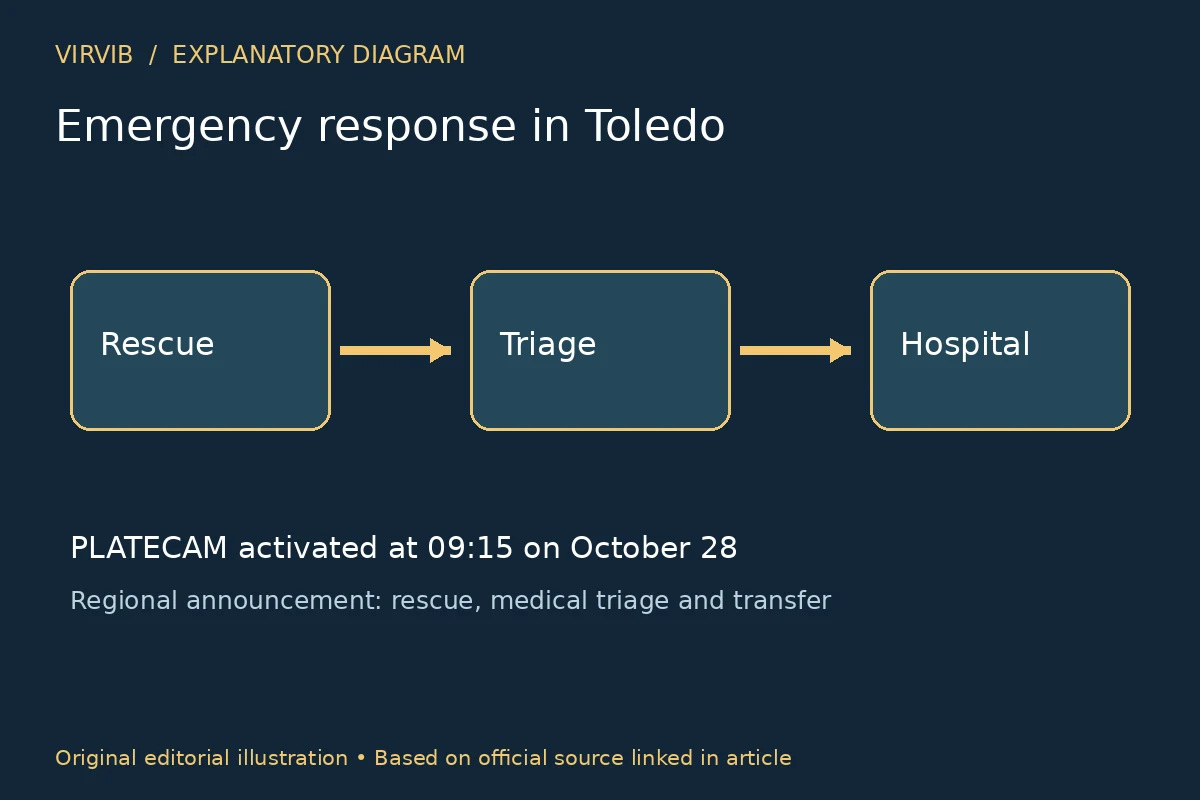
Castilla-La Mancha initially activated its territorial emergency plan, PLATECAM, at 9:15 a.m. for Toledo province. The regional authority subsequently raised the response to operational situation 2 at 10:30 a.m., after requesting activation of the Military Emergency Unit, known as the UME. That later escalation updates the initial situation-1 announcement cited in the first version of this article.
The initial emergency release describes an advanced command post, firefighters, Civil Guard personnel, Civil Protection volunteers and SESCAM medical resources. It also describes a medical post for triage, initial treatment and hospital transfers. The subsequent regional update identifies hospitals in Alcázar de San Juan, Ciudad Real, Toledo and Albacete receiving injured people. These arrangements explain how rescue work at the railway and treatment elsewhere form different parts of the response.
The regional emergency service has established 900 122 112 as an information number for relatives and friends of possible victims. Renfe’s own statement gives 900 10 10 20 for victims and families and identifies family-assistance centers shared with Iryo in Madrid, Córdoba and Seville. These are Spanish assistance numbers published by the authorities and operator; overseas callers should check the linked official channels for access arrangements.
Prime Minister Pedro Sánchez visited the command post in Urda and said the priorities were finding survivors and providing material and psychological support to injured people and bereaved families. The government’s published transcript also records his commitment to establish what happened. It identifies railway-accident investigators and judicial authorities as carrying out their work. That commitment is an official response to the disaster, rather than evidence that an investigation has already reached its conclusions.
The mourning period is established in Royal Decree 949/2026, published in Spain’s official gazette. It runs from midnight at the start of October 29 through the end of October 31, with the national flag at half-staff on public buildings and naval vessels. Sánchez announced those same dates during his appearance in Urda. The decree provides a fixed, checkable period for the national observance.
Sánchez also acknowledged that Spain had experienced two major high-speed railway disasters in the same year. He said the indications pointed toward different origins, while explicitly leaving that determination to investigators. The distinction matters: the existence of an earlier catastrophe makes scrutiny urgent, but does not prove a shared technical cause. The investigation into Urda must establish its own chain of events.
Sources: Castilla-La Mancha 112 — updated provisional toll and emergency resources ↗ · Castilla-La Mancha 112 — initial PLATECAM activation ↗ · Castilla-La Mancha 112 — 10:30 escalation and family information number ↗ · La Moncloa — Sánchez’s published remarks at Urda ↗ · BOE — Royal Decree 949/2026 declaring official mourning ↗ · Renfe — family assistance, alternatives, changes and cancellations ↗
Madrid–Andalusia trains: what the official travel notices say
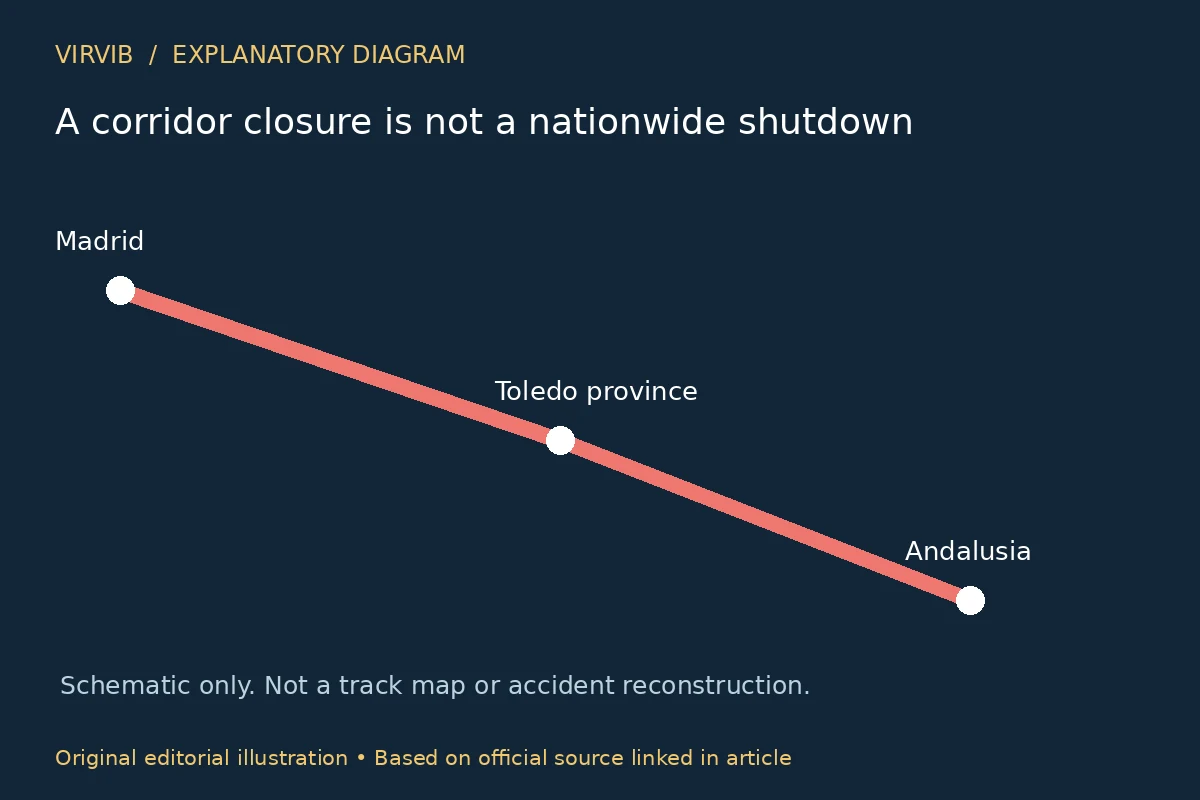
Adif’s October 28 network bulletin says circulation on the affected Madrid–Andalusia high-speed line is interrupted and directs passengers to their operating companies. It identifies assistance points at Madrid-Puerta de Atocha Almudena Grandes, Sevilla-Santa Justa, Córdoba-Julio Anguita and Málaga-María Zambrano. The bulletin also says the Madrid–Toledo and Málaga–Seville high-speed sections were operating normally at the time of its update. The disruption should therefore be checked by route, rather than described as a nationwide railway shutdown.
Renfe has announced conventional-line alternatives between Madrid, Ciudad Real and Puertollano, adding approximately 90 minutes to journeys. It also offers changes and cancellations without a charge for travelers affected by the suspension. These are Renfe’s arrangements; another operator’s passengers need that company’s instructions.
Renfe says a wider Madrid–Andalusia alternative plan will begin Friday, October 30; detailed schedules were still being finalized. That announcement does not establish a reopening date for the damaged high-speed line. Travelers should distinguish a replacement itinerary from restoration of their original service.
Renfe separately warns that October 29 strike action may affect some routes, including minimum services. Verify the specific journey close to departure. A strike-related change should not automatically be attributed to the collision. For anyone comparing travel options, both the reason for a change and the revised arrival time matter.
For travelers, the practical sequence is to check the operator, route and departure shown on the booking, then consult the official notice before accepting a replacement itinerary. A family-assistance center serves a different purpose from a ticket-change channel. People seeking news of relatives should use the dedicated assistance contacts rather than rely on a general departures board or an unverified passenger list circulating online.
The confirmed developments now extend beyond the first emergency report: the provisional toll has reached 68, the regional response was escalated, official mourning has begun, and Renfe has published initial alternatives. The next consequential updates will be verified rescue and casualty information, documented investigative findings and specific transport arrangements. Each answers a different question for families, passengers and the wider public following the disaster.
Sources: Adif — dated network bulletin and assistance points ↗ · Renfe — family assistance, alternatives, changes and cancellations ↗
Why this story is in the editionSpain train crash appeared in Google Trends Trending Now for the United States, past 24 hours, checked October 29, 2026. Editorial selection; no claim of a search ranking or exact search count.
Prepared with AI assistance. Source-based reporting checked on 2026-10-29. This article does not update automatically. Read our editorial standards.