Case timeline
- A man using the name Dan Cooper hijacks Flight 305, receives ransom in Seattle and jumps from the aircraft.Source ↗
- $5,800 matching ransom serial numbers is found.Source ↗
- The FBI publishes evidence photographs and an investigator’s assessment.Source ↗
- FBI redirects resources away from the active NORJAK investigation.Source ↗
- VIRVIB checks the official public case information.Source ↗
The documented flight: Portland, Seattle and a disappearance

A little after 8 p.m. on November 24, 1971, the man who had taken control of Northwest Orient Flight 305 left the aircraft with a parachute and the ransom money. The plane continued to Reno. Its crew landed safely. The hijacker did not reappear in the FBI’s documented account.
Earlier that afternoon he had bought an ordinary one-way ticket from Portland to Seattle, using the name Dan Cooper. By nightfall, he had exchanged the passengers for $200,000 and parachutes, ordered the aircraft back into the air and disappeared somewhere along its onward route. The flight is documented. His identity and ultimate fate remain unresolved. The story now called the D.B. Cooper mystery begins with the difference between those two facts.
The FBI’s displayed plane ticket preserves a useful starting point. The passenger used the name Dan Cooper when he bought a one-way ticket from Portland, Oregon, to Seattle, Washington. That name was an identity he presented, not an identity investigators subsequently authenticated. The familiar initials “D.B.” became attached to the case through press reporting; the Bureau says a man it questioned with those initials was not the hijacker.
During the flight, Cooper gave a flight attendant a note claiming that his briefcase contained a bomb. The FBI describes her seeing wires and red sticks when he opened it. That account records a threatening display. It does not establish through a recovered device that the object was an operational explosive. His demands were specific: four parachutes and $200,000 in twenty-dollar bills.
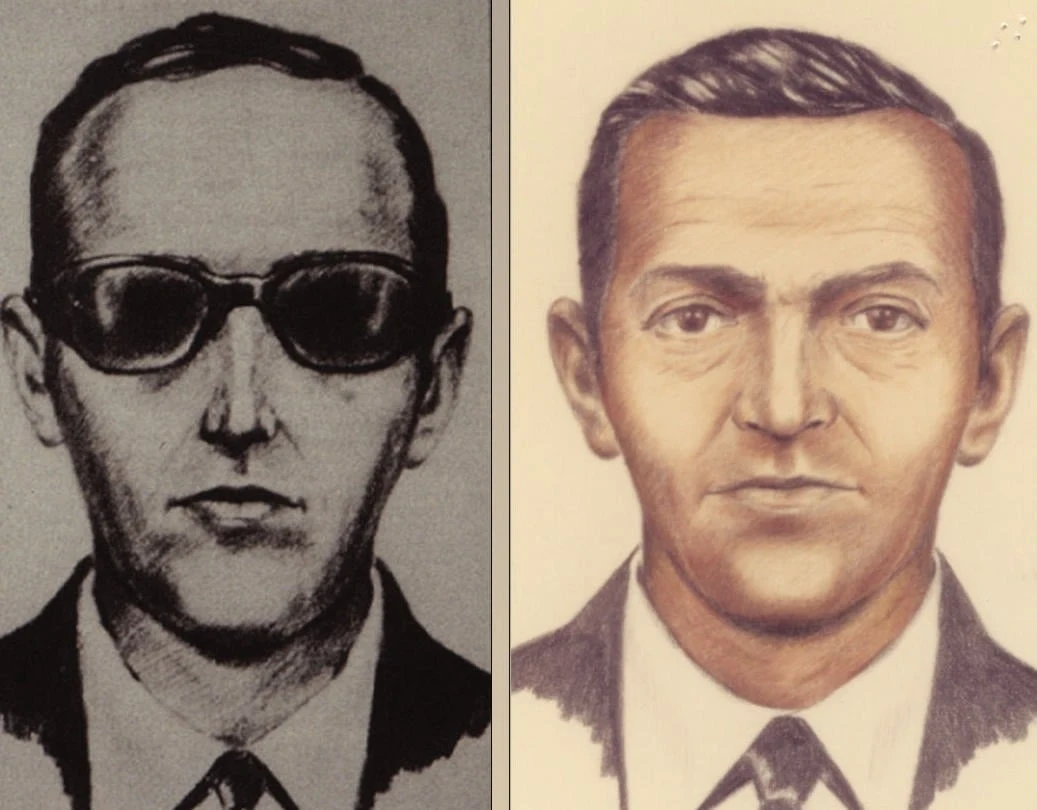
For the passengers and crew, the episode began inside a familiar commercial journey. The FBI describes a man in a business suit, white shirt and black tie, appearing to be in his mid-forties. He ordered bourbon and soda before departure. Then, shortly after 3 p.m., he passed a flight attendant a note indicating that he had a bomb. An ordinary passenger transaction had become a threat.
The briefcase display and written demands moved information through the cabin to the cockpit. Four parachutes. Two hundred thousand dollars in twenty-dollar bills. Those particulars survive in the official account because they shaped what happened next. Seattle became the location of an exchange: the passengers came off the aircraft, while the money and equipment came aboard. For thirty-six passengers, that ended their time under the hijacker’s control. For the crew members he retained, the ordeal continued into a second flight.
The two departures should not be collapsed into one. The original scheduled service ran from Portland to Seattle. The later departure occurred after the ransom delivery, with Cooper directing a course toward Mexico City. The jump took place on that onward journey, somewhere between Seattle and Reno. Mexico City was an instruction, not a destination he is known to have reached. Reno was where the aircraft landed, not where investigators established that Cooper landed.
The equipment left behind gave investigators objects they could examine after the man was gone. The tie was especially personal in appearance: a commonplace item worn during the hijacking, later identified by the FBI as a source of DNA material. Yet an object can survive without yielding a name. The same contrast runs through the case’s photographs of parachute equipment. The materials show what was supplied and what remained; they do not show what happened after the jump.
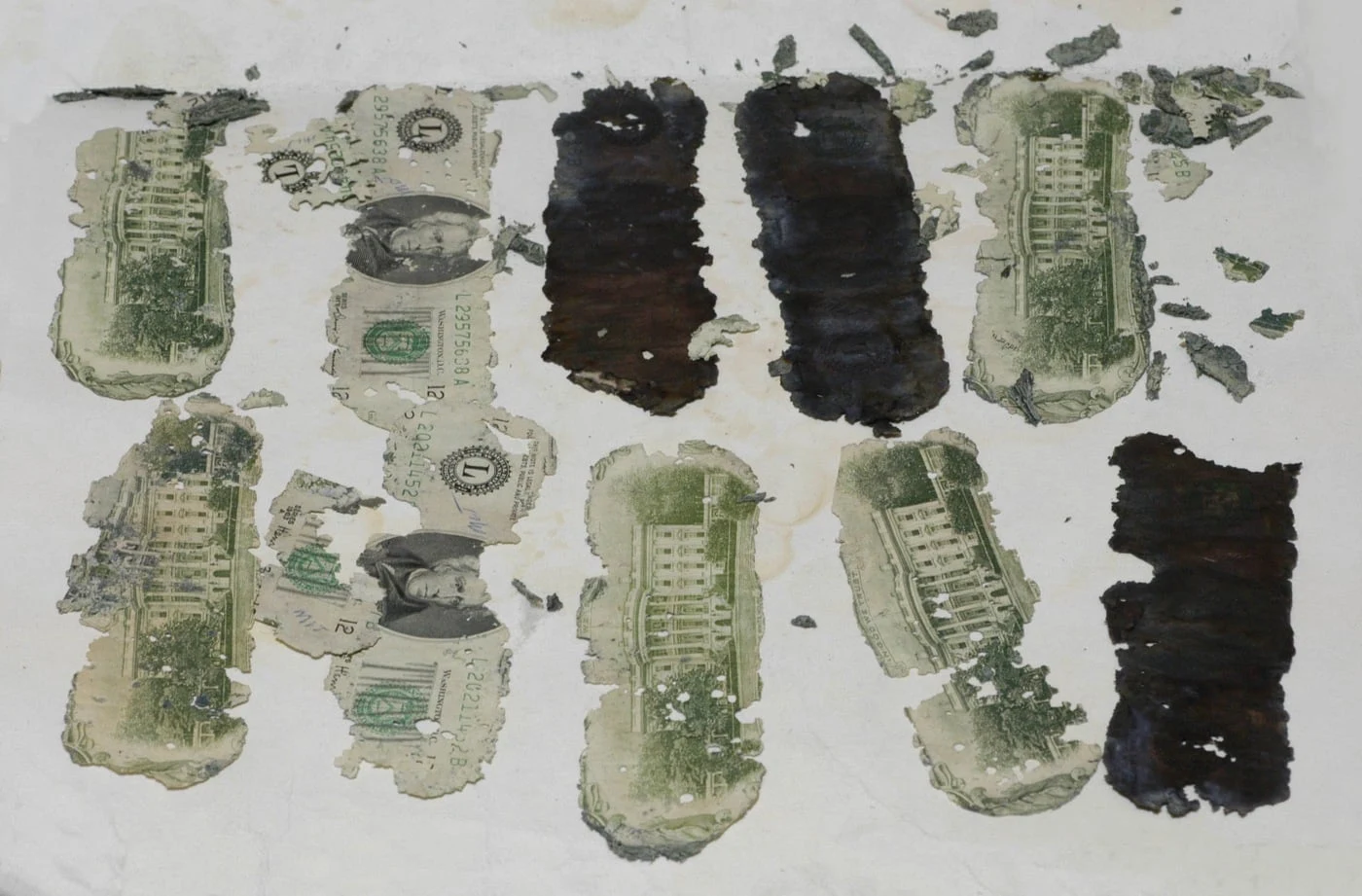
Nine years later, the recovered money changed the evidence without ending the mystery. The serial numbers connected the deteriorated notes to the ransom. A physical fragment of the crime had emerged outside the aircraft, but the crucial sequence was still incomplete. How the cash reached its discovery location, what happened to the rest, and whether its movement tracked the hijacker’s own fate remained separate questions.
That is the enduring structure of NORJAK. The investigation accumulated identifiable objects and a detailed account of the flight while the person at its center remained unidentified. The evidence brings a reader close to the event, then stops short of the answer.
The plane landed in Seattle, where the money and parachutes were supplied. Thirty-six passengers were released, while several crew members remained aboard. The aircraft then departed again on a course Cooper directed toward Mexico City. The FBI places his jump a little after 8 p.m., somewhere between Seattle and Reno. The pilots landed safely. Cooper’s disappearance begins at the point where the documented flight no longer supplies an observable account of his movements.
That sequence matters when reading reconstructions. A departure airport, a ransom exchange and a later landing do not together provide a verified landing site for the hijacker. A drawing of a forest or an aircraft can help a reader imagine the geographical setting, but it cannot establish a route on the ground. This file’s accompanying illustration is an atmospheric interpretation, not a map of recovered evidence.
The case also involved people subjected to a threat. A narrative that treats the flight only as a puzzle about a daring escape leaves out the passengers and crew. Their observations helped investigators describe the man and the sequence of events. They do not give later storytellers access to his private thoughts, motivations or intentions.
Sources: FBI case history ↗ · FBI plane-ticket artifact ↗ · FBI archived investigator assessment, December 31, 2007 ↗ · FBI archived case account, November 24, 2006 ↗
What the physical evidence and witness accounts can establish
The FBI opened its investigation during the flight and called it NORJAK, short for Northwest hijacking. Its account describes interviews, searches and an examination of the aircraft. By the fifth anniversary, investigators had considered more than 800 suspects and reduced the list substantially. The size of that inquiry shows the breadth of the search; it does not mean that one of the remaining names must have been the hijacker.
Several objects survived. The Bureau identifies a black J.C. Penney tie left aboard the plane, parachute equipment and ransom currency recovered in 1980. A boy found $5,800 whose serial numbers matched the money supplied during the hijacking. The currency provides a physical connection to the ransom. On its own, that connection cannot identify the person who last possessed it or explain every movement of the money before its discovery.
The tie later supplied material for DNA analysis. In the FBI’s December 2007 account, Special Agent Larry Carr discussed both the evidence and investigators’ assessment of Cooper’s experience. He said flight attendants interviewed separately gave closely matching descriptions. That is an attributed account of witness consistency. It is stronger than a resemblance suggested decades later by a photograph selected from a large number of candidates, but a description still does not name a person.
Carr challenged the popular image of an expert parachutist. He pointed to the weather, darkness, clothing and a reserve parachute that had been sewn shut for training. Those details informed his belief that Cooper probably did not survive. They should be read as an investigator’s assessment of risk and probability, not as a recovered body or a forensic determination of death.
The distinction is especially important with repeated suspect claims. The FBI’s historical account says Richard McCoy, who committed a separate similar hijacking, was ruled out for reasons including the mismatch with flight attendants’ descriptions. Similar methods do not by themselves establish the same offender. This file does not reinstate an excluded individual simply because the two stories appear to resemble one another.
Two propositions can remain true together: the jump was exceptionally dangerous, and the public record does not establish Cooper’s ultimate fate. Neither “he must have died” nor “he got away” follows automatically from an unresolved ending. Any new identification would need evidence that connects an identifiable person to this particular flight, with an explanation that also accounts for contradictory material. An appealing biography or a claimed confession is a lead to assess, not the assessment’s conclusion.
Sources: FBI case history ↗ · FBI archived investigator assessment, December 31, 2007 ↗ · FBI archived case account, November 24, 2006 ↗
The latest official position: unresolved does not mean actively investigated
The most consequential official status change in the sources reviewed occurred in July 2016. On July 12, the FBI announced that it had redirected resources from NORJAK four days earlier. Its statement described a forty-five-year investigation in which credible leads, searches, witnesses and laboratory work had not produced a definitive identification. Evidence would be retained at FBI Headquarters for historical purposes.
The Bureau expressly said it would no longer actively investigate the case. It left a narrower opening for people who possessed specific physical evidence relating to the parachutes or the stolen money to contact a local FBI field office. That distinction remains visible in the FBI’s case history and plane-ticket page checked for this report. VIRVIB has not verified an official announcement reopening the active investigation.
This is why a recent discussion of a suspect, a documentary release or a newly circulating image should not be described as an FBI breakthrough without a corresponding official finding. Public attention can increase while the agency’s published position remains unchanged. A claim can also be new to an audience without being new to investigators. Dates attached to records help readers distinguish those situations.
For someone reviewing a proposed solution, the useful questions are concrete. What original material supports it? Does that material identify its own date and origin? Has an authority authenticated it, or has a commentator merely described it as authentic? Does the explanation account for the witness evidence and physical objects, or only for selected similarities? These are editorial questions about the strength of a claim, not instructions to investigate private individuals.
There is a further difference between an object being interesting and being linked to a crime. A parachute found years later would need an established connection to the equipment supplied in Seattle. A story about sudden wealth would need corroboration beyond its fit with the amount of a famous ransom. A photograph resembling a composite sketch would need more than a subjective impression. The FBI’s 2016 statement explicitly acknowledged plausible tips while explaining that they had not supplied the required proof.
The next meaningful development would therefore be authenticated evidence and an accountable explanation of what it establishes. Until that happens, the documented ending is an unidentified hijacker leaving the aircraft, a surviving collection of evidence and an investigation whose active resources were withdrawn. The mystery remains. Its unanswered questions should remain visible, without being filled by a cinematic image or a confident guess.
Sources: FBI plane-ticket artifact ↗ · FBI investigation update, July 12, 2016 ↗
Prepared with AI assistance. Source-based reporting checked on October 28, 2026. This article does not update automatically. Read our editorial standards.