Case timeline
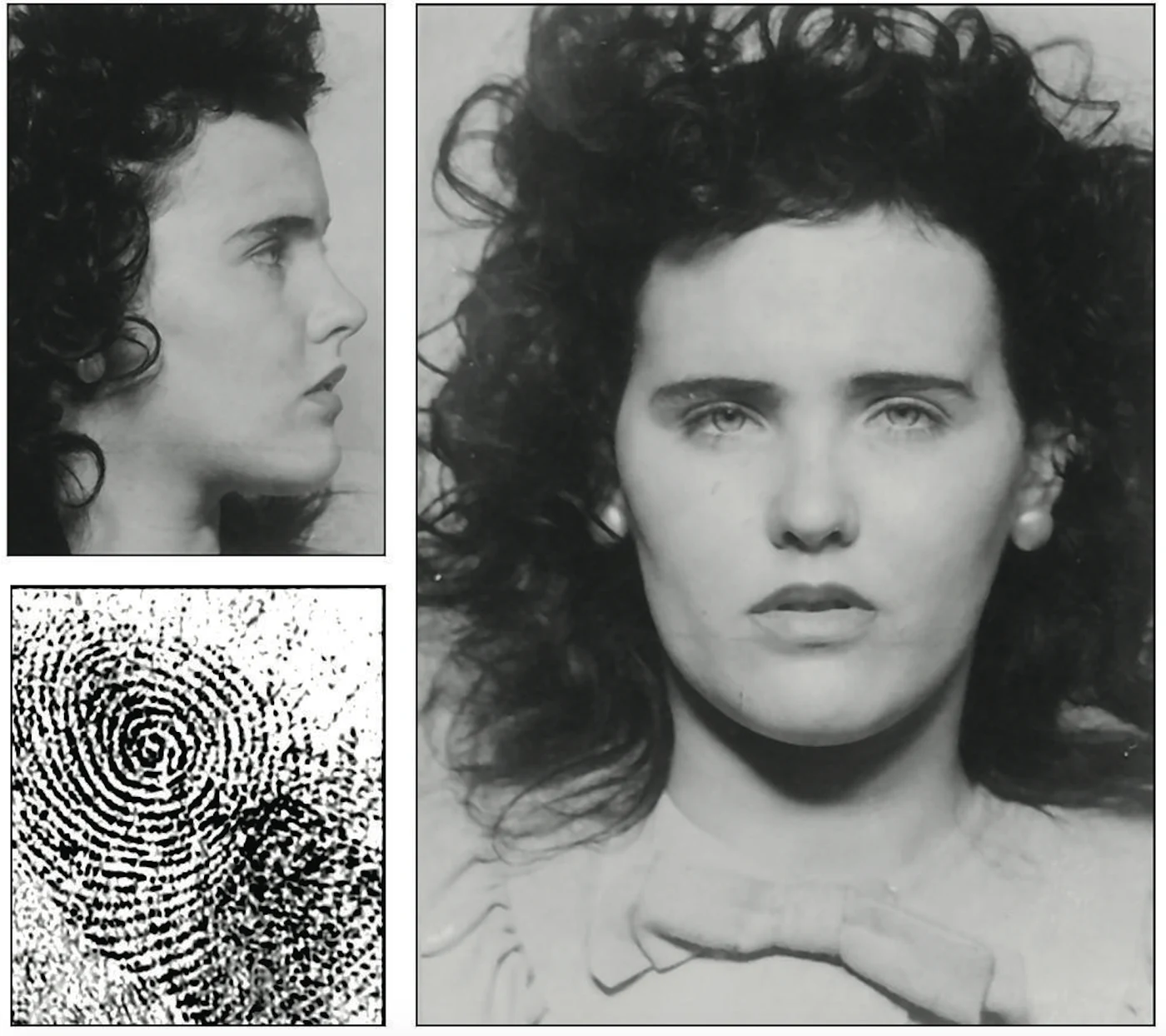
- Elizabeth Short’s body is discovered in Los Angeles; fingerprints establish her identity.Source ↗
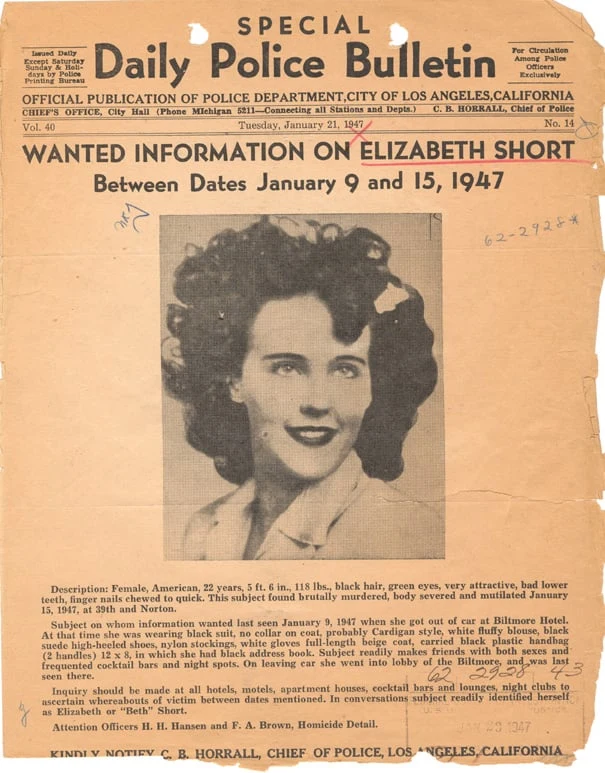
- LAPD issues a bulletin seeking information, later reproduced by the FBI.Source ↗
- FBI publishes a guide to its supporting records and their limitations.Source ↗
- VIRVIB reviews the cited official sources; no solution is established in them.Source ↗
January 1947: a name established, a killing unexplained

On the morning of January 15, 1947, a mother walking with her child in Los Angeles noticed a figure lying near the sidewalk. The FBI’s account says she initially thought she was looking at a mannequin. It was the body of a young woman. Within hours, the discovery would acquire a name: Elizabeth Short. Almost eighty years later, the person who killed her has still not been established in the Bureau’s published history.
The investigation began with a striking imbalance. Investigators could identify the victim in minutes once her fingerprints reached Washington. They could not identify her killer in decades. Between those two outcomes lies the story of the Black Dahlia: a rapid technical success followed by a much longer search through records, interviews, public claims and unanswered questions.
Fingerprints sent from Los Angeles by Soundphoto allowed the FBI to identify Short in 56 minutes after receiving them. Her fingerprints were already in its records. This was a concrete investigative result, rather than a theory about her final movements. It answered who the victim was without answering where she had been held, how the offender encountered her or who moved her body.
Before January 1947, Short’s fingerprints had entered federal records for reasons unrelated to the homicide. In January 1943 she applied for work as a clerk at the commissary at California’s Camp Cooke. Seven months later, Santa Barbara police arrested her for underage drinking. The FBI’s history explains that these earlier records made identification possible when Los Angeles investigators needed a name. An administrative record from one stage of her life became the means of identifying her at its violent end.
The comparison happened through Soundphoto, a technology used to transmit images over distance. Los Angeles sent blurred fingerprints; the FBI reports that it found the match fifty-six minutes after receiving them. The number is memorable because it measures something investigators accomplished. It does not measure how long Short had been missing, the length of the assault, or the time between her death and the discovery. It marks the moment a body became an identified person in the investigation.
The next surviving dated marker in this file is the LAPD bulletin of January 21. Six days after the discovery, authorities were seeking information about Short. The bulletin, reproduced in the FBI archive, belongs to the original search. Its physical survival lets a reader encounter the investigation as a contemporary appeal rather than only as a later legend. It also brings a difficult fact into focus: knowing her name did not tell police who had killed her.
The images carried another consequence. The FBI supplied Short’s identification photographs to the press. They became part of the public account of a murder that would attract intense attention. The Bureau’s 2006 guide describes press interference recorded in its files, including journalists arriving at the discovery scene before police. Publicity could spread an appeal widely, but the archive also records investigators’ frustration with reporters intruding on their work.
That tension belongs to the story as much as the famous nickname. The public could see a face and read a striking label while investigators still needed dependable accounts of movements, contacts and locations. The appearance of detail in print was not the same as progress toward a supported identification. The historical record leaves the reader at precisely that point: the victim was known, the crime was public, and the decisive connection to a perpetrator remained missing.
The surviving official image of Short includes photographs and a fingerprint supplied from FBI files. Those are archival identification materials, not pictures of her final day. They should be read with their source and context intact. A contemporary photograph can establish a person’s appearance at the time it was taken; it cannot, by itself, establish a relationship, a motive or the sequence of a later crime.
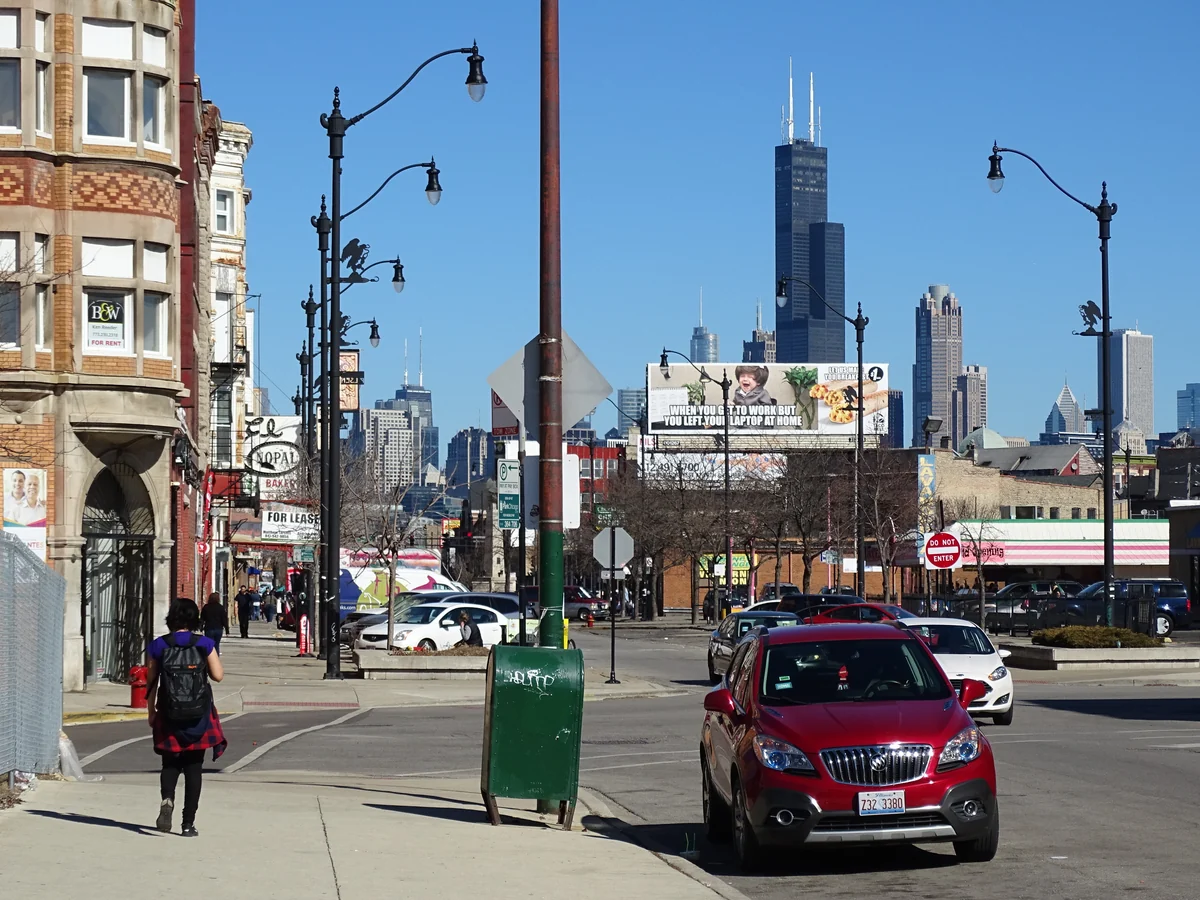
Our accompanying illustrated Los Angeles street serves a different purpose. It suggests a period and a city without claiming to show the precise discovery site, the weather that morning or an encounter witnessed by anyone. No figure in an invented scene can fill the absence of a verified witness. Keeping that visual boundary visible allows the reader to picture the historical setting while recognizing exactly where the documented narrative ends.
The unresolved question is consequently specific. This is not an unidentified-person case in which the first task is restoring a name. It is a homicide with a named victim and an unknown perpetrator. Treating Elizabeth Short as the subject, rather than treating the Black Dahlia label as a character, also keeps the record anchored to the person whose death requires explanation.
Sources: FBI case history — Black Dahlia ↗ · FBI archive — The Black Dahlia Murder, October 20, 2006 ↗ · LAPD bulletin on Elizabeth Short, January 21, 1947 ↗ · FBI — Elizabeth Short photographs and fingerprint ↗
What the FBI archive can—and cannot—tell us
The FBI’s October 2006 archival guide explains that its files are not a comprehensive account of the investigation, because the Los Angeles Police Department had jurisdiction. The collection describes federal assistance, including records checks and interviews conducted around the country. Its contents also include press clippings, identification documents, public correspondence and requests from investigators. These categories do not all carry the same evidentiary weight.
The guide identifies a request to compare fingerprints from an anonymous letter that might have come from the killer. No matching record was found. It also describes inquiries into medical students prompted by a suspicion about the offender’s possible anatomical skills. Neither item established authorship of the letter or the occupation of the murderer. The archive records questions investigators pursued, not a finding that those questions pointed to the right person.
The Bureau also notes that it had no photograph from Short’s Army job application, correcting a claim made in some accounts. It released a January 21, 1947, LAPD bulletin seeking information. These are useful examples of what a dated official source can do: clarify provenance and show what authorities wanted to learn at a particular stage.
For the reader, the distinction between a document and the truth of every statement inside it is crucial. A letter preserved in a police file proves that a person sent a claim to investigators. It does not automatically prove the claim. A clipping establishes what a newspaper reported. It does not transform that report into a forensic conclusion merely because an agent kept a copy. The same discipline applies to interviews: an interview record is evidence of what was said, while corroboration determines how much weight the underlying assertion can bear.
Redactions create another limit. Where a name or passage is withheld, the blank cannot responsibly be filled with a preferred suspect. An absence from the public version is not evidence of a cover-up, an acquittal or a hidden confession. It is an absence from the material available to the reader. The reason for that gap must come from the release itself or a separately verified explanation.
This file therefore uses the archive as a source guide, rather than claiming a complete independent review of every original investigative page. A compelling new theory would need to identify its supporting documents, distinguish contemporary evidence from later recollection, and explain contradictory material. A chronology assembled solely from statements that favor one candidate would not meet that test, even if each individual statement appeared in a genuine historical file.
Sources: FBI archive — The Black Dahlia Murder, October 20, 2006 ↗ · FBI Vault — Elizabeth Short records collection ↗ · LAPD bulletin on Elizabeth Short, January 21, 1947 ↗
Unproven explanations and the status of the case
Who killed Short, and why, remain unanswered in the official history reviewed for this article. That is different from saying that no one has ever offered an explanation. It is also different from saying that an investigator’s interest in a person amounted to a supported accusation. This case file does not nominate a killer. It follows the narrower conclusion the sources permit: the published FBI account supplies no identified perpetrator.
Consider the medical-skill hypothesis. As an investigative idea, it could help define questions about access, training or opportunity. As a conclusion, it would require evidence connecting a particular person to the offense. The two cannot be exchanged. Even a technically plausible explanation for an injury does not identify who caused it. Likewise, the possibility that an anonymous letter came from the offender would have to be established before its writer’s words could be treated as inside knowledge.
The most useful way to assess a proposed solution is to ask what it newly proves. Does it establish contact with Short at a relevant time? Does it identify a location through independently supported evidence? Does it connect physical material to a person with a documented chain of custody? Or does it mainly rely on resemblance, reputation and the reinterpretation of an old story? Those are editorial questions for evaluating claims, not findings about any named suspect.
The dates attached to the sources matter as well. A historical FBI article and a continuing records collection are not an announcement that a federal team is actively pursuing the case today. The Bureau’s supporting role should not be rewritten as ownership of the original investigation. As of this review on October 28, 2026, the cited materials establish that the murder remains unsolved; they do not provide a new arrest, a verified identification or a current staffing account.
Future coverage should distinguish a genuinely new investigative development from another retelling. A newly available document may expand public understanding without solving the murder. A researcher’s allegation may deserve examination without becoming the site’s conclusion. An official identification supported by evidence would change the case status and require a substantive update, with the original announcement linked and its scope accurately described.
Until then, the reliable narrative retains its gaps. Elizabeth Short was identified. Her death was investigated. Federal records document assistance to Los Angeles police. The person responsible has not been established in the official material reviewed here. Those limits leave important questions open without turning uncertainty into permission to invent the missing events.
Sources: FBI case history — Black Dahlia ↗ · FBI archive — The Black Dahlia Murder, October 20, 2006 ↗ · FBI Vault — Elizabeth Short records collection ↗
Prepared with AI assistance. Source-based reporting checked on October 28, 2026. This article does not update automatically. Read our editorial standards.