Case timeline
- Suzanne Streeter and Stacy McCall attend graduation parties before going to Levitt’s home.Source ↗
- The FBI places the disappearance between 2:15 a.m. and 7:30 a.m. in Springfield, Missouri.Source ↗
- FBI ViCAP poster updated with identification details and age-progressed images.Source ↗
- KY3 reports that Springfield police still consider the case an active investigation.Source ↗
- VIRVIB checks the cited sources; the FBI appeal remains available.Source ↗
Graduation night and the missing hours

The graduation celebrations were over. Suzanne Streeter and Stacy McCall went to the Springfield home of Suzanne’s mother, Sherill Levitt, to spend the night. It was June 7, 1992. By the end of the disappearance window later published by the FBI, all three women were missing. The agency places that window between 2:15 a.m. and 7:30 a.m. It does not provide a witnessed account of their departure.
There was no confirmed destination to follow. Three women had been at the same home; their lives then dropped out of the documented chronology together. More than three decades later, the FBI’s public appeal still carries their names. The Springfield Three case remains unresolved, with the central questions unchanged: what happened in those missing hours, and where are Sherill, Suzanne and Stacy?
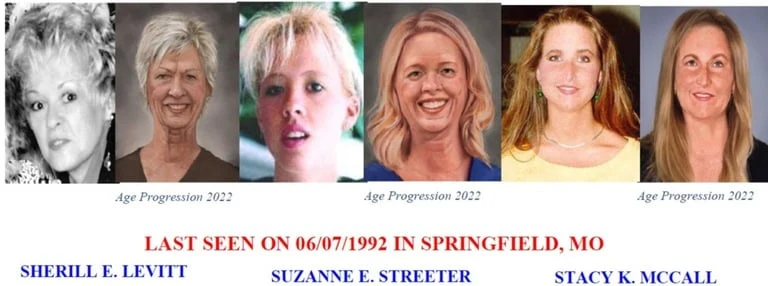
The FBI’s ViCAP poster gives their ages at the time: Levitt was 47, Streeter 19 and McCall 18. It identifies the Springfield Police Department case as 92-40169 and lists separate NamUs numbers for the women. The poster was updated on June 14, 2022, and includes age-progressed images. Those images are identification aids, not photographs taken after the disappearance. They should never be captioned as evidence that any of the women was later located.
The ages on the FBI poster make the household’s relationships immediately clear. Levitt was forty-seven. Her daughter was nineteen. Stacy was eighteen. Two of the missing women had just reached the end of high school; the third was the mother whose home had become their place to stay. The ordinary decision to spend the night together is the last shared movement described in the federal summary.
The next chapter is defined by what remained. KY3’s retrospective reports that vehicles and personal belongings were at the house, along with the family dog, and that police found no apparent signs of a struggle. Those details made the scene difficult to interpret. Objects that might normally accompany a departure were still there, yet the three people connected to them were gone. The available reporting supplies the condition of the house, not the missing sequence that would explain it.
In a solved case, later evidence might connect such a scene to a journey, an encounter or a place of confinement. Here, the public record reviewed for this article does not supply that connecting passage. It is why accounts of the Springfield Three repeatedly return to the same home and the same early-morning interval. They are the firmest shared markers, while the narrative beyond them remains uncertain.
Years passed and specific possibilities were tested. The 2022 retrospective describes a search in 2002 where bones proved too old to be those of the women. Another search in 2003 produced inconclusive testing. A later parking-garage theory drew attention, but the same reporting says police did not find it credible. These episodes gave the investigation dates and locations without providing the answer families needed. Their outcomes are essential to the chronology: an unsuccessful search is not evidence that the women were there.
The public identification effort continued alongside those investigations. The ViCAP poster updated in 2022 retained the original photographs and added age progressions. Side by side, the images describe two different kinds of knowledge: a recorded appearance before the disappearance and an estimate of what time might have changed. Neither is a later sighting. Their purpose is to help someone recognize a person or remember relevant information.
By the thirty-fourth anniversary, local reporting still described an active investigation. That does not erase the long interval since 1992. It means the official search has not reached a public conclusion. The story’s tension comes from that continuing gap between a well-known disappearance and an unknown outcome.
KY3’s June 2026 anniversary report places the disappearance against the graduation celebrations of the preceding day and identifies Levitt as a cosmetologist. Its account also distinguishes the family relationships among the three. These details matter because a collective case name can obscure that three people, with different ages and family roles, vanished from the same setting. Their disappearance is a shared investigation without making their individual lives interchangeable.
There is an important limit to an apparently precise timeline. A window can be bounded by information investigators accept without revealing what occurred at every point within it. Readers should not convert the beginning into the exact time of an abduction or the end into a witnessed last sighting. The short FBI summary does not supply those conclusions.
The imagined house illustration accompanying this file is therefore contextual. It is not the actual residence and does not reconstruct a door opening, a vehicle arriving or a person approaching. Those choices would imply events the cited account does not establish. The verified story is already consequential without adding a cinematic encounter: three named women went missing, and their whereabouts remain unknown.
Sources: FBI — The Springfield Three ↗ · FBI ViCAP poster — updated June 14, 2022 ↗ · KY3 — 30-year review, June 6, 2022 ↗ · KY3 — 34-year anniversary, June 7, 2026 ↗ · KY3 — Ozarks Unsolved, June 11, 2026 ↗
The house, the searches and the difference between a lead and a result
KY3’s 2022 retrospective reports that personal possessions, vehicles and the family dog remained at the home, while police saw no apparent signs of a struggle. The same review describes searches over the years, including a 2002 search in which recovered bones proved too old to belong to the missing women. It also reports inconclusive testing after a 2003 search and says police found a later theory involving a hospital parking garage not credible. These are reported investigative outcomes, not proof that the women were in any of those locations.
The distinction between searching a place and establishing its role in a crime is central to this case. A search can be a responsible response to information even when the information does not prove accurate. Its occurrence records a step taken to test a possibility. The result, including a negative or inconclusive result, must travel with any account of the search. Leaving out the result can make an old lead look like an unresolved breakthrough.
The same reasoning applies to the condition of the house. Possessions left behind are relevant to understanding why a disappearance aroused concern, but they do not independently identify an offender or establish a method. An apparent absence of struggle is not evidence that nothing coercive occurred. It also cannot tell the reader how many people might have been involved, whether someone was known to the women, or which person an offender might have targeted. Those propositions require additional support.
A missing-person poster answers a different set of questions. The ViCAP document supplies identifying characteristics, names, ages at disappearance and reference numbers that help agencies distinguish records correctly. It is not a complete crime-scene report. It contains no public laboratory inventory, full interview transcript or comprehensive account of every lead. Its brevity should not be mistaken either for a lack of investigative work or for permission to fill gaps with popular accounts.
Witness material requires equally careful treatment. A person may accurately report an observation while being uncertain about the date, the identity of someone seen or its relationship to the disappearance. The useful question is not simply whether a sighting was reported, but whether authorities corroborated its timing and connection. This article does not turn an unverified recollection into a confirmed sighting.
The consequence for reconstruction is practical. A map can show Springfield and identify the documented city of disappearance. It cannot responsibly draw a route to an alleged burial site as though that journey were established. A timeline can show the dates of official appeals and reported searches. It should label those as investigative events, keeping them separate from confirmed movements of the three women themselves.
Sources: KY3 — 30-year review, June 6, 2022 ↗ · FBI ViCAP poster — updated June 14, 2022 ↗
What remains open, and how to read the latest status
By June 2026, local coverage was marking 34 years since the disappearance. KY3’s June 11 report described the Springfield Police Department as still considering it an active investigation. The FBI appeal remained available when this case file was checked on October 28, 2026. Those sources support continued public interest in receiving information; they do not announce a solved case. The public status must remain an unresolved disappearance rather than a confirmed account of a particular killing.
The distinction matters for families as well as accuracy. The central unknown concerns what happened to the women and where they are. An unsupported assertion about their deaths would prematurely replace that unknown with an answer. A familiar name circulated in connection with the investigation would not supply the missing proof. This file deliberately does not publish a shortlist that could make people seem culpable solely through repeated association with the case.
There are several separate questions a useful new development might address. It could establish a reliable movement after the last documented location. It could explain a physical item with a verified connection to the women. It could corroborate information that previously stood alone. Each would need to be assessed on its actual scope. A meaningful lead can narrow an investigation without resolving it, and a public announcement should be reported at that level rather than expanded into a complete solution.
The distinction between the date of an event and the date of publication is especially important in anniversary coverage. A new article can accurately repeat a decades-old search. Its publication date does not make that search recent. Similarly, the 2022 poster update is a dated public document, not proof that its photographs depict the women in 2022. Readers following this case should be able to see whether an update changes the evidence, changes the public appeal or simply renews attention.
Anyone with relevant information can use the submission route on the linked FBI case page or contact a local FBI office. The agency offers an online anonymous-tip option. A useful account should distinguish what the person directly observed from information learned later, preserving uncertainty about dates or details instead of supplying false precision. A tip is information for investigators to assess; it is not a public verdict.
The next substantive update to this file should come from evidence or a clearly attributed investigative announcement. Until then, the confirmed chronology ends with disappearance from Levitt’s Springfield home. The official poster keeps three names and three identification records visible. Neither the passage of time nor the popularity of an explanation closes the gap between those records and a supported account of what happened.
Sources: FBI — The Springfield Three ↗ · KY3 — 34-year anniversary, June 7, 2026 ↗ · KY3 — Ozarks Unsolved, June 11, 2026 ↗
Prepared with AI assistance. Source-based reporting checked on October 28, 2026. This article does not update automatically. Read our editorial standards.