A landing rehearsal in Maryland
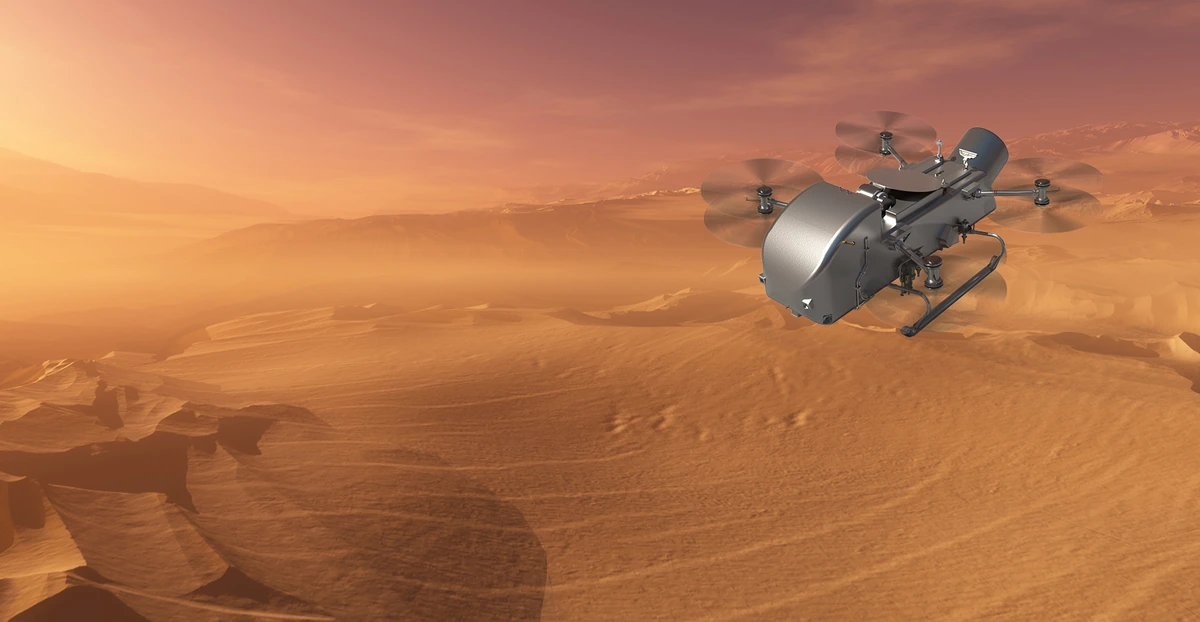
NASA reported on October 23 that Dragonfly had completed a simulated first flight on a computer testbed at Johns Hopkins Applied Physics Laboratory in Laurel, Maryland. The announcement does not give the test date.
Flight-like avionics and flight software received artificial camera, motion-sensor and lidar readings. The simulation followed the rotorcraft over dunes, through a landing-site search, and back around for touchdown. No flight took place on Titan.
Engineers next plan to run the sequence on Dragonfly’s actual flight system and introduce faults. The vehicle must make flight decisions without real-time help from Earth.
Sources: NASA — October 23 announcement of Dragonfly’s first simulated flight ↗
When is Dragonfly scheduled to launch?
NASA’s mission overview currently lists launch no earlier than July 2028 and arrival at Titan in late 2034. Those are planning targets. The agency is describing a mission still in development, with a long journey ahead before surface exploration begins.
The planned primary science mission lasts 3.3 years. Dragonfly would move between locations that include dunes and the region around Selk Crater, collecting material at different stops. Its intended rhythm is measured in Titan days: NASA anticipates a flight every one or two of them, with each Titan day lasting about 16 Earth days.
Why send a mission to Titan?
Saturn’s largest moon has a substantial atmosphere and a familiar-looking cycle of clouds, rain and flowing liquids. Its rivers, lakes and seas involve hydrocarbons such as methane and ethane. The resemblance to Earth’s water cycle should not be mistaken for an Earthlike surface environment.
NASA’s Titan overview describes the planned exploration in terms of prebiotic chemistry: the processes involving complex organic compounds that preceded life on Earth. Studying those materials is a way to investigate chemical possibilities on another world. The presence of lakes or organic compounds, by itself, does not establish that an environment contains living organisms.
Sources: NASA — Titan’s atmosphere, liquids and exploration ↗
Why fly, and how will the aircraft get power?
Titan’s dense atmosphere and low gravity make flight useful for traveling between sites. NASA says a rotorcraft can cross rough or sandy terrain that would constrain a wheeled rover. The spacecraft is intended to carry its laboratory to different landscapes, rather than investigate only the area within reach of its first landing.
Sunlight is weak at Titan, so Dragonfly will use a Multi-Mission Radioisotope Thermoelectric Generator, or MMRTG. NASA identifies the same type of power system on its Curiosity and Perseverance Mars rovers.
The sampling hardware includes a drill system called DrACO, which will collect surface material and deliver it to the Dragonfly Mass Spectrometer, or DraMS. That instrument will analyze chemical components. Cameras will document landforms and surface processes from the ground and the air.
Sources: NASA — Dragonfly spacecraft, power and instruments ↗
What will scientists try to learn?
NASA’s science plan combines chemistry with measurements of the surrounding environment. Surface samples will be analyzed for their molecular composition, while another instrument will measure the elements present in surface material. Meteorology and geophysics sensors will monitor conditions and support seismic studies of activity below the surface.
During flights, the mission plans to gather atmospheric profiles and aerial images, and scout possible future landing sites. Those observations will help place individual samples in their wider geological setting.
One area of interest is Selk Crater, where scientists think an impact brought liquid water and organic materials together in the past. NASA describes the frozen remains of that environment as a possible record of reactions relevant to the origins of life.
The useful distinction for readers is between investigating habitability and demonstrating biology. Measurements of composition, weather and geology can improve scientists’ understanding of the conditions and chemistry at Titan. A claim that life exists would require evidence beyond a flight rehearsal or the presence of interesting chemicals.
Sources: NASA — Dragonfly science objectives and Selk Crater ↗ · NASA — Dragonfly mission schedule and overview ↗
How does this fit into the wider test program?
NASA announced the start of Dragonfly’s rotorcraft integration and testing in March 2026. At APL, early activities included power and functional checks of the Integrated Electronics Module, which houses core avionics, and the Power Switching Units. Both were connected to the vehicle’s wiring system for initial power-service checks.
The March update also described work at Lockheed Martin in Colorado on the cruise-stage and aeroshell assemblies, plus testing of the insulating foam intended to protect the rotorcraft from Titan’s cold.
At that time, NASA outlined further system and space-environment testing before a planned transfer to Kennedy Space Center in 2028. That earlier outline provides context for the development program, rather than confirmation that those later steps are complete.
Sources: NASA — March 2026 integration and testing announcement ↗
Prepared with AI assistance. Source-based reporting checked on October 24, 2026. This article does not update automatically. Read our editorial standards.