Intel closes down 28.6% after its earnings outlook

Intel shares closed at $65.76 on October 30, 2026, down $26.31, or 28.58%, from the previous close. Nasdaq’s quote feed marks the market closed with those figures. Google Finance corroborates the regular-session close at 4:00 p.m. Eastern Time and displays its after-hours quote separately. This completed-session figure supersedes the earlier intraday snapshot in this article. It is a dated closing result, not a continuously updated market feed.
Reuters independently reported a 28.6% fall as Friday’s session ended. The selloff extended across technology shares: the Nasdaq Composite lost 2.86%, while the S&P 500 fell 1.82%. Those market movements are distinct from Intel’s reported sales. A share-price decline does not mean quarterly revenue fell by the same percentage. The financial results below cover the completed quarter; the stock quote measures a later market reaction.
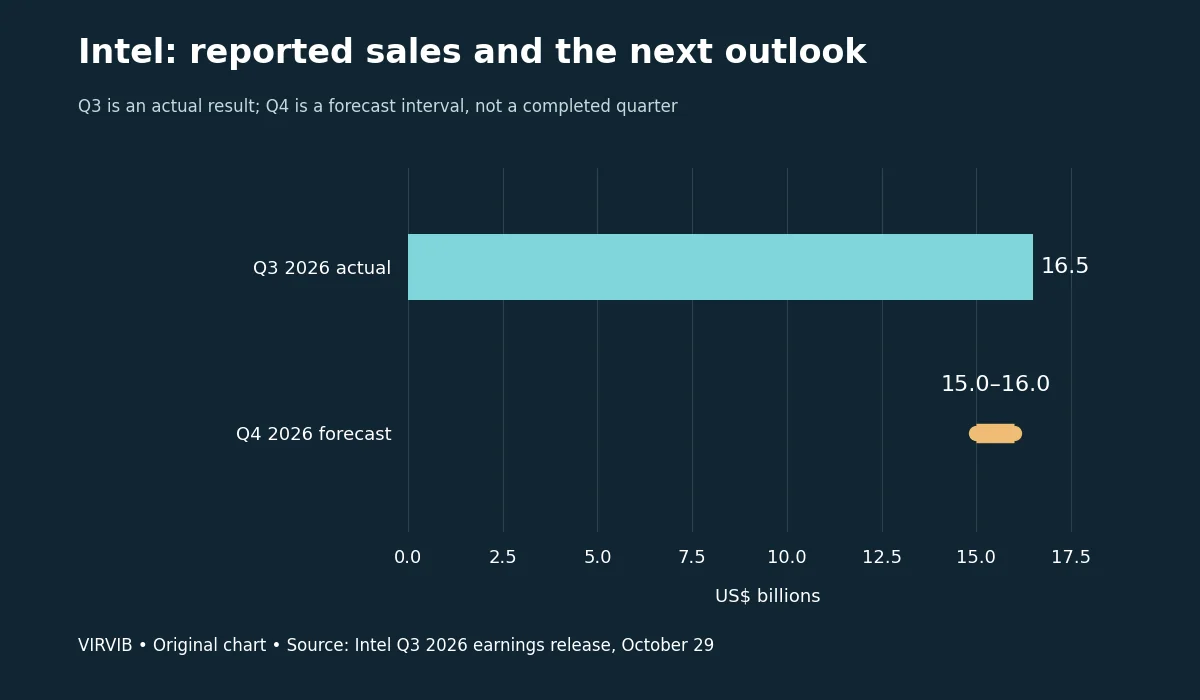
Intel reported $16.5 billion in revenue for the quarter ended September 26 on October 29, 2026, up 21% from a year earlier, but its forecast points to a more difficult end to the year. The chipmaker expects fourth-quarter revenue between $15 billion and $16 billion. That range puts the next quarter below the reported third-quarter total even at its upper end. It is a management forecast, however, rather than revenue Intel has already earned or a completed measure of demand.
The earnings figures also need their accounting labels. Intel reported diluted earnings per share of 60 cents under generally accepted accounting principles, or GAAP, and 52 cents on its adjusted, non-GAAP basis. For the fourth quarter, it forecast 10 cents under GAAP and 25 cents adjusted. Comparing the adjusted forecast with GAAP historical earnings would mix two different definitions and exaggerate or obscure the change. The release supplies reconciliations rather than asking readers to treat the figures as identical.
The previous announcement shows how expectations evolved. In July, Intel forecast third-quarter sales between $15.8 billion and $16.8 billion, with adjusted earnings of 38 cents a share. The newly reported revenue falls inside that earlier range, while adjusted earnings exceed that earlier company forecast. This is a comparison with management’s own published outlook, not a claim that every Wall Street analyst had made the same prediction.
The reaction began before Friday’s regular session. Reuters’ October 29 report described a 23% decline during Thursday’s extended trading. That earlier percentage belongs to a different trading window from the October 30 closing result above. After-hours prices and regular-session closing prices should be compared with their timestamps intact.
VIRVIB analysis: those facts explain how a company can report substantial growth while disappointing investors looking ahead. The completed quarter measures business already recorded. Guidance describes what management currently expects next. A strong backward-looking comparison cannot guarantee an equally strong next quarter, especially when different parts of the business are moving in opposite directions. The useful question is which operations are growing, which are slowing, and what Intel can actually supply.
Sources: Intel — original Q3 2026 results and Q4 outlook, October 29 ↗ · Reuters via Euronext — results, trading window and original executive interview ↗ · Intel — July 23 Q2 results and previous Q3 forecast ↗ · Nasdaq — October 30 INTC closing quote, market status Closed ↗ · Google Finance — INTC October 30 regular-session close, separately labeled from after-hours trading ↗ · Reuters via AOL — October 30 closing market report ↗
Why foundry revenue cannot simply be added to product sales
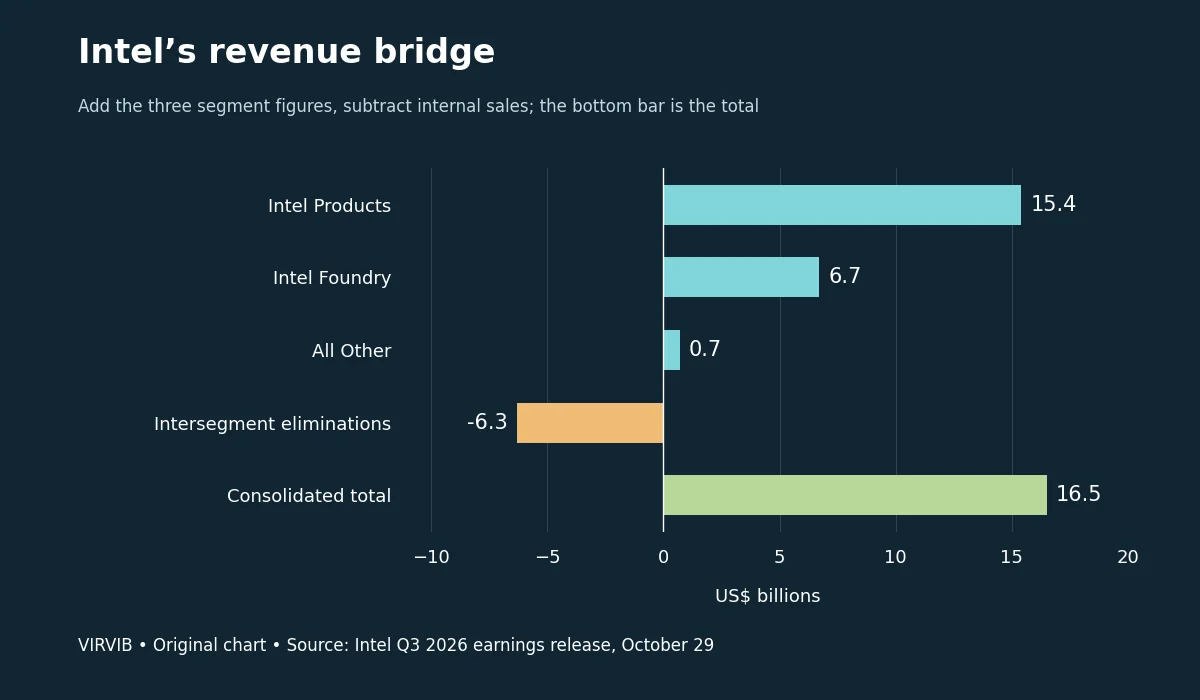
The business-unit table contains the clearest explanation of that uneven performance. Intel’s Client Computing and Physical AI Group reported $8.1 billion in sales, down 5% year over year. Data Center and AI reported $7.3 billion, up 78%. Together they formed $15.4 billion of Intel Products revenue. The group’s name is Data Center and AI; it is not a standalone disclosure of generative-AI revenue. The contrast matters: a statement about a slowing PC market does not describe every customer group buying Intel chips.
Intel Foundry reported another $6.7 billion in segment revenue, but that is not an extra $6.7 billion to place on top of consolidated sales. The release includes $6.3 billion of intersegment eliminations. Its table also reports $0.7 billion in All Other revenue. Using the rounded figures, the bridge is $15.4 billion plus $6.7 billion plus $0.7 billion, less $6.3 billion, arriving at the $16.5 billion consolidated total.
An internal transaction can help measure the work performed by one part of a group for another. At the consolidated-company level, adding both sides without eliminating the internal sale would overstate the external business. The chart alongside this section therefore includes the subtraction visibly. It is an accounting bridge, not a ranking of independent outside revenue streams. Nor does the $6.7 billion foundry figure, on its own, establish the value of orders placed by external foundry customers.
The SEC’s guide to financial statements helps separate another pair of concepts: revenue and profit. An income statement traces revenue through the costs and expenses that lead to earnings. A cash-flow statement instead records cash movements over a period. A sales increase is therefore not automatically a matching increase in profit or cash available to spend. Different statements are needed to assess growth, profitability and funding requirements.
Adjusted earnings require similar care. SEC staff guidance explains that non-GAAP measures need clear labels and descriptions, and that inconsistent treatment between reporting periods can mislead. It also warns that excluding normal recurring cash operating costs can make a performance measure misleading. These are general presentation principles, not a finding that Intel has violated a rule. For a reader comparing quarters, the practical implication is to examine the reconciliation and use the same basis on both sides.
Intel’s July report illustrates why that discipline matters. It showed a GAAP loss of $2.16 a share alongside positive adjusted earnings of 42 cents. Those two numbers were published together for the same quarter. Quoting one without its label could create a very different impression of the business. The latest report should receive the same treatment: adjusted and GAAP results can both inform the story, but neither should silently replace the other.
Sources: Intel — original Q3 2026 results and Q4 outlook, October 29 ↗ · Intel — July 23 Q2 results and previous Q3 forecast ↗ · SEC — introductory financial-statement guide ↗ · SEC staff — non-GAAP financial-measure guidance ↗
Supply recovery is the next test for the turnaround
Reuters’ original interview reporting attributes a substantial supply problem to the October explosion at Intel’s Kiryat Gat factory in Israel. The company told the news agency it expected roughly $600 million in lost revenue across two quarters. Finance chief David Zinsner described an approximately $300 million effect on the fourth-quarter outlook and a similar expected effect in the first quarter. Those are company estimates reported by Reuters, not completed revenue losses independently audited by VIRVIB.
The same reporting says Intel planned to increase production at the facility by the end of the week after a two-week shutdown. A restart plan is different from confirmation that output has returned to normal. The relevant financial question is how much saleable production becomes available, and when it can reach customers.
Intel’s Form 10-Q filed October 30 adds that the disruption is expected to affect manufacturing costs, gross profit and operating results in the fourth quarter and through the first half of 2027. It identifies scrapped inventory, remediation, cleanup and factory overhead costs associated with reduced utilization. Intel said it could not reasonably estimate the incident’s total financial impact or insurance recoveries. Those unresolved costs and recoveries are separate from the lost-revenue estimates discussed above. The filing’s expectation of resuming operations by the end of October remains a forecast, not verification that production has restarted.
That supply issue sits alongside a separate demand problem. In the company’s earnings announcement, Zinsner said the PC slowdown was expected to continue at least through the first half of next year. Intel’s commentary therefore describes simultaneous pressures: constrained availability in parts of its manufacturing operation and softer conditions in the PC market. Treating every shortfall as a lack of AI demand would erase that distinction. Treating strong AI-related demand as a remedy for every PC weakness would do the same.
The leadership context is a turnaround already underway. Intel appointed Lip-Bu Tan as chief executive effective March 18, 2025, after announcing his selection on March 12. He previously led Cadence Design Systems from 2009 to 2021. His appointment predates the current report, so the October release is a checkpoint in an existing strategy rather than the launch of a new leadership team. Evaluating that strategy requires examining the operating divisions and their capacity constraints, as well as the headline earnings figure.
VIRVIB analysis: subsequent disclosures will need to connect production recovery with deliveries, revenue and margins. An announced improvement in capacity would answer an operational question; reported sales would show how much business was ultimately recognized. Neither should be assumed from the other in advance. For now, the record establishes a growing third quarter, an uneven product mix and a lower fourth-quarter sales range, with the size and timing of the supply recovery still to be demonstrated.
Sources: Intel — original Q3 2026 results and Q4 outlook, October 29 ↗ · Reuters via Euronext — results, trading window and original executive interview ↗ · Intel — CEO appointment announcement, March 12, 2025 ↗ · Intel — Form 10-Q filed October 30; Israel Fab Business Disruption, printed page 32 ↗
Why this story is in the editionGoogle Trends U.S. RSS reviewed October 31 included current sports, entertainment and political searches. This existing earnings article was updated for the completed October 30 market session and a primary regulatory filing. Intel is not represented as a listed query in that fresh RSS snapshot; no search rank or volume is claimed.
Prepared with AI assistance. Source-based reporting checked on 2026-10-31. This article does not update automatically. Read our editorial standards.