Amazon’s earnings surprise is in the cash flow
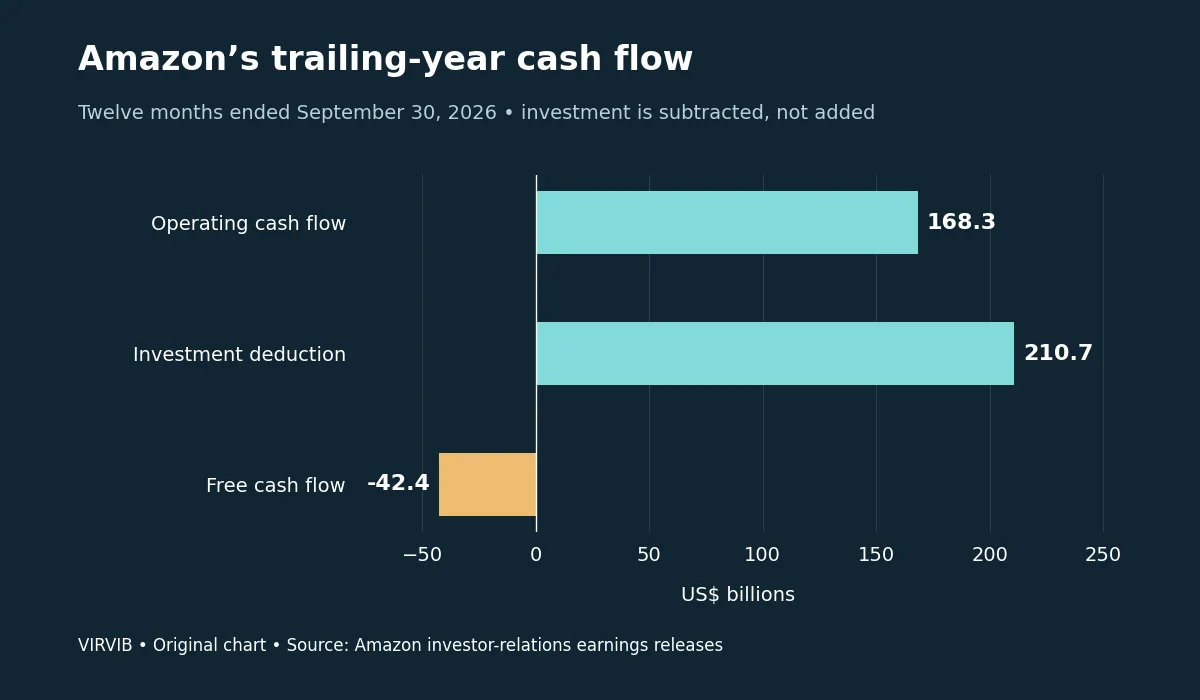
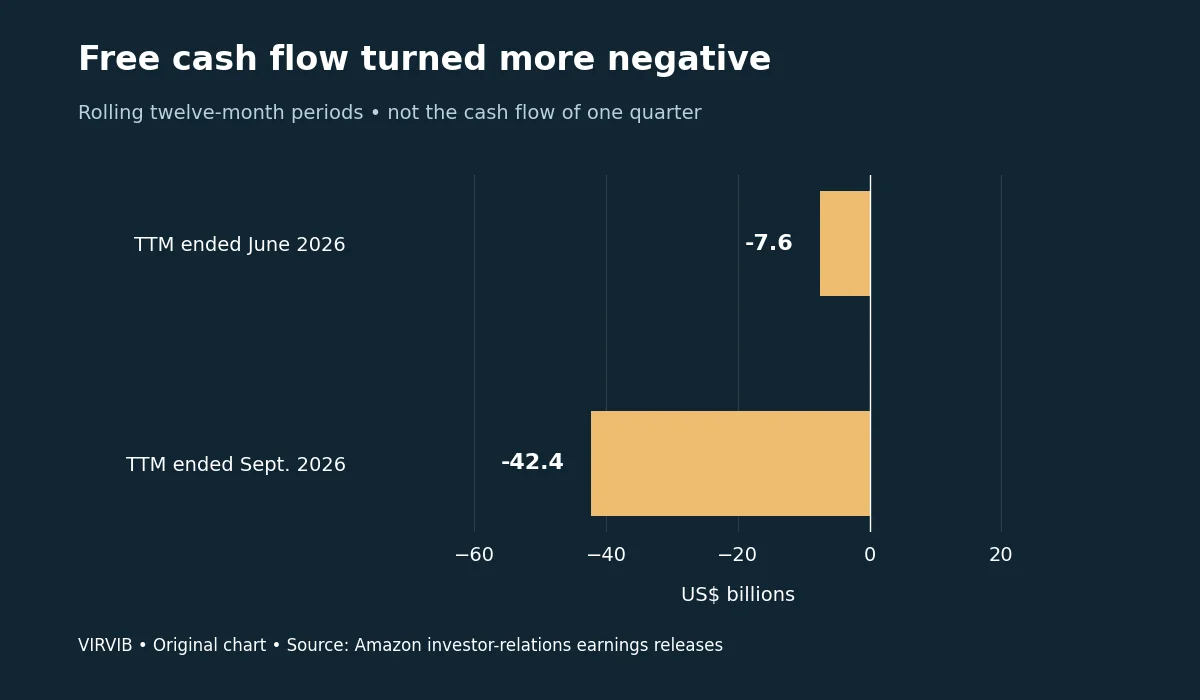
Amazon reported $201.9 billion in third-quarter revenue on October 29, 2026, with operating income of $28.1 billion. Yet the figure dominating the response was negative: free cash flow was an outflow of $42.4 billion over the twelve months ended September 30. That is a trailing-year cash measure, not a $42.4 billion quarterly net loss. Keeping the period and accounting label attached is essential to understanding why a growing business is facing sharper questions about its spending.
Amazon Web Services generated $46 billion in quarterly sales, up about 39% from a year earlier. The company reported net income of $20.7 billion, or $1.89 per diluted share. Those results establish that Amazon remained profitable under its reported accounting measures. They also show why a single headline about cash consumption cannot describe the whole income statement: revenue, operating profit, net profit and free cash flow answer different questions.
Reuters independently reported that Amazon shares fell as much as 7% in extended trading after the release. That report also records a 4.3% decline during Thursday’s regular session, which ended at $243.79. The two moves belong to different trading windows. This article does not present the extended-hours move as a completed October 30 closing result, or add the percentages together as though they shared the same starting price.
The Associated Press likewise described strong cloud growth alongside investor concern about cash being consumed by artificial-intelligence investment. That independent coverage supports the central tension in the announcement without establishing that every seller had the same motivation. A share-price reaction is observable; the precise reasons behind every trade are not. The company’s explanation and outside reporting should remain distinguishable from a complete account of market psychology.
VIRVIB analysis: the relevant question has shifted from whether Amazon can sell more cloud services to how much investment it needs to support that growth. A company can improve its operating performance while committing still more cash to equipment and infrastructure. Investors evaluating that combination need both sides of the record. Celebrating the sales increase alone leaves out the funding requirement; describing the cash outflow as an operating collapse leaves out the profitable business producing the cash.
Sources: Amazon — original Q3 2026 earnings release, October 29 ↗ · Reuters via Euronext — independent earnings and market report ↗ · Associated Press — independent Q3 results report, October 29 ↗
What the $42.4 billion outflow actually measures
The SEC’s introductory guide to financial statements separates the income statement from the cash-flow statement. An income statement records revenue and expenses over a period; a cash-flow statement tracks cash entering and leaving the business. The latter groups activity into operations, investment and financing. A balance sheet supplies another perspective: assets, liabilities and shareholders’ equity at a particular date. These documents are connected, but they are not interchangeable descriptions of the same number.
That framework helps explain why equipment spending and reported profit can move differently. The SEC guide describes depreciation as an allocation of an asset’s cost over its useful life, rather than a fresh cash payment every time the expense is recognized. Buying infrastructure can therefore require cash before all of its cost passes through future income statements. This is a general accounting explanation, not a finding that any particular Amazon asset will earn an adequate return.
Amazon defines its free cash flow as operating cash flow less purchases of property and equipment, net of proceeds from sales and incentives. Its current release reports $168.3 billion of operating cash flow for the trailing twelve months. Under that definition, the deduction for investment was larger than the operating cash generated, producing the negative result. The accompanying original chart identifies the period explicitly so readers do not confuse an annual rolling measure with a single quarter.
There was already a warning in the previous report. Amazon’s second-quarter release showed $161.4 billion of trailing-year operating cash flow and $7.6 billion of negative free cash flow. AWS sales in that quarter had risen 37% to $42.2 billion. That earlier release provides a useful comparison: rapid cloud growth and negative free cash flow were already occurring together. The latest announcement deepens the cash concern rather than introducing the accounting distinction for the first time.
The SEC staff’s non-GAAP guidance adds an important limitation. Free cash flow has no uniform definition, so the calculation and its reconciliation need to be explained. Staff guidance also warns against implying that it represents money freely available for discretionary spending, because debt service and other mandatory demands may remain outside the measure. That caution applies to comparisons as well: a cash-flow label from another company should not be assumed identical without checking its deductions.
VIRVIB analysis: a negative free-cash-flow number does not, by itself, establish insolvency. Nor does strong operating cash generation settle whether spending is economical. Those conclusions require different evidence, including financing obligations and the returns eventually produced by the investment. The useful reading preserves the narrower finding that the defined investment deduction exceeded operating cash flow during this particular twelve-month window.
Sources: Amazon — original Q3 2026 earnings release, October 29 ↗ · SEC — beginner’s guide to financial statements ↗ · SEC staff — non-GAAP measures, including free cash flow, Question 102.07 ↗ · Amazon — Q2 2026 release and prior-period context ↗
The outlook is a forecast—and the next test is execution
Reuters reports that Amazon maintained a roughly $220 billion capital-expenditure expectation for 2026 and that CEO Andy Jassy told analysts spending would be meaningfully higher next year. That is management’s spending outlook, not an already completed 2027 payment total. It also should not be substituted directly into the trailing-year free-cash-flow calculation: a calendar-year forecast and a historical rolling period have different boundaries.
The previous quarter offers a second reason to read comparisons carefully. Amazon’s July release said second-quarter net income included $53.4 billion in non-operating pre-tax other income, primarily associated with Anthropic investments. A large investment-related gain is different from revenue earned by selling cloud capacity or delivering retail orders. That disclosure makes a simple comparison of consecutive net-profit headlines a poor substitute for examining the business segments and the notes behind the totals.
Quarter-to-quarter sales comparisons also require context. Amazon’s earlier outlook disclosed that Prime Day had shifted into the second quarter in most large markets, unlike its placement in the third quarter a year earlier. A promotional calendar can change which quarter contains sales without establishing that the underlying customer relationship changed by the same amount. Readers should distinguish the reported growth rate from a company’s explanation of timing effects, and neither should be treated as a guaranteed pattern for the next holiday season.
VIRVIB analysis: the next useful evidence will connect investment to operating results over time. Growing cloud revenue, an improving capacity position and a credible path to cash generation would answer different parts of that question. A spending forecast alone cannot demonstrate the eventual return, while one difficult cash-flow period cannot determine the outcome of every project funded within it. The evidence needs to develop across subsequent reports rather than being forced into a verdict on announcement night.
For now, the October 29 release establishes a profitable quarter alongside a large trailing-year free-cash outflow. The independent reporting explains why that combination drew scrutiny. The next earnings reports will matter for whether growth, investment and cash generation begin to move into a more sustainable relationship, not merely for whether another headline contains a bigger cloud-sales number.
Sources: Reuters via Euronext — independent earnings and market report ↗ · Amazon — Q2 2026 release and prior-period context ↗ · Amazon — original Q3 2026 earnings release, October 29 ↗
Why this story is in the editionThe Google Trends U.S. RSS feed checked October 30 included “stock market today” with earnings-related coverage. Amazon was selected as a verified new earnings development within that broader topic. No claim is made that “Amazon” itself appeared as a listed query or had a particular U.S. rank or search volume. The interactive Trending page timed out; the RSS feed was retrieved.
Prepared with AI assistance. Source-based reporting checked on 2026-10-30. This article does not update automatically. Read our editorial standards.