What the new PSLF buyback lawsuit alleges
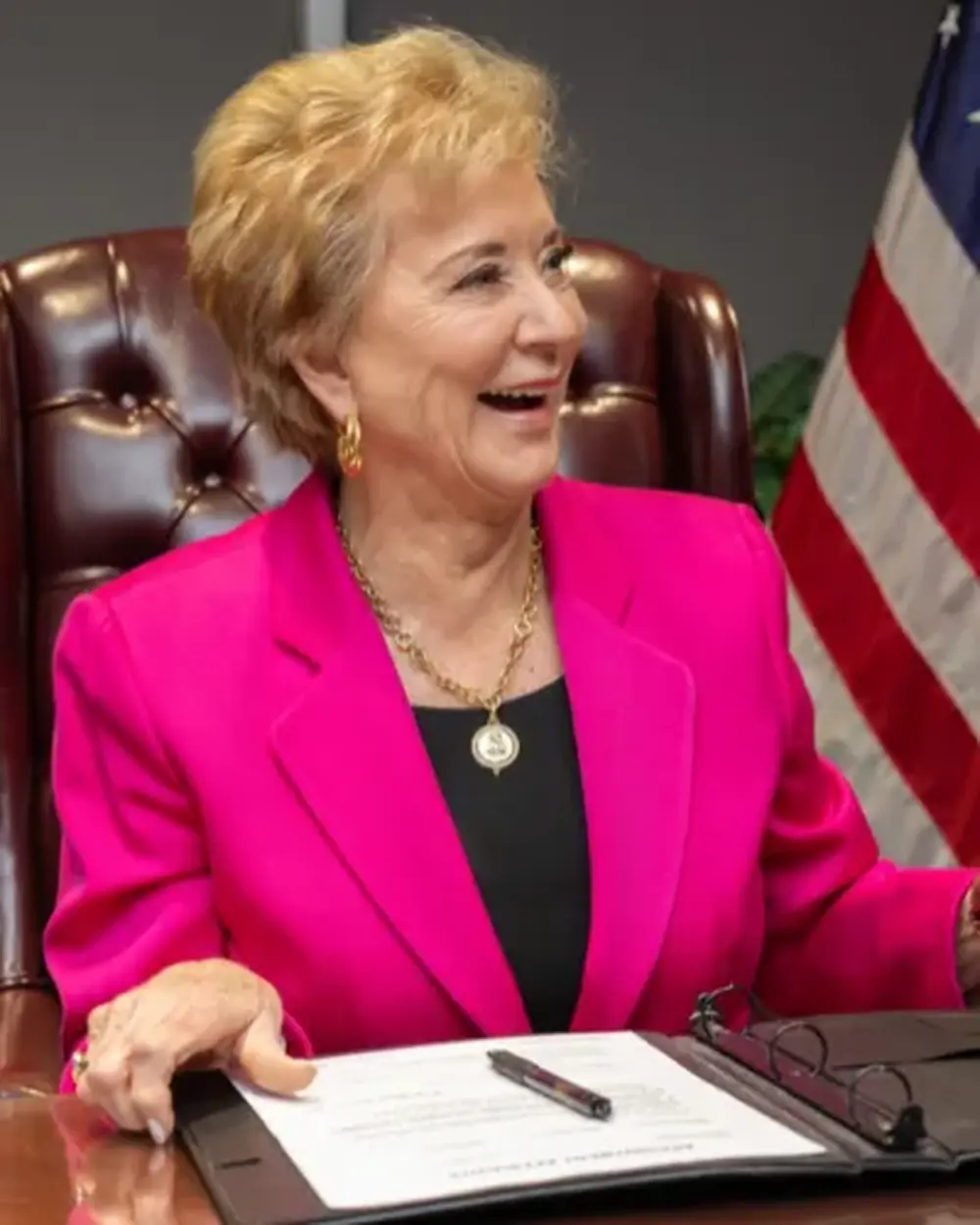
A new federal lawsuit is challenging how the Education Department handles Public Service Loan Forgiveness, bringing months of disputed payment counts and stalled buyback requests into a single proposed class action. Filed on October 30, 2026, in the U.S. District Court for the District of Columbia, the complaint names the department and Education Secretary Linda McMahon as defendants. It seeks court intervention over processing and credit decisions, rather than announcing a new loan-cancellation benefit.
The filing, docketed as case 1:26-cv-03826, is brought by American Federation of Teachers President Randi Weingarten in her official capacity and public-service borrowers. Their central allegations fall into three groups: delayed buyback decisions, failure to post newly earned qualifying months and removal of credit previously awarded. These remain the plaintiffs’ allegations. A complaint begins a case; it does not establish that the agency violated the law or that a proposed borrower class has been certified.
WBUR independently reported the filing and the union’s announcement in Boston on Friday, including borrowers’ accounts of waiting for paperwork to be processed. Its reporting makes clear why a payment counter matters: the counter is supposed to show progress toward the threshold for cancellation. If a month disappears or a request remains unresolved, a borrower may be unable to establish that the threshold has been met, even while continuing to work in public service.
The department has offered a different explanation for payment-count corrections. MarketWatch reported that the agency has described count corrections as addressing coding errors from the Biden administration. That explanation does not settle the individual disputes alleged in the suit, but it belongs alongside the plaintiffs’ claims. VIRVIB has not independently audited borrowers’ account histories or determined which particular months should count.
The effects are described through individual accounts as well as national totals. WBUR reported that plaintiff Jennifer Jessel owes approximately $50,000 and had expected to reach the 120-payment threshold by June 2025. According to the lawsuit, her loans entered involuntary forbearance in September 2024, and she applied for buyback in July 2025. She told the station she wanted to pay the government but could not complete that step while the paperwork remained unprocessed. Her account illustrates the dispute without establishing the outcome of every pending request.
Sources: Original complaint — case 1:26-cv-03826, filed October 30 ↗ · AFT — plaintiff-side announcement, October 30 ↗ · WBUR — independent reporting and borrower account ↗ · MarketWatch — independent report and department explanation ↗
Why 88,000 applications is not a current borrower count
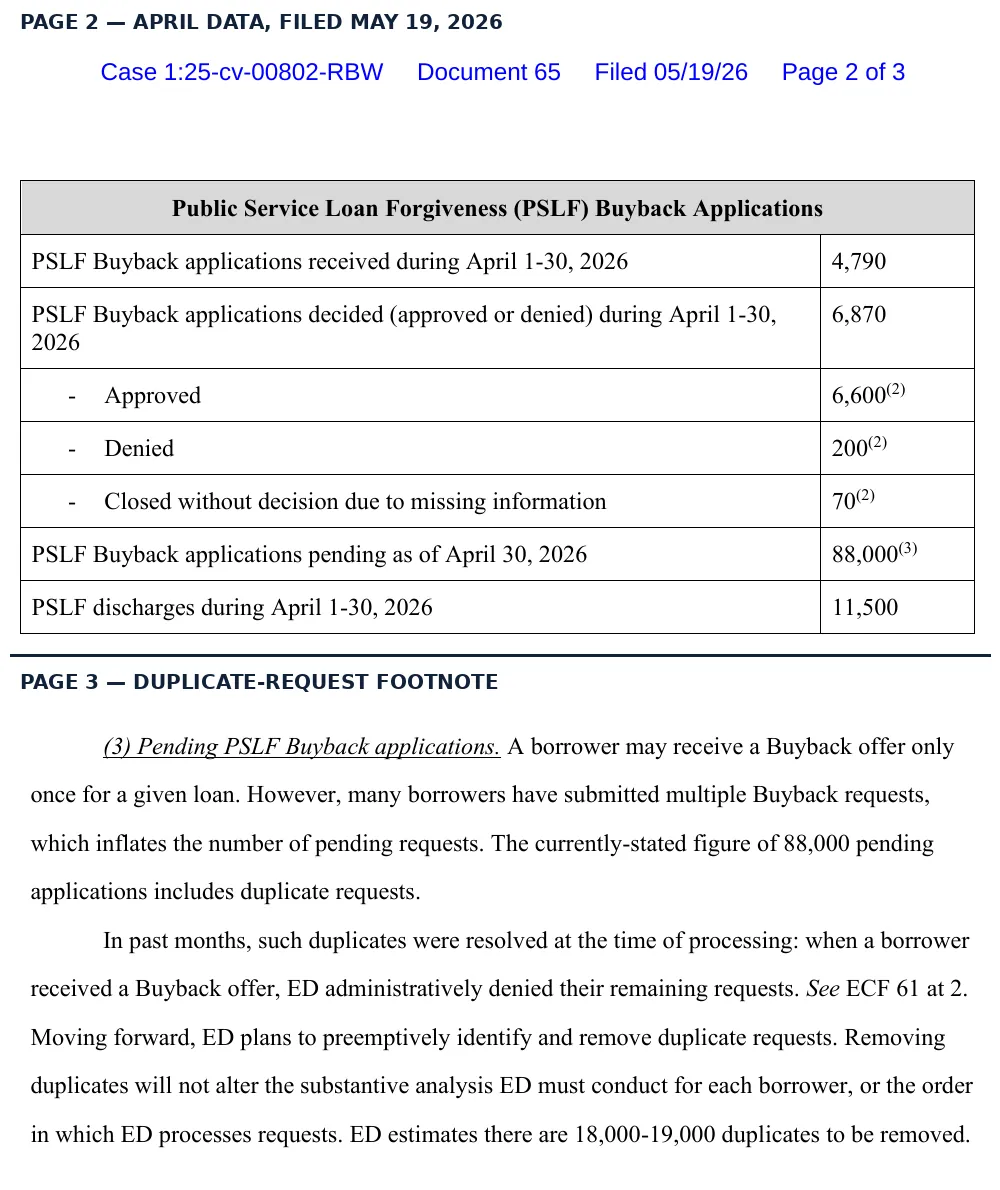
One widely repeated figure in the coverage is 88,000 pending PSLF buyback requests. The original government record provides essential limits on that number. It is an April 30, 2026 snapshot, submitted to the court on May 19 in an earlier case, AFT v. Department of Education. It is not an October 30 measurement of the queue, and it does not represent 88,000 distinct people whose eligibility a court has confirmed.
The department’s status report lists 4,790 buyback applications received during April and 6,870 processed in its decisions category. The breakdown is more informative than the category label alone: 6,600 were approved, 200 were denied and 70 were closed without a decision because information was missing. These figures describe application handling during a particular month. They are not a count of borrowers whose entire loan balances were canceled that month.
Most significantly, the report’s next-page footnote states that the 88,000 pending applications include duplicate requests. It explains that some borrowers submitted more than one request and estimates that 18,000 to 19,000 duplicates would be removed. Previously, additional requests were resolved when a borrower received an offer; the department said it planned to identify duplicates earlier. The figure is consequently a workload measure with a documented duplication issue, not a clean headcount.
That caveat does not make the waiting experienced by an individual borrower disappear. It does change what can responsibly be inferred about the national scale. Removing a duplicate record and deciding the underlying request are different administrative actions. The report itself says duplicate removal would not change the substantive analysis required for each borrower or the order in which requests were processed.
The new complaint uses historical government reporting to argue that delays are unreasonable. Readers should distinguish that argument from a forecast. A calculation based on one month’s throughput cannot establish when today’s queue will clear without knowing new applications, staffing, case complexity and subsequent processing. This report does not present the April balance as today’s backlog or turn the plaintiffs’ estimate into a promised completion date.
Sources: Original complaint — case 1:26-cv-03826, filed October 30 ↗ · Federal defendants’ May 19 status report — April figures and duplicates ↗
What PSLF buyback does — and what to watch next
The basic PSLF framework requires more than simply holding a public-service job for ten calendar years. The Consumer Financial Protection Bureau’s official explanation identifies qualifying federal Direct Loans, a qualifying repayment plan, an eligible public-service employer and 120 qualifying monthly payments. Those conditions work together. A job title alone does not establish eligibility, and the 120 payments do not have to be consecutive.
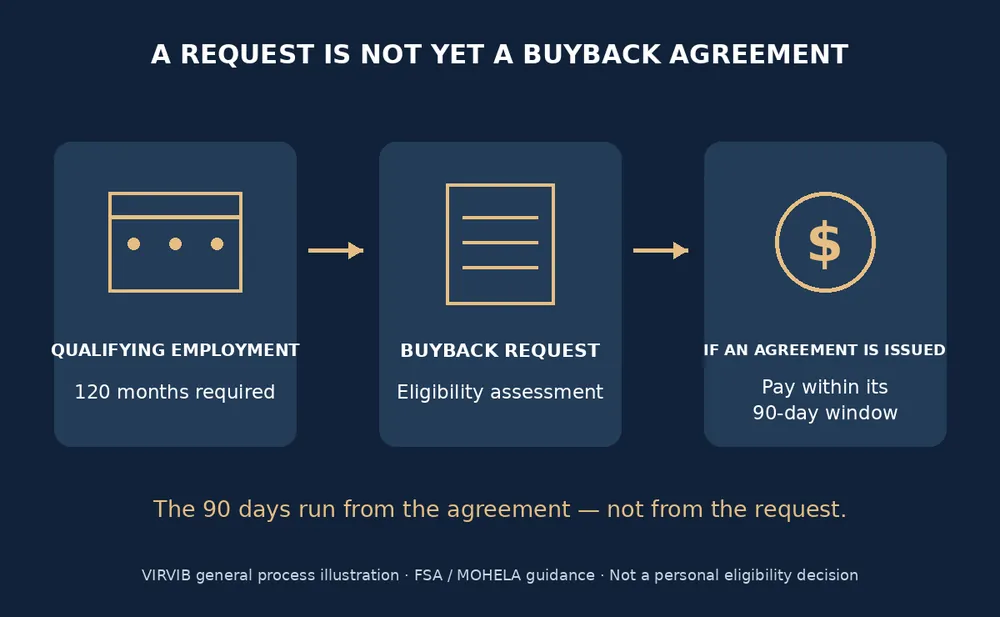
Buyback addresses a narrower problem within that framework. MOHELA’s current official servicing guidance says the opportunity is available only when a borrower already has 120 months of qualifying employment and buying back eligible deferment or forbearance months would result in forgiveness under PSLF or Temporary Expanded PSLF. It is not a general option to purchase an unlimited number of years of credit or to replace the qualifying-employment requirement with a lump sum.
Federal Student Aid’s buyback guidance describes a further distinction between requesting a determination and receiving an agreement. If eligible, a borrower receives a buyback agreement stating the amount and instructions to pay it in full within 90 days of the agreement’s date. That is a payment window after an agreement is issued. It should not be confused with a guarantee that every request will be decided within 90 days, or that the new lawsuit creates such a deadline.
The practical recordkeeping question is separate from the litigation’s eventual outcome. CFPB guidance recommends retaining payment confirmations and checking the qualifying-payment tally against personal records. Employment certification and payment history provide different parts of that picture. A discrepancy can be documented without assuming that a press release establishes a particular borrower’s entitlement, and an unresolved lawsuit is not itself a new repayment instruction.
For the case, the next meaningful developments will be the department’s court response, any decision on the proposed classes and any order addressing the challenged processing practices. The plaintiffs want the department compelled to administer existing forgiveness rights; they have not enacted a new cancellation program. The verified development is a new legal challenge on October 30. Its importance lies both in the unresolved individual accounts and in whether the court requires changes to a system whose published workload figures need careful interpretation.
Sources: Federal Student Aid — PSLF buyback and agreement payment window ↗ · MOHELA — current official PSLF and buyback guidance ↗ · CFPB — PSLF framework and recordkeeping guidance ↗
Why this story is in the editionGoogle Trends U.S. RSS checked October 31 contained a broad “loans” entry linking October 30 PSLF lawsuit coverage. This does not establish a PSLF query rank or search volume. Selected for the documented new filing and original-record explanation of the historical backlog.
Prepared with AI assistance. Source-based reporting checked on 2026-10-31. This article does not update automatically. Read our editorial standards.