Career timeline
- Soros fellowship
The fellowship program records his selection in its 2012 class.
Source ↗ - Columbia faculty
Columbia’s 2015 announcement dates the start of his epidemiology faculty role to the previous year.
Source ↗ - Detroit health administration
The Ford School records his service as Detroit health director and his 2017 departure to run for governor.
Source ↗ - Michigan gubernatorial primary
A University of Michigan event biography records a second-place finish behind Gretchen Whitmer.
Source ↗ - Ford School teaching appointment
The school announced a fall residency and a graduate seminar connecting politics, policy and public health.
Source ↗
Behind the campaign biography
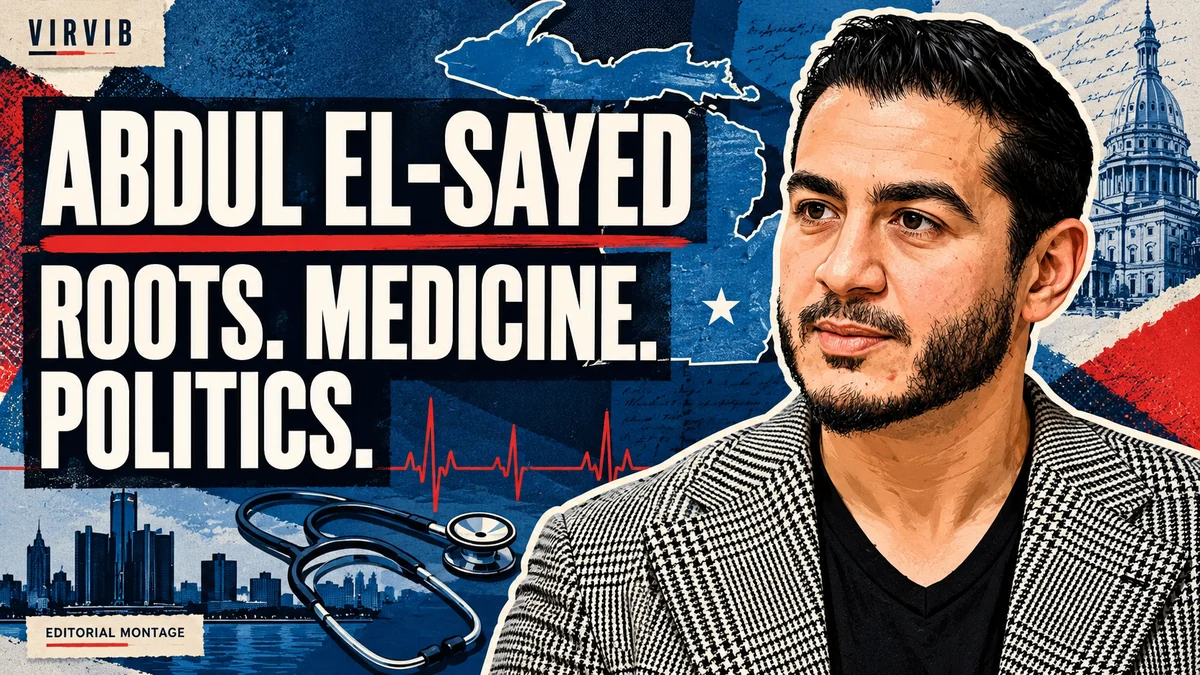
Abdul El-Sayed’s biography raises several questions: Where is he from? What are his Egyptian roots? How did someone trained in medicine become a Michigan political figure? As of October 23, 2026, he is the Democratic nominee for Michigan’s U.S. Senate seat, facing Republican Mike Rogers in the November 3 election. But a campaign label tells only part of the story. His background moves through an immigrant family, Michigan classrooms, Oxford research and local health departments before reaching a statewide ballot. The following ten facts trace that path through university records, public-agency documents and independent reporting. These are documented details, rather than claims of private revelations.
1. His Egyptian roots and Michigan upbringing belong to the same story
El-Sayed was born in Michigan, not Egypt. A University of Michigan event biography describes his parents as immigrants who came to Detroit from Alexandria, the Egyptian Mediterranean city. That distinction matters when reading abbreviated descriptions of him as “Egyptian” or “Egyptian-American”: one refers to family origins, while the other captures a background that also includes an American birthplace and upbringing. The university’s account places his education in Michigan before his later studies abroad and in New York. His movement between those places was an educational journey, not evidence that he first arrived in the United States as an adult. For readers encountering his name through national politics, this is the useful starting point. The roots run across borders; the childhood story is anchored in Michigan. Neither part needs to disappear to make the other understandable. A family’s place of origin also does not, by itself, establish a person’s political beliefs or organizational affiliations.
Sources: University of Michigan: family origins and education ↗
2. His family story includes a Michigan stepmother as well as an immigrant father
His campaign biography identifies the people who raised him as his father, Mohamed, an Egyptian immigrant, and his stepmother, Jackie. It says Jackie’s family has lived in Michigan’s Gratiot County since the nineteenth century. Those are details the campaign presents about his upbringing, and should be read with that attribution rather than as an independently reconstructed family tree. They nevertheless explain why the familiar shorthand “son of immigrants” leaves out part of the household story. In an October 2026 interview with Bon Appétit, El-Sayed described a childhood table that included both his father’s Egyptian ful medames and his stepmother’s meatloaf. Food offers a concrete glimpse of the family traditions behind the biography. It is more revealing than treating ancestry as an abstract label: different histories could meet in an ordinary meal. That picture does not tell readers how to vote. It helps them understand the family setting the candidate describes.
Sources: El-Sayed campaign: family biography (self-description) ↗ · Bon Appétit: family food traditions, October 23, 2026 ↗
3. Academic honors arrived before the campaign signs
The Paul & Daisy Soros Fellowships for New Americans identifies El-Sayed as a 2012 fellow and the child of Egyptian immigrants. Its biography records an undergraduate education at the University of Michigan, graduation with highest distinction and membership in Phi Beta Kappa. It also notes that he delivered student remarks at a commencement that featured Bill Clinton. These are milestones from an academic trajectory that predates his statewide political campaigns. The fellowship record further identifies his Oxford public-health doctorate and Columbia medical degree, alongside support through the Medical Scientist Training Program. A scholarship or fellowship is a specific educational credential; it should not be stretched into evidence for unrelated political claims about the recipient. Taken together, the documented honors show the route through which he entered research and medicine. They also make clear why a brief political biography can miss an earlier chapter in which his principal institutions were universities, laboratories and classrooms.
4. He planned a clinical career, then changed direction
A 2016 profile published by Columbia’s medical school describes a consequential change in El-Sayed’s plans. After studying at Michigan and completing an Oxford doctorate, he continued his medical education at Columbia, where he worked with epidemiologist Sandro Galea. The account says he initially intended to pursue surgical training. His experience with a patient whose housing and health needs remained unresolved helped persuade him to withdraw his residency application and turn toward public health. This is the explanation he gave in that profile, rather than a claim that every part of a career decision can be reduced to one encounter. It also clarifies an important distinction: earning a medical degree and working as a licensed clinician are different things. Bridge Michigan’s 2026 reporting says he does not have a license to practice medicine. His professional record should therefore be described precisely, including his medical education without implying an ongoing clinical practice.
Sources: Columbia Medicine: 2016 alumni profile ↗ · Bridge Michigan: record review, September 2026 ↗
5. Detroit brought him back from university research to local government
Columbia’s Mailman School announced in September 2015 that Detroit Mayor Mike Duggan had selected El-Sayed for the city’s top health post. He was 30 and had joined Columbia’s epidemiology faculty the previous year. The university described his research as examining connections between poverty, social marginalization and outcomes including obesity and infant mortality. Moving to Detroit placed him on the administrative side of problems he had studied. The announcement named immunization, maternal and child health, and HIV/AIDS among the areas he expected to address. It also discussed supporting community efforts, including neighborhood recreation and urban agriculture. Those were descriptions of priorities at the start of the appointment, not a scorecard proving that every objective was achieved. The move is still a central turning point: he left a faculty role to take responsibility for a public agency in the metropolitan area where he had grown up. The research questions had acquired a city budget, staff and residents attached to them.
Sources: Columbia Mailman: Detroit appointment, September 2015 ↗
6. Some of his best-known initiatives were about everyday obstacles
A Michigan Medicine account published before his 2019 commencement address highlighted work on children’s glasses, environmental health and testing water for lead in schools and early-childhood settings. The institution described the task of rebuilding Detroit’s health department after its services had been privatized during the city’s financial crisis. Those examples help explain what “public health” meant in his local-government biography. The subject was not confined to a hospital ward: a child’s ability to see in class or the safety of water in a building could also become a health-department concern. The university’s account is a useful record of how his work was presented at that time, although it is not a comprehensive independent audit of every program. Readers assessing a public official should keep that difference in mind. A program’s creation, its reach and its measurable effects are separate questions, even when all three are compressed into a single sentence in a campaign speech.
Sources: Michigan Medicine: public-health work and 2019 commencement ↗
7. He returned to Michigan to teach the relationship between policy and health
The University of Michigan’s Ford School announced El-Sayed’s appointment as a Towsley Foundation Policymaker in Residence in April 2021. His planned graduate seminar was titled Policy, Politics, and Public Health. According to the announcement, it would examine how political decisions shaped systems including education, food, air and water, and healthcare. It also addressed the roles of poverty, structural racism, corporate power and public advocacy. The appointment supplies another chapter between his public-health administration and later Senate campaign: he was teaching students to examine how government decisions reach into daily life. The school described the residency program as bringing experienced policymakers into contact with students through teaching, advising and public events. This was a defined academic role, rather than an elected position. For anyone trying to follow his career chronologically, it helps connect the government administrator with the writer and political commentator who subsequently became more visible to a national audience.
Sources: University of Michigan Ford School: 2021 teaching appointment ↗
8. His media work grew from the same questions he brought to the classroom
In a September 2021 Ford School interview, El-Sayed described using his podcast, America Dissected, to discuss interactions among public policy, politics and health. He said he had recently interviewed Anthony Fauci for a second time. He also discussed his newsletter, The Incision, and the difficulty of helping audiences understand the pandemic amid uncertainty. The interview records his argument that rebuilding public health required rebuilding public trust, including addressing the way social-media platforms shaped information. Those are his stated views, not findings that every reader must accept. What the interview establishes is the continuity between his teaching interests and his public communication. His appearances in media were not an entirely separate chapter from his health-policy career. They provided another venue for explaining the connections he wanted audiences to see. Reading that earlier interview also gives voters a way to compare what he discussed before the Senate contest with the themes he emphasizes during it.
Sources: University of Michigan Ford School: September 2021 interview ↗
9. The medical-debt story requires separating a goal from a result
Wayne County’s official program description says its partnership with the nonprofit Undue Medical Debt has the potential to relieve up to $700 million in medical debt. That wording matters: a ceiling or target is not the same as completed cancellation. The county explains that relief depends on acquiring qualifying debt from participating providers; people do not simply submit an application asking the program to erase any bill they hold. In its September 2026 review, Bridge Michigan reported that more than $95 million in bills had been cleared for more than 100,000 county residents since 2024. That is a dated reporting figure, not a live total for publication day. The difference between the ambition and the documented result is essential to evaluating El-Sayed’s record. It preserves recognition of an actual initiative while leaving room to examine implementation and follow-through. Readers should use subsequent county updates for newer totals, rather than assume either the target or an older snapshot is the final outcome.
Sources: Wayne County: medical-debt relief program ↗ · Bridge Michigan: record review, September 2026 ↗
10. His Senate nomination followed an earlier statewide defeat
El-Sayed’s political career did not begin with a winning statewide campaign. University of Michigan records note that he finished second to Gretchen Whitmer in the 2018 Democratic gubernatorial primary. In 2026, the Associated Press reported that he narrowly defeated Haley Stevens for the Democratic Senate nomination and would face Mike Rogers in November. That sequence is more informative than a biography that lists only advances and honors. It includes a loss, a period of continued public activity and a later primary victory. As of this article’s October 23 publication date, the general election has not taken place. A nomination is therefore not a Senate seat, and the profile should not be read as predicting the result. His educational background, family history and administrative experience supply context for evaluating him. They cannot settle the separate questions voters face about his proposals, judgment or ability to deliver in federal office.
Sources: University of Michigan: family origins and education ↗ · Associated Press: 2026 Democratic primary victory ↗
What the record shows
The documented biography is substantial without embellishment: an American upbringing with Egyptian family roots, advanced study, a shift toward population health, and a move from appointed government work into electoral politics. The most useful way to read that story is to keep its parts distinct. Family origins explain background; university records establish education; agency documents describe programs; independent reporting tests claims about results. For a public figure, those distinctions offer something more durable than a purported secret: a record readers can examine for themselves.
Sources: University of Michigan: family origins and education ↗ · Paul & Daisy Soros Fellowships: Abdul El-Sayed ↗ · Columbia Mailman: Detroit appointment, September 2015 ↗ · Wayne County: medical-debt relief program ↗ · Bridge Michigan: record review, September 2026 ↗
A reader’s guide to checking his career record
Start with the institution responsible for the claim. A fellowship directory can establish selection for a fellowship; a dated university announcement can establish an appointment and its intended responsibilities. Neither is an independent review of an entire political career. Columbia’s September 2015 announcement, for example, describes what El-Sayed planned to do in Detroit. The Ford School’s April 2021 announcement supplies the later dates of his Detroit tenure. Read those documents together to separate an initial job description from the length of time he held the job.
Then record three things alongside any claim: who published it, when it was published, and whether it describes a qualification, an ambition or a measured result. An older institutional biography may still use the present tense for a role that has ended. Historical appointments are useful evidence of experience; they are not proof of someone’s current employment or the success of every initiative associated with them.
Sources: Paul & Daisy Soros Fellowships: Abdul El-Sayed ↗ · Columbia Mailman: Detroit appointment, September 2015 ↗ · University of Michigan Ford School: 2021 teaching appointment ↗
How to compare the medical-debt figures
Wayne County’s program page identifies two different measures in its dashboard notes: the face value of qualifying debt canceled and the county’s spending on the program. They answer different questions. A dollar of debt eliminated is not necessarily a dollar paid from a county budget. The page also says relief efforts can include state funding and philanthropic support, which makes it important to identify which contributors a particular total includes.
For a fair comparison, keep the reporting period, funding scope and measurement the same. Check the county’s dated results before repeating a campaign figure, and distinguish the program’s potential reach from cancellations already completed. Those checks apply regardless of which candidate is discussing the program. This profile’s earlier $95 million figure remains explicitly attributed to September 2026 reporting; it is not presented as a newly checked October total.
Sources: Wayne County: medical-debt relief program ↗ · Bridge Michigan: record review, September 2026 ↗
Why this story is in the editionA biographical explainer tied to the October 2026 Michigan Senate race; no search-volume or virality claim.
Prepared with AI assistance. Source-based reporting checked on October 23, 2026. This article does not update automatically. Read our editorial standards.