Three named ads, immediate removal and canceled placements
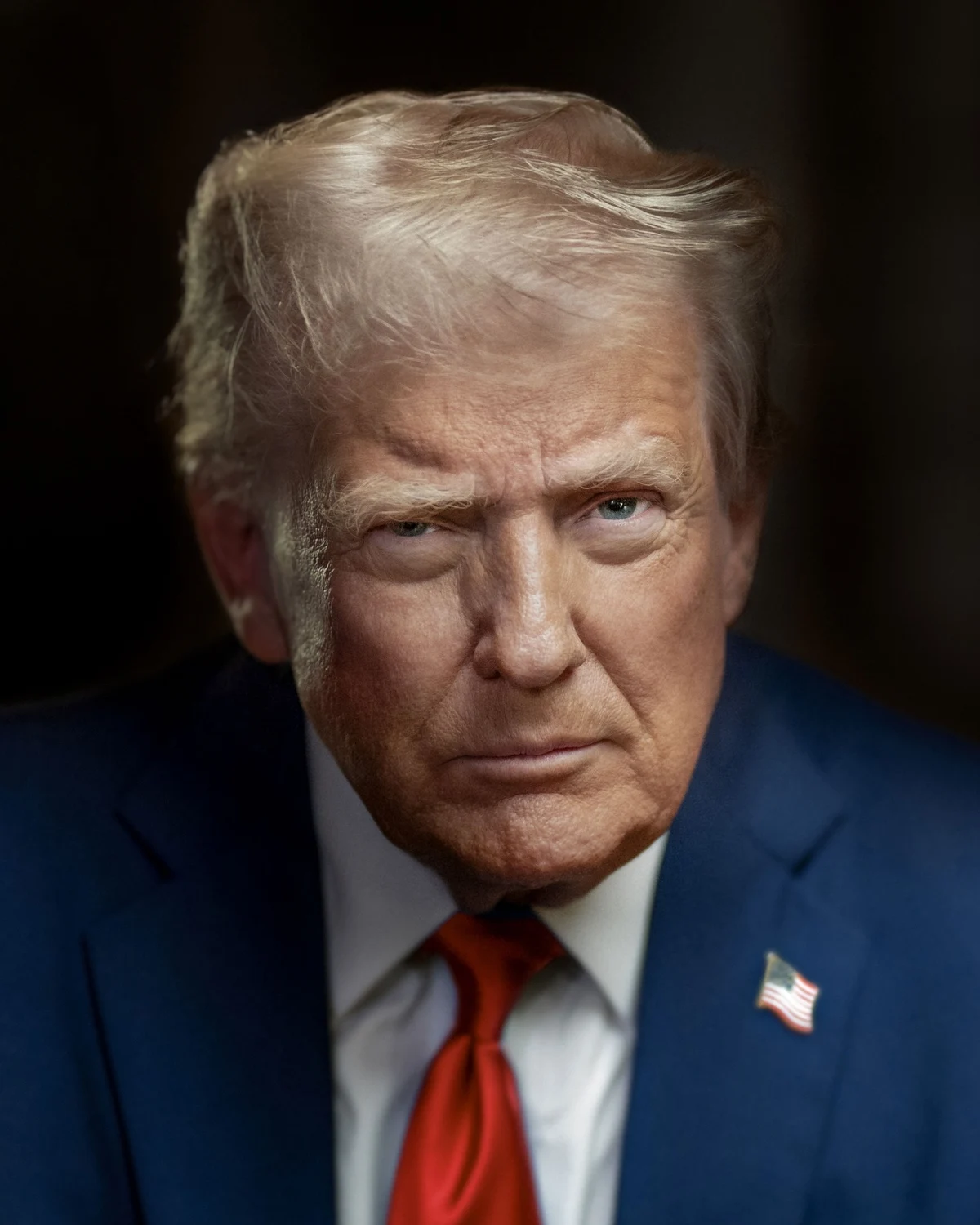
A federal judge ordered the Trump administration to stop distributing three taxpayer-funded advertisements on October 30, 2026, extending a dispute over government advertising into official social media and placements through authorized third parties. The written order requires immediate removal of the three ads from government websites, including YouTube and Instagram. It also requires cancellation of arrangements for their distribution, expressly including airing by MAGA Inc. The order grants temporary relief in part; it does not resolve the entire lawsuit.
The three titles matter because they define the operative restriction: “$5,000 to Americans,” “Every Democrat Voted Against No Tax on Tips,” and “Cost of Socialism.” U.S. District Judge Jennifer L. Rochon identified each in document 101 of Common Cause v. Department of Homeland Security, case 1:26-cv-08882-JLR in the Southern District of New York. The order does not announce a general prohibition on every administration advertisement or every political message involving President Donald Trump.
Rochon found a clear and substantial likelihood that the moving plaintiffs would succeed on their claim that officials acted beyond their lawful authority with respect to at least those three advertisements. She also found a strong showing of irreparable harm and concluded that the balance of interests supported an injunction. Those findings explain why the court intervened before a final resolution. They are preliminary assessments supporting a temporary remedy, rather than findings following a completed trial.
The Associated Press independently reported that the plaintiffs had sought restrictions on at least thirteen ads, while the judge restricted these three for now. AP also reported Rochon’s recognition that a president may explain policy and respond to political criticism. That distinction is important to the scope of the decision: the immediate relief targets identified advertisements within a public-funding dispute, while broader questions remain for further proceedings.
The written order follows a motion submitted on October 23, an administration opposition on October 27, a reply on October 29 and a hearing on October 30. The moving plaintiffs were Robert Hunter, SEIU Local 32BJ and Empire State 32BJ SEIU PAC. Common Cause is also a plaintiff in the underlying action. The defendants include the Department of Homeland Security, the Office of Management and Budget and executive officials sued in their official capacities.
For readers encountering a clip online, the useful first question is whether it is one of the three identified advertisements. The next is how it is being distributed. The text reaches official government accounts and arrangements through authorized third parties; it does not turn the presence of any Trump video on a private account into proof that this particular order has been violated.
Sources: Southern District of New York — October 30 expanded temporary restraining order, document 101 ↗ · Associated Press — independent report on the three-ad restriction ↗ · Federal Rule of Civil Procedure 65 — injunctions and restraining orders ↗
Why the funding dispute survived a move beyond television
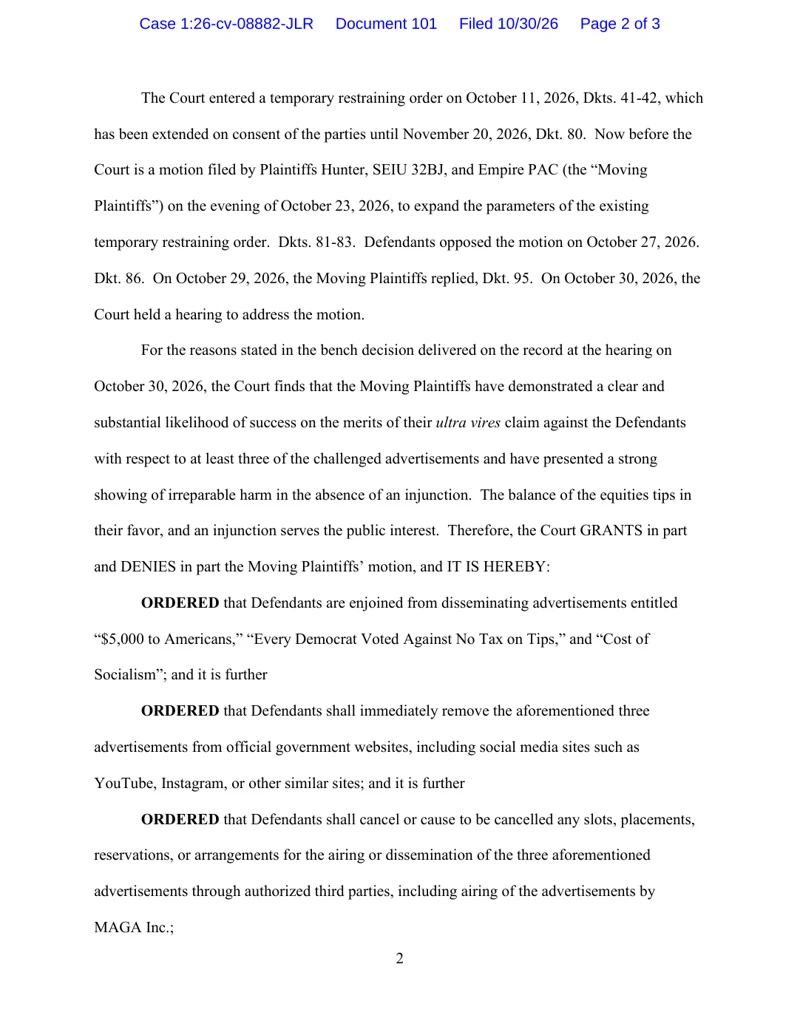
The October 30 decision builds on an earlier temporary restraining order entered on October 11. That first order addressed the government’s financing and distribution of a different group of challenged advertisements. Its financial provisions stayed a September 20 Customs and Border Protection purchase order with Lepugh Inc., doing business as LMD Agency, and a related $20 million OMB apportionment. An apportionment concerns the availability of funds; that figure should not be reported as proof that the full amount had already been spent.
Rochon’s October 12 opinion explaining the first order supplies more detail. It describes a September 19 reapportionment of $20 million to a CBP commemorative-events account and the next day’s purchase order. The opinion cites the government’s account that the purchase order covered placement of the advertisements, rather than their creation or production. This matters when evaluating the financing: money authorized or committed for placement, money paid and the cost of making the material are different questions.
The earlier opinion addresses both the statutory purpose of appropriations and restrictions on publicity or propaganda. The basic rule in 31 U.S.C. § 1301 is that appropriated funds must serve the purposes Congress authorized, unless another law provides otherwise. That is the foundation for asking whether a particular advertisement is an authorized government expense. An executive agency’s approval of a transaction does not by itself answer the separate question of whether Congress permitted that use.
The procedural history also explains why assurances about stopping a campaign did not immediately end the case. In the October 12 opinion, Rochon rejected the argument that voluntary cessation made the dispute moot. The record discussed purchased airtime and remaining financial obligations. The opinion records that the government did not contest likelihood of success on the merits at that stage, while pressing objections including standing, venue and mootness. That earlier litigation position should not be confused with an admission resolving every claim in the later motion.
The plaintiffs subsequently argued that the disputed material continued circulating through official online channels and MAGA Inc. In an October 30 release, Democracy Forward described the expanded order as a response to that distribution. Campaign Legal Center Action likewise presented the ruling as another success in its challenge. Both organizations participated in the plaintiffs’ legal effort, so their descriptions are advocacy accounts. The court’s own operative paragraphs establish what officials must now do.
The resulting issue is continuity of distribution: moving an advertisement from a government-funded television placement to another channel does not, by itself, settle a challenge to its public financing. Here, the latest written remedy specifically addresses websites, social platforms and authorized third-party arrangements. Whether particular later conduct complies requires evidence about that conduct, not an assumption based only on the platform carrying it.
Sources: Southern District of New York — October 30 expanded temporary restraining order, document 101 ↗ · Southern District of New York — October 11 order, document 41 ↗ · Southern District of New York — October 12 opinion explaining the first order, document 42 ↗ · U.S. Code — 31 U.S.C. § 1301, purposes of appropriations ↗ · Democracy Forward — October 30 plaintiffs’ account and original court documents ↗ · Campaign Legal Center Action — October 30 plaintiffs’ update ↗
The reporting deadline and the two separate temporary orders
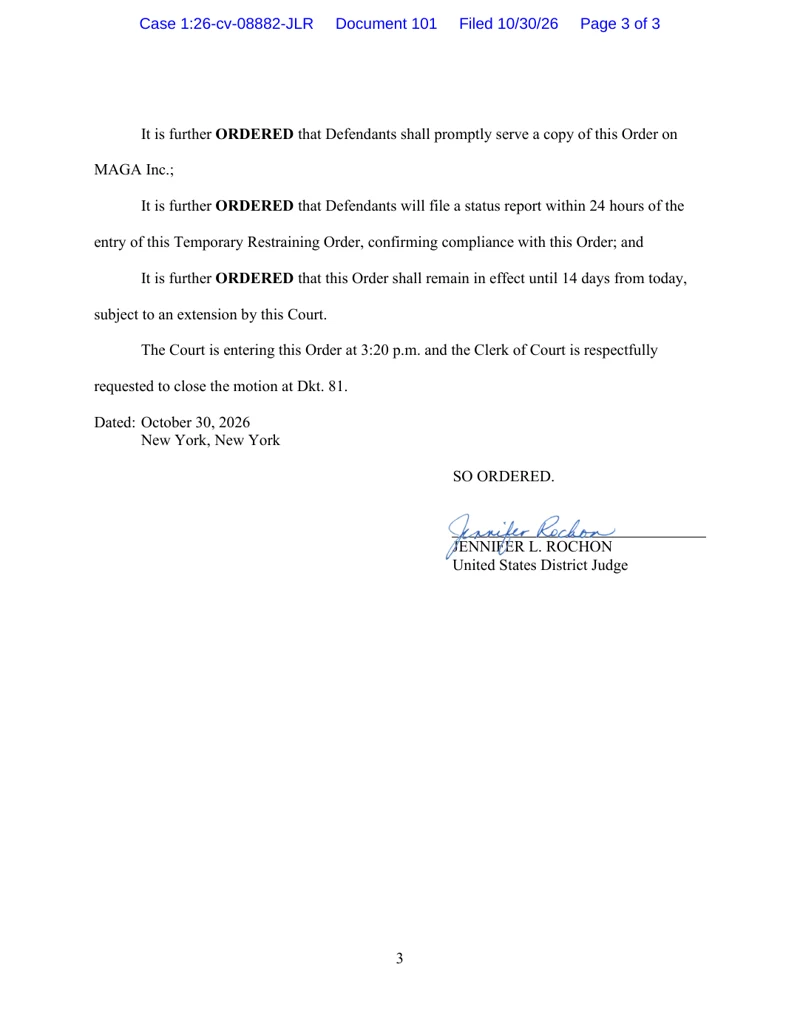
The October 30 order directs the defendants to serve a copy promptly on MAGA Inc. It also requires a status report within twenty-four hours of entry confirming compliance. These are affirmative obligations in the court document. VIRVIB has not independently verified the resulting compliance filing or established that every copy and placement covered by the order was removed. Reporting the requirement accurately is different from announcing that the government has completed it.
The dates require particular care. Document 101 says the new order remains in effect for fourteen days from October 30, subject to an extension by the court. The same document separately notes that the earlier October 11 restraining order had already been extended by consent until November 20. Those are distinct references to distinct temporary measures. Describing November 20 as the stated expiration of the new three-ad restriction would merge provisions that the court kept separate.
An October 22 scheduling order set a preliminary-injunction hearing for November 13. That is the schedule documented in the reviewed record, rather than a guarantee that no later scheduling change can occur. Further filings may address compliance, the scope of relief or arguments for maintaining, modifying or ending restrictions. A later order would need to be read on its own terms before reporting a changed deadline or a broader ban.
The distinction between a temporary restraining order and a final judgment is central to what happens next. The present order protects against harm the judge found sufficiently likely and urgent while litigation continues. It does not impose a criminal conviction or announce a final damages award. Federal Rule of Civil Procedure 65 also requires injunctions to describe the restrained acts specifically. The named advertisements and distribution instructions provide that specificity here.
Readers should also separate an advertisement’s title from a government benefit announcement. “$5,000 to Americans” is one of the titles used to identify the prohibited material. The court order does not create a payment program, determine anyone’s eligibility or direct that a payment be issued. Its subject is the dissemination of the identified advertising and the officials’ legal authority to use public resources.
VIRVIB analysis: the next consequential evidence is the compliance record and any subsequent ruling on continued relief. The verified development is already substantial: Rochon required three specified ads to be taken off official government channels, canceled their authorized third-party distribution arrangements and demanded a prompt account of compliance. Following those concrete obligations gives readers a firmer account of the case than treating a temporary, partial decision as either a comprehensive ban or a completed final verdict.
Sources: Southern District of New York — October 30 expanded temporary restraining order, document 101 ↗ · Southern District of New York — October 22 scheduling order, document 80 ↗ · Federal Rule of Civil Procedure 65 — injunctions and restraining orders ↗
Why this story is in the editionGoogle Trends U.S. RSS and current reliable news reviewed November 1, 2026 UTC. This uncovered public-spending court development was selected after reviewing the 507-article archive. No claim is made that this subject holds a Google Trends rank or search-volume figure.
Prepared with AI assistance. Source-based reporting checked on 2026-11-01. This article does not update automatically. Read our editorial standards.