Mavericks vs. Thunder: Flagg leads a 120–96 Dallas win
Cooper Flagg delivered 26 points, eight assists and no turnovers as the Dallas Mavericks beat the Oklahoma City Thunder 120–96 at American Airlines Center on October 28, 2026. Oklahoma City’s first defeat left it 4–1, while Dallas moved to 3–2. The result and Flagg’s production are supported by the NBA’s final game record and independent reports from Reuters/Field Level Media and Sportsnet.
Dallas did not need a single enormous scoring performance to get there. Eight Mavericks reached double figures, and the team made 16 three-pointers to Oklahoma City’s five. Flagg was the leading scorer, but the spread of contributions gave the home side several ways to sustain its advantage. P.J. Washington supplied 18 points, Kyrie Irving had 15 and Zaccharie Risacher added 13.
The game became more one-sided after halftime. Dallas led 33–30 following the first quarter and 65–59 at the break. It then won the third period 29–22 and the fourth 26–15. That converted a six-point halftime margin into a 24-point final difference. Oklahoma City scored 59 points in the opening half and only 37 in the second, a decline visible in the official quarter totals.
Flagg’s combination of scoring and ball security gives the result its clearest individual thread. His 26 points came on 10-for-23 shooting, including two threes, plus four free throws. He also collected five rebounds. Eight assists without a turnover meant that his own possession losses did not offset the passing production recorded beside his scoring.
VIRVIB analysis: those figures make this a useful game to examine beyond the headline score. Dallas won while Flagg missed more field goals than he made, because passing, additional scorers and the team’s shot distribution mattered too. A productive lead player does not have to convert every difficult attempt when the rest of the offense is supplying points. The final numbers describe that balance more convincingly than a declaration that one young player has already solved every challenge.
Sources: NBA — final game record and published structured statistics ↗ · NBA — final box score ↗ · Reuters / Field Level Media — independent result report ↗ · Sportsnet — final score and leading players ↗
The third-quarter sequence that widened the gap
Oklahoma City opened the second half with two free throws to make it 65–61. The NBA’s play-by-play then records an 11–0 Dallas run, starting with Irving’s driving floater at 9:49 and ending with Flagg’s pull-up jumper at 7:50. In less than two minutes of game time, a four-point difference became 15.
The sequence involved five Dallas baskets by five players. Irving’s floater was followed by a Max Christie three-pointer, a Washington layup, a Risacher tip-in and Flagg’s jumper. Flagg assisted the first basket and Irving assisted Christie’s three. That distribution captures the challenge for Oklahoma City during the stretch: stopping one scorer would not have removed every scoring route.
Dallas’s first made basket of the half did not arrive until more than two minutes had elapsed. The eventual separation therefore came through a concentrated burst rather than uninterrupted scoring from the opening possession. The clock and score record help distinguish the decisive passage from the broader third quarter, which also contained a Thunder response.
Ajay Mitchell and Shai Gilgeous-Alexander subsequently helped cut the deficit to seven. Mitchell made a three and a bank shot, before Gilgeous-Alexander’s three brought Oklahoma City within 78–71 with 5:56 remaining. Dallas still finished the quarter ahead 94–81. The visitors had narrowed the gap, but they had not regained the position they occupied at halftime.
Irving finished with four assists and three made threes in just under 27 minutes. The Associated Press identified this as his first home regular-season appearance since his March 2025 knee injury. That home milestone should not be confused with his first appearance of the current season: he had already played elsewhere. Here, his contribution fitted alongside Flagg’s playmaking rather than replacing it.
Sources: NBA — final game record and published structured statistics ↗ · NBA — final box score ↗ · NBA — official play-by-play ↗ · Associated Press via CBS Sports — Irving’s home appearance milestone ↗
How 16 Dallas threes changed the scoring equation
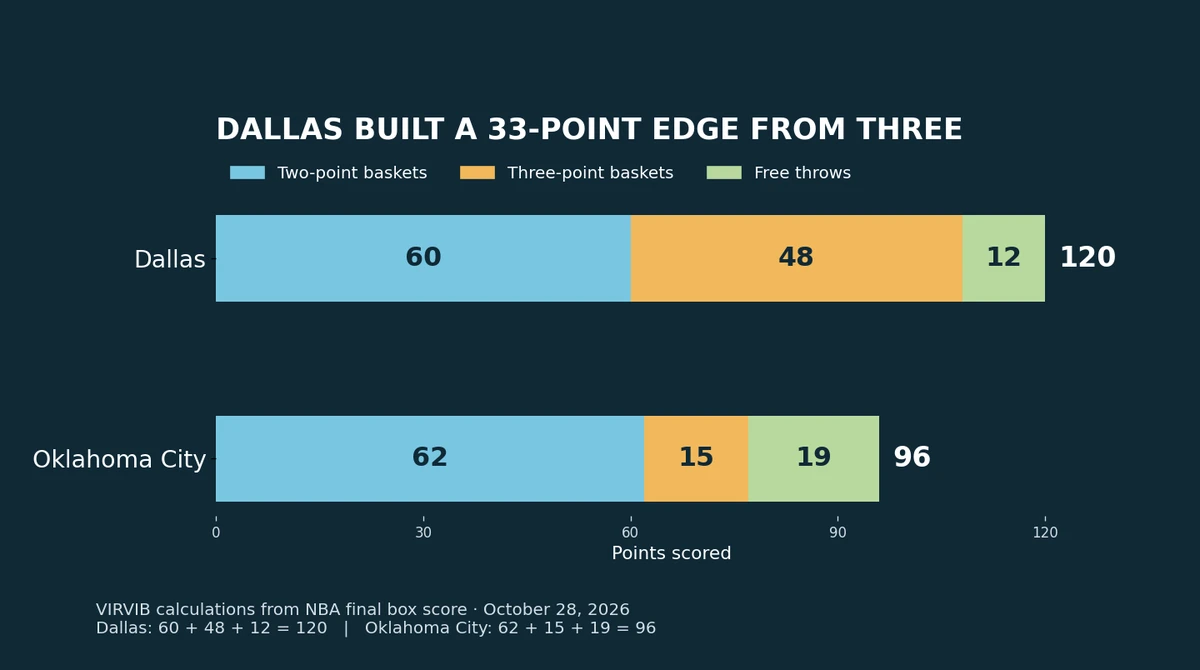
The largest scoring contrast was beyond the arc. Dallas made 16 of 45 attempts, or 35.6 percent. Oklahoma City made five of 32, or 15.6 percent. Those totals produced 48 Dallas points and 15 Thunder points from three-point baskets. VIRVIB’s calculation gives the Mavericks a 33-point advantage in that category, nine more than their eventual winning margin.
The rest of the arithmetic explains why that distinction was so powerful. Oklahoma City scored 62 points from two-point baskets and 19 at the line. Dallas scored 60 from twos and 12 from free throws. The Thunder therefore held a combined nine-point advantage in those two categories. Dallas’s 33-point edge from three overcame it to produce the 24-point result shown in the accompanying chart.
This does not mean that every Dallas three came from the same play or that the Thunder’s misses had one cause. The statistical record establishes the gap, while attributing each attempt to a particular defensive decision would require a separate possession review. It also shows why describing Dallas simply as extraordinarily accurate would miss part of the story: the Mavericks took 13 more threes as well as making a higher percentage.
Daniel Gafford contributed one of those makes, hitting a first-quarter three off a Flagg assist at 8:29. His larger contribution to the possession battle included 11 rebounds, six of them offensive. Dallas collected 15 offensive rebounds as a team and scored 18 second-chance points; Oklahoma City had 12 offensive boards and seven second-chance points.
The Mavericks also scored 16 points off turnovers, compared with nine for the Thunder. These categories overlap with the made baskets already counted in the final score; they should not be added to the shooting totals as extra points. They describe how scoring opportunities developed. Together, the three-point advantage, recovered misses and points after turnovers explain why Dallas could build separation without relying on a huge free-throw total.
Sources: NBA — final game record and published structured statistics ↗ · NBA — final box score ↗ · NBA — official play-by-play ↗
What the result means before Dallas faces Houston
Mitchell led Oklahoma City with 29 points on 12-for-20 shooting. Gilgeous-Alexander added 21, and Isaiah Hartenstein contributed 10 points and 14 rebounds. The leading scorer on the night therefore played for the losing side. Dallas’s broader distribution outweighed Mitchell’s individual output: its bench supplied 43 points, compared with 19 from Oklahoma City’s reserves.
The Thunder’s available personnel also matter when interpreting the defeat. Their official inactive list included Jalen Williams, Cason Wallace, Chet Holmgren and Alex Caruso. Dallas had absences of its own, including Dereck Lively II, Santi Aldama and Naji Marshall. Those names establish who was unavailable for this particular game; they do not justify assuming a return date or predicting the outcome of a future meeting with different lineups.
For Dallas, the supporting production extended beyond Irving and Washington. Christie scored 11, while Morez Johnson Jr., Marcus Sasser and Caleb Martin each had 10. Walter Clayton Jr. did not score, but supplied five assists without a turnover. That is another example of a contribution that a scoring-only account would overlook.
The next scheduled test is Houston’s visit on Friday, October 30, at 8 p.m. Eastern, according to the NBA game listing. It is a West Group A NBA Cup game. Denver, Phoenix and Utah complete the group alongside the two Texas teams, giving the upcoming fixture a tournament context as well as its regular-season significance.
VIRVIB analysis: the repeatable questions concern Dallas’s passing, possession control and ability to generate contributions across its rotation. The three-point margin may vary sharply from night to night. Flagg’s eight assists without a turnover and the production around him provide more specific things to track than a sweeping forecast after five games. Wednesday established that Dallas could beat this available Thunder lineup decisively. Houston will supply the next evidence of how consistently the Mavericks can play that way.
Sources: NBA — final game record and published structured statistics ↗ · NBA — final box score ↗ · NBA — Houston at Dallas, October 30 official listing ↗ · NBA — West Group A composition ↗
Why this story is in the editionThunder vs Mavericks appeared in Google Trends Trending Now for the United States, past 24 hours, checked October 29, 2026. This is an editorial selection, not a claim of national search rank or precise search volume.
Prepared with AI assistance. Source-based reporting checked on 2026-10-29. This article does not update automatically. Read our editorial standards.