Sunday Ticket subscribers win back a liability verdict
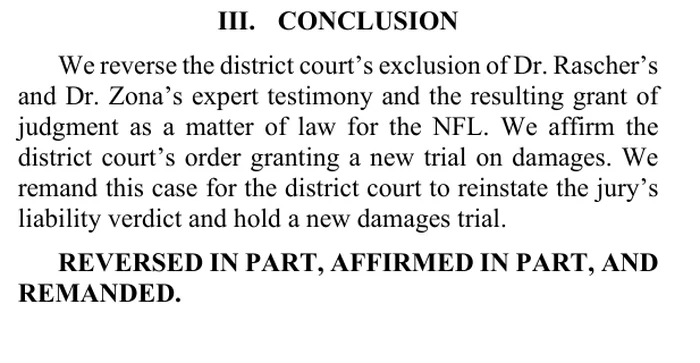
A federal appeals court has revived the finding that the NFL violated antitrust law through the historical distribution of Sunday Ticket, while leaving the amount it must pay unresolved. In an October 30, 2026 opinion, the Ninth U.S. Circuit Court of Appeals instructed a Los Angeles district court to reinstate the jury’s liability verdict and conduct a new trial on damages. The distinction matters for subscribers: the decision does not restore the roughly $4.7 billion award as an amount ready for payment.
The appeal concerns the paid package of Sunday games unavailable in a subscriber’s local television market. Residential customers and commercial establishments challenged agreements that pooled teams’ telecast rights and made the out-of-market bundle exclusive to DirecTV. Their case alleged that the arrangements restricted competition and caused them to pay more than they would have in a competitive market. The opinion identifies the class period as June 2011 through February 2023.
A jury found for the subscribers in 2024. U.S. District Judge Philip S. Gutierrez subsequently excluded testimony from two of their economic experts and entered judgment for the NFL. He also made a conditional ruling: if that judgment were overturned, there should be a new damages trial because the jury’s award did not follow the evidence properly. Friday’s appellate decision overturned the first ruling and upheld the second.
Judge Anthony D. Johnstone wrote the opinion for a panel that also included Circuit Judge Holly A. Thomas and visiting District Judge Joan H. Lefkow. The panel concluded that Gutierrez had gone beyond the permissible assessment of expert reliability when he excluded the testimony. Restoring that evidence removed the basis for the judgment that had displaced the jury’s finding of liability.
Reuters independently reported the outcome and the league’s response. The NFL said it was disappointed and was considering further court review, while defending its television distribution approach. That response indicates the league continues to contest the result; it is not an announcement of a settlement or a payment program. The court’s operative instruction is a return to the district court for further proceedings.
Sources: Ninth Circuit — full October 30 opinion, Nos. 24-5493 and 24-5691 ↗ · Reuters — appellate outcome and NFL response ↗ · Associated Press — independent account of the revived liability verdict ↗
Why the broadcast agreements and economic models matter
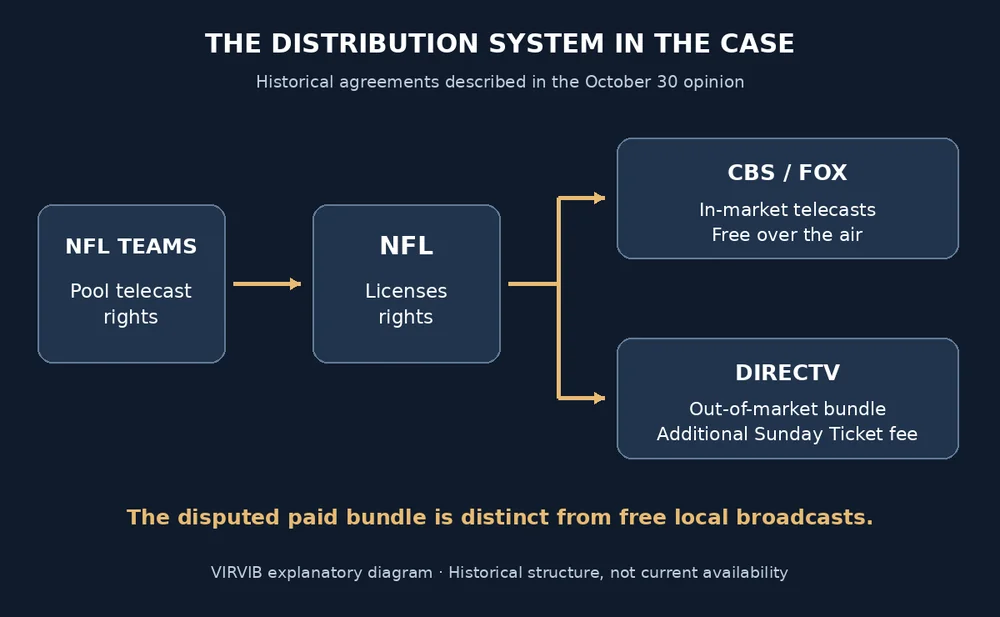
The dispute is about how rights were sold, rather than whether a football game took place or whether a particular subscriber watched it. As the opinion explains, the NFL’s teams pooled their telecast rights under league control. Separate agreements supplied CBS and Fox with in-market games and DirecTV with the out-of-market package. Sunday Ticket purchasers paid an additional charge above their regular satellite television subscriptions.
That structure created different experiences for different fans. A game carried by the local CBS or Fox affiliate could be available free over the air. A fan living beyond the market where a preferred team’s game was shown might need the paid package to watch it. The plaintiffs’ theory was that the interlocking agreements reduced distribution choices and maintained prices above a competitive level. The case did not turn simply on the existence of a subscription fee.
Congress’s Sports Broadcasting Act is important to that distinction. The Ninth Circuit explained that the statute protects joint sales of rights for advertising-supported, free over-the-air broadcasts. Its precedent does not extend that exemption to league contracts for cable or satellite services for which subscribers pay a fee. The opinion therefore treats the protected local broadcasts and the challenged paid bundle as legally distinct parts of the distribution structure.
Proving that subscribers were overcharged required a comparison with a market that did not actually exist: one without the challenged conduct. Economist Daniel Rascher used college football telecasts as a yardstick for how a more competitive distribution system might work. Economist Douglas Zona examined direct-to-consumer competition and a separate model addressing a premium allegedly imposed to protect local broadcast audiences. These were models offered as evidence, not alternative subscription plans ordered into operation by the court.
Gutierrez had questioned the comparison between college and professional football, the feasibility of hypothetical competitors and aspects of the predicted consumer behavior. The appeals court held that the experts had sufficient foundations for their testimony to be admitted. Differences between markets and disagreements over conclusions could be tested through cross-examination and weighed by jurors. The panel did not say that every assumption was beyond criticism or that any economic prediction should automatically be accepted.
This is the central procedural issue behind the reversal. Federal Rule of Evidence 702 requires a judge to examine whether expert testimony rests on reliable methods and sufficient information. The panel said that responsibility does not allow a judge to take over the jury’s task of weighing otherwise admissible evidence. In this case, excluding the economic testimony had eliminated the subscribers’ ability to prove their injury; reversing those exclusions restored the foundation for the liability verdict.
Sources: Ninth Circuit — full October 30 opinion, Nos. 24-5493 and 24-5691 ↗ · U.S. Courts — Federal Rules of Evidence ↗
Why the $4.7 billion award still needs a new trial
The subscribers’ success on liability did not cure the separate problem with the jury’s arithmetic. The appellate opinion records awards of approximately $4.61 billion to the residential class and $96.9 million to the commercial class. It upheld the district court’s conclusion that the calculation behind those awards did not measure the overcharge the jury had been instructed to determine.
The judges focused on a $191.26 figure. That was the difference between a $294 residential list price for the 2018 and 2019 seasons and an expert’s disputed estimate of $102.74 as the average price actually paid. The district court inferred that the jury had used that difference to calculate the awards. The appeals court accepted that inference and agreed that it exposed a fundamental problem.
A list price minus a lower actual price measures a discount from the advertised price. It does not establish how much extra a customer paid because of unlawful conduct. The required comparison was between the price subscribers actually paid and the price they would have paid without the anticompetitive arrangements. The opinion also explained that using residential prices did not account for the substantially different amounts paid by commercial establishments.
The new trial must therefore address the amount of damages supported by the evidence. The opinion does not supply a replacement total, set a date for distributing money or direct a new retail price for Sunday Ticket. It also does not announce a mechanism through which an individual customer can immediately collect a refund. Claims about checks being available now would go beyond what the court decided.
There are further procedural questions beyond the headline dollar figure. In a footnote discussing a companion disposition, the opinion says the court affirmed certification of the damages classes. It also returned to the district court the question of whether classes seeking injunctive relief should remain certified now that the NFL–DirecTV agreement has expired. An expired historical agreement and the availability of prospective relief require separate consideration; the liability ruling alone does not resolve every question about future distribution.
VIRVIB’s reading of the ruling is that subscribers have regained a significant legal finding while the financial consequences remain unsettled. The next consequential developments are any further review the league pursues and the district court’s handling of the damages proceedings. Those decisions, rather than the original award’s reappearance in a headline, will determine what compensation is ultimately established.
Sources: Ninth Circuit — full October 30 opinion, Nos. 24-5493 and 24-5691 ↗ · Associated Press — independent account of the revived liability verdict ↗
Why this story is in the editionGoogle Trends U.S. RSS reviewed October 31 at approximately 03:06 UTC. Its current topics included Lakers, Luka Doncic and other NBA searches. Sunday Ticket was selected independently for the verified sports-business ruling, not represented as a listed trending query. No ranking, search volume or growth claim is made.
Prepared with AI assistance. Source-based reporting checked on 2026-10-31. This article does not update automatically. Read our editorial standards.