Roblox Q3 2026 earnings: why revenue and bookings diverged
Roblox reported higher third-quarter revenue on October 29, 2026, even as bookings and two major measures of platform usage fell from a year earlier. Revenue reached $1.572 billion, up 16%, while bookings declined 12% to $1.697 billion. The results cover the three months ended September 30. The central question is how a gaming platform can record revenue growth while the spending activity feeding its business moves in the opposite direction.
The answer begins with accounting timing. Roblox defines bookings as sales activity during a period, with substantially all bookings coming from sales of virtual currency. Revenue follows a different timetable: the company recognizes much of that activity later, as virtual items are consumed or remain available to users. Roblox said the vast majority of third-quarter bookings would be recognized over an estimated paying-user lifetime of 27 months. That means the revenue reported today includes the effects of purchases made in earlier periods.
VIRVIB analysis: the distinction makes both numbers necessary. Revenue describes the business under generally accepted accounting principles, while bookings provide a more immediate view of sales activity. Higher revenue does not erase a decline in current bookings, and lower bookings do not mean that recognized revenue must fall in the same quarter. The company's reconciliation shows $136 million added through the change in deferred revenue, offset by $11 million of other adjustments, bridging the $1.572 billion revenue figure to $1.697 billion in bookings.
Profitability also requires a precise label. Roblox's consolidated net loss narrowed to $230 million from $258 million a year earlier. The loss attributable to common stockholders was $227 million, or 32 cents a share, compared with $256 million, or 37 cents a share. Those are related but distinct measures. Independent coverage in The Wall Street Journal corroborated the narrower shareholder loss, higher revenue and lower bookings; the detailed figures and accounting explanation here come from Roblox's published financial materials.
Cash generation provides another view rather than a replacement for the loss figures. Operating cash flow was $395 million, below $546 million in the comparable 2025 quarter. Free cash flow, the company's non-GAAP measure after specified capital spending, was $364 million, down from $443 million. Roblox said some capital expenditures shifted into the fourth quarter. That timing matters: a positive third-quarter cash figure cannot, by itself, establish that investment needs have permanently fallen or that the company has reached accounting profitability.
Sources: Roblox investor relations — October 29 results and original materials ↗ · Roblox Q3 2026 shareholder letter — results, metric definitions and Q4 guidance ↗ · Roblox Q3 2026 investor data sheet — historical financial and operating figures ↗ · Roblox Q3 2026 supplemental materials ↗ · The Wall Street Journal — independent coverage of the October 29 results ↗ · Business Wire — Roblox October 29 results announcement ↗
Usage recovered from Q2 but remained below the 2025 comparison
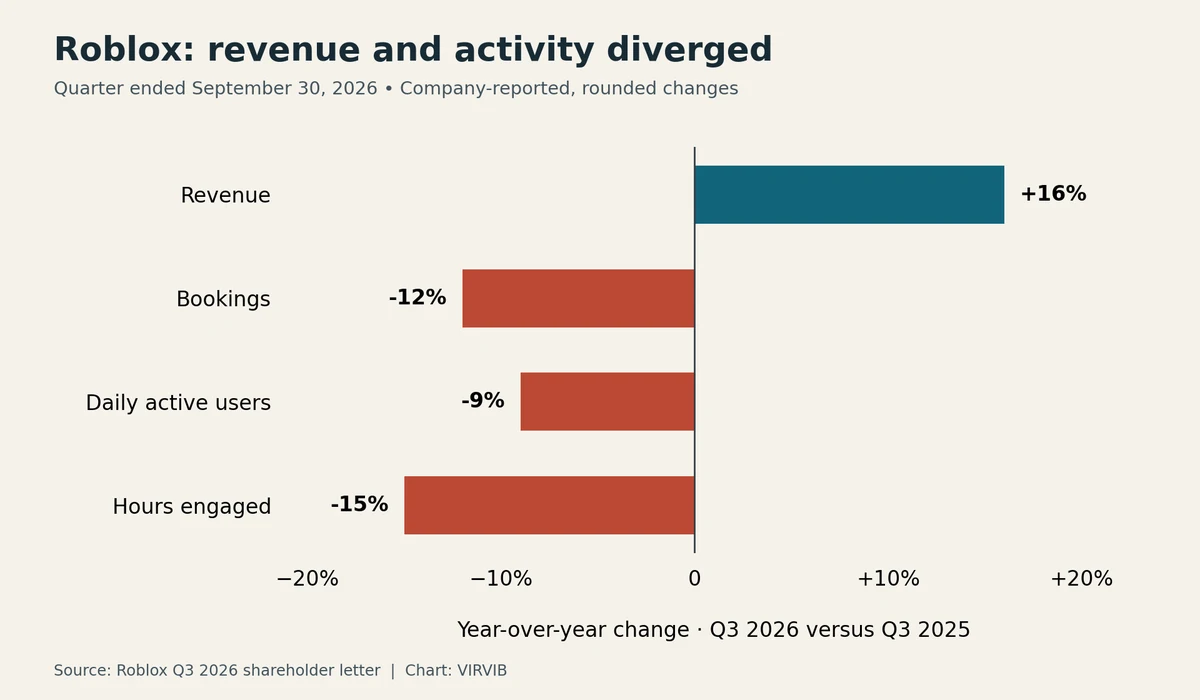
Roblox reported 138 million daily active users in the third quarter, down 9% from the same period in 2025. Hours engaged were nearly 34 billion, down 15% year over year. Those declines describe a different comparison from the sequential recovery emphasized near the beginning of the shareholder letter: daily active users increased 12% from the second quarter, and hours increased 17%. All four percentages can be true because they use different starting periods.
The accompanying chart keeps that distinction visible. It compares the annual changes in revenue, bookings, daily active users and hours engaged, using the rounded percentages published by Roblox. It does not combine dollars, users and hours into a single total or treat one measure as a substitute for another. The sequential improvements belong in the text alongside those annual comparisons, rather than being mixed into the same series without explanation.
Management described the annual declines as comparisons against unusually strong growth in 2025. Its longer comparison showed daily active users up 55% and hours engaged up 63% from two years earlier, with bookings more than 50% above that earlier period. These are company-reported comparisons, not independent evidence that the recent annual decline is harmless. They show that the platform remained substantially larger than in 2024 while leaving open how quickly it can return to sustained annual growth.
Paying activity adds a useful distinction between audience size and spending. Average monthly unique payers totaled 30 million, down 16% year over year, while average bookings per monthly unique payer increased 5%. Roblox also reported global bookings per hour up approximately 4%. A smaller paying group spending more on average can produce a different business result from a larger group spending less. These measures help explain why an engagement headline alone cannot describe the entire quarter.
VIRVIB analysis: the results therefore pose two separate tests. One is whether the recovery from the second quarter continues; the other is whether annual comparisons improve. A sequential rebound is evidence of a change within 2026, but it does not reverse the documented annual declines. Nor do higher average spending measures establish that all user groups are behaving alike. Roblox's totals describe a platform with different markets, ages and experiences, and the aggregate figures should not be turned into unsupported claims about individual players.
For readers following RBLX stock, this distinction is more useful than an unverified claim about a share-price reaction. This article reports the operating results and management's outlook, without asserting a live market move, an analyst consensus or an investment recommendation. The Google Trends U.S. feed included “rblx stock” during this research check; that establishes a timely search-interest signal, not a national search ranking or a measured search-volume claim.
Sources: Roblox Q3 2026 shareholder letter — results, metric definitions and Q4 guidance ↗ · Roblox Q3 2026 investor data sheet — historical financial and operating figures ↗ · Roblox Q3 2026 supplemental materials ↗ · Google Trends — U.S. trending-search RSS checked October 29 ↗
The holiday outlook and the next test for Roblox’s AI plans
Roblox's fourth-quarter guidance continues the split between recognized revenue and current bookings. Management forecast revenue of $1.470 billion to $1.580 billion, representing annual growth of 4% to 12%, and bookings of $1.890 billion to $2.000 billion, a decline of 10% to 15%. These are forecasts issued October 29, not completed holiday-quarter results. The company said its revenue outlook includes recognition of earlier bookings, particularly the elevated sales activity recorded during 2025.
The cash outlook also makes the spending timetable concrete. Roblox forecast fourth-quarter operating cash flow of $190 million to $275 million, alongside negative free cash flow of $190 million to $105 million. Its guidance includes $380 million in capital expenditures and purchases of intangible assets, incorporating the shift from the third quarter. The projected cash outflow should be read with that explanation, rather than presented as an unexplained contradiction of the positive third-quarter cash figure.
Against that financial backdrop, Roblox is describing a broader expansion in how games are made and distributed. The company said its prompt-to-game tool, Build, had attracted more than 500,000 users and produced more than 70,000 published games during an alpha release in New Zealand, Singapore, Serbia and Thailand. Those are internal company measurements from a limited rollout. They do not establish worldwide availability, independent quality assessments or the eventual commercial success of the games created.
Roblox Everywhere is a separate distribution initiative. Management said creators would be able to publish standalone games through app stores of their choice while using Roblox services, and it expects an initial phase involving selected top games in the first half of 2027. The proposed Universal Player goes further, envisioning AI-assisted imports of existing games into Roblox's cloud platform. That is a development ambition described by the company, not a verified ability to bring every console, PC or mobile game onto Roblox today.
VIRVIB analysis: easier creation and wider distribution address different constraints. Creation tools may reduce the effort required to produce a game; distribution tools may help a creator reach an audience elsewhere. Neither automatically demonstrates durable engagement, paying demand or favorable economics. The relevant evidence will be the actual rollout, the games and audiences it reaches, and later operating results. Announced capabilities should remain separate from delivered capabilities when judging this strategy.
The quarter leaves a clear, mixed record: revenue grew, annual bookings and usage declined, and usage improved from the preceding quarter. Management is forecasting another annual bookings decline during the holiday period while investing in a larger platform vision. The next substantive checkpoints are the fourth-quarter results and the promised product rollouts. Until those arrive, the strongest reading of Roblox's October 29 report keeps its recorded results, accounting timing and forward-looking ambitions distinct.
Sources: Roblox Q3 2026 shareholder letter — results, metric definitions and Q4 guidance ↗ · Roblox Q3 2026 investor data sheet — historical financial and operating figures ↗ · Roblox Q3 2026 supplemental materials ↗
Why this story is in the editionThe fresh Google Trends U.S. RSS check on October 29 included “rblx stock”, with an entry dated 13:40 PDT. This is a selection signal; no national ranking or search-volume claim is made.
Prepared with AI assistance. Source-based reporting checked on 2026-10-29. This article does not update automatically. Read our editorial standards.