Packers 27, Panthers 19: Love supplies the scoring, defense closes the door
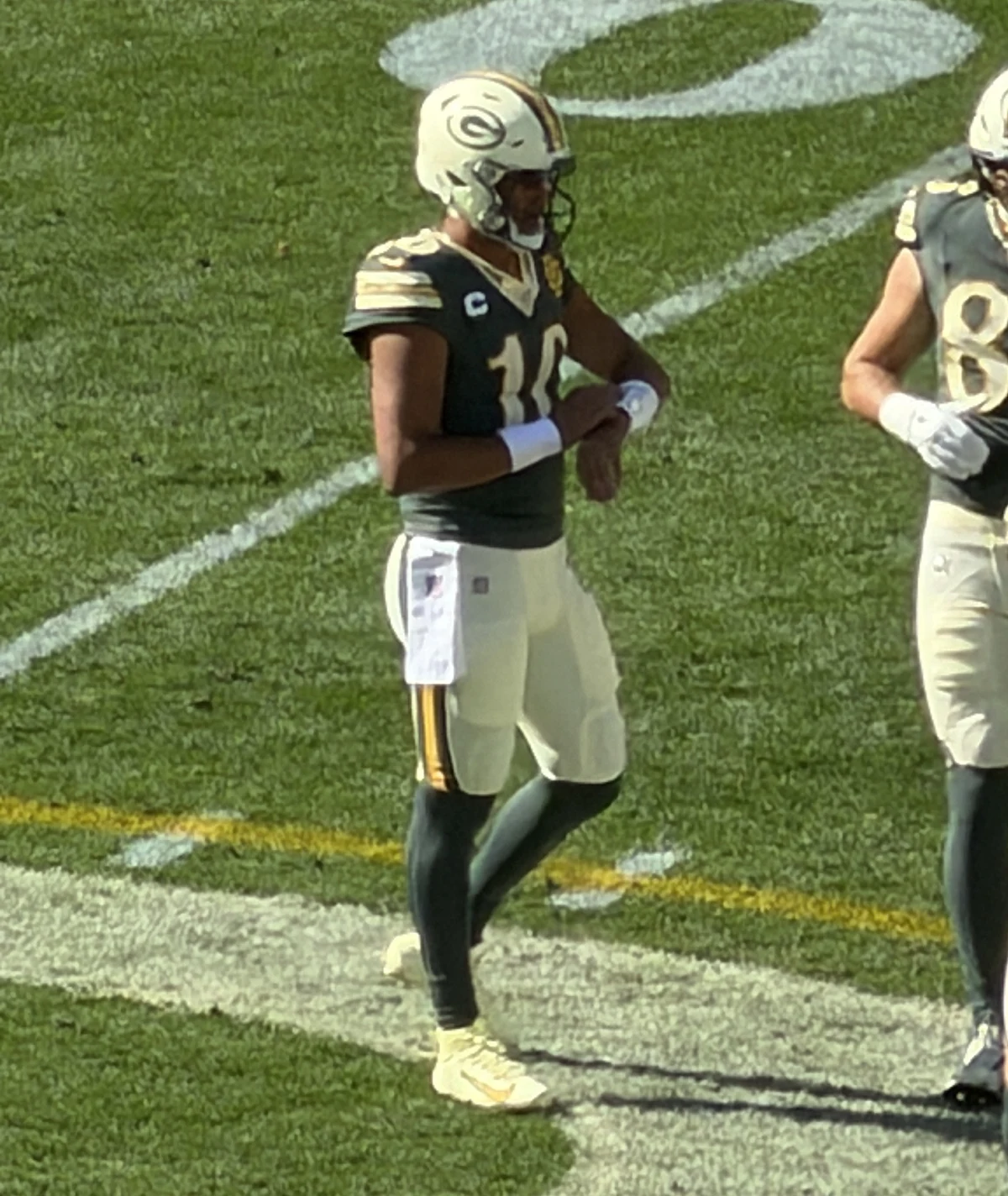
The Green Bay Packers beat the Carolina Panthers 27–19 at Lambeau Field on Thursday, October 29, 2026, with Jordan Love throwing three touchdown passes and the defense repeatedly disrupting Bryce Young. Green Bay improved to 5–3; Carolina fell to 3–4. The final margin was eight points, but the route there involved an early Carolina lead, a 17-point Packers advantage and a fourth-quarter challenge that Green Bay had to survive.
The aftermath brought a significant change for Carolina. On Friday, October 30, the Panthers announced that head coach Dave Canales had parted ways with defensive coordinator Ejiro Evero and defensive passing game coordinator Jonathan Cooley. Defensive line coach Todd Wash becomes interim defensive coordinator and will call the defensive plays. This report has been updated to include that announcement; the game result and original publication date remain unchanged.
Love’s touchdown passes went to Tucker Kraft, Matthew Golden and Josh Jacobs. Jacobs also scored on the ground. Those four touchdowns were enough to overcome three Green Bay turnovers and a missed extra point, although the mistakes helped keep the outcome unresolved late. The result was a recovery from the Packers’ 20–17 loss at Detroit four days earlier, rather than a clean performance across all three phases.
Carolina’s best late opening came after Jalen Coker’s 26-yard touchdown reception on fourth-and-three with 5:37 remaining. The attempted two-point conversion failed, preserving an eight-point gap. The Panthers subsequently had possession near midfield, but their fourth-down pass did not produce the conversion they needed. Their final possession began with just 22 seconds and no timeouts. Green Bay had created enough separation earlier to withstand that last attempt.
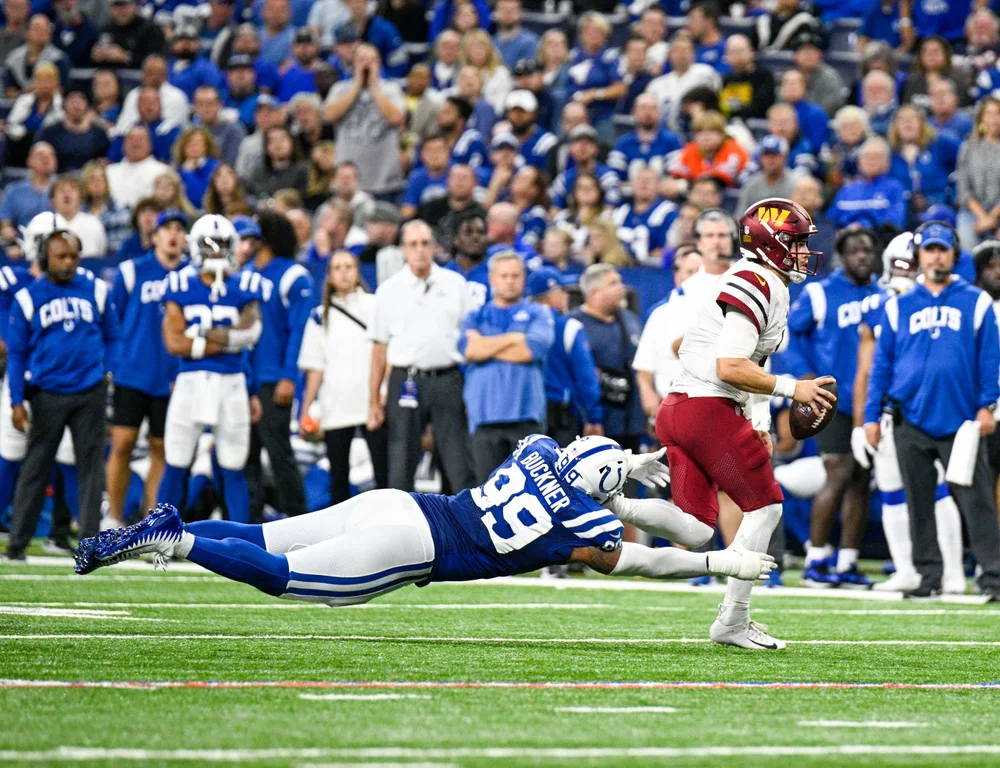
The passing statistics show how differently the quarterbacks experienced the same number of attempts. ESPN’s final box score records Love completing 30 of 41 for 288 yards, three touchdowns and one interception, without taking a sack. Young completed 23 of 41 for 209 yards, one touchdown and one interception, and was sacked six times for 33 lost yards. Those sack losses help explain why Carolina’s net passing output was lower than Young’s individual passing-yard total.
VIRVIB analysis: this was a win built around two complementary advantages, successful passing and defensive pressure. Calling it simply an offensive shootout would miss the significance of Carolina’s stalled possessions. Calling it a comfortable victory would overlook how the Packers’ errors gave the visitors further chances. Green Bay’s strongest work established the lead; its defense then protected what remained of it.
Sources: Packers — official final report and scoring chronology ↗ · ESPN — final game statistics, original data feed ↗ · Associated Press via Times Union — independent final recap ↗ · Panthers — October 30 official defensive coaching announcement ↗ · Pro Football Rumors — independent coaching-change and season-context report, October 30 ↗
Why Jacobs’s two touchdowns do not mean the running game is fixed
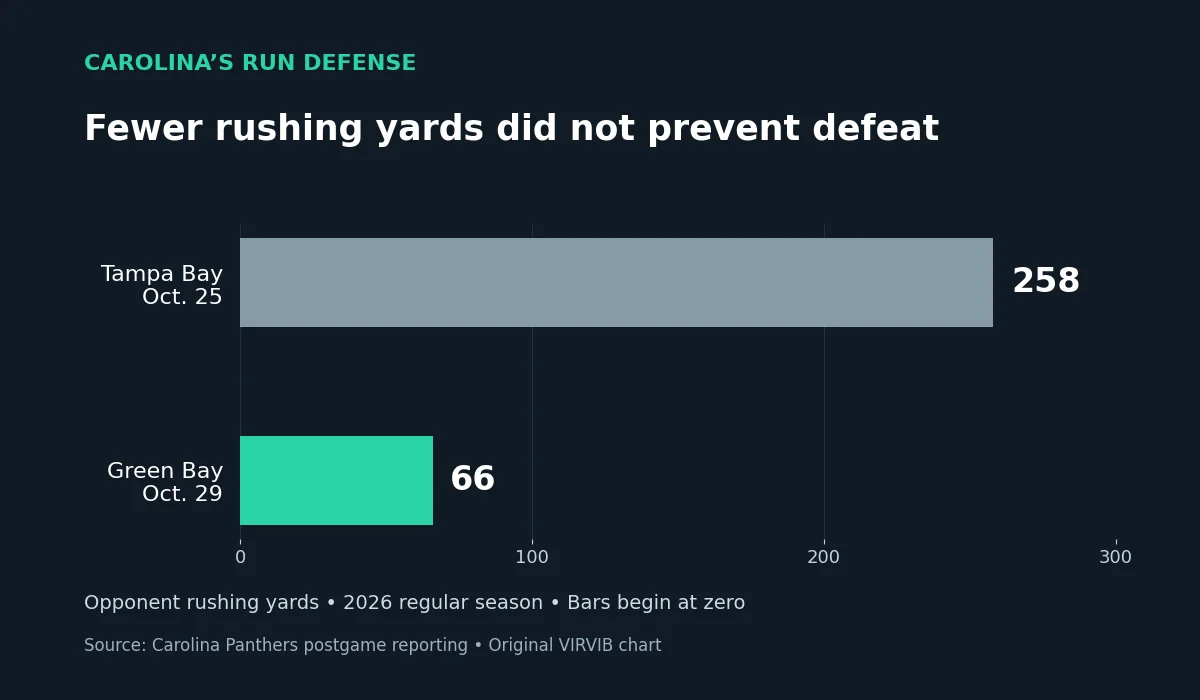
Before kickoff, the Packers’ own preview identified the ground game and finishing drives as problems requiring attention. The team had managed only 57 rushing yards against Dallas two games earlier, and the preview noted that Carolina had surrendered 258 rushing yards to Tampa Bay the previous weekend. That made Thursday an obvious test of whether Green Bay could improve against a defense that had recently been vulnerable on the ground.
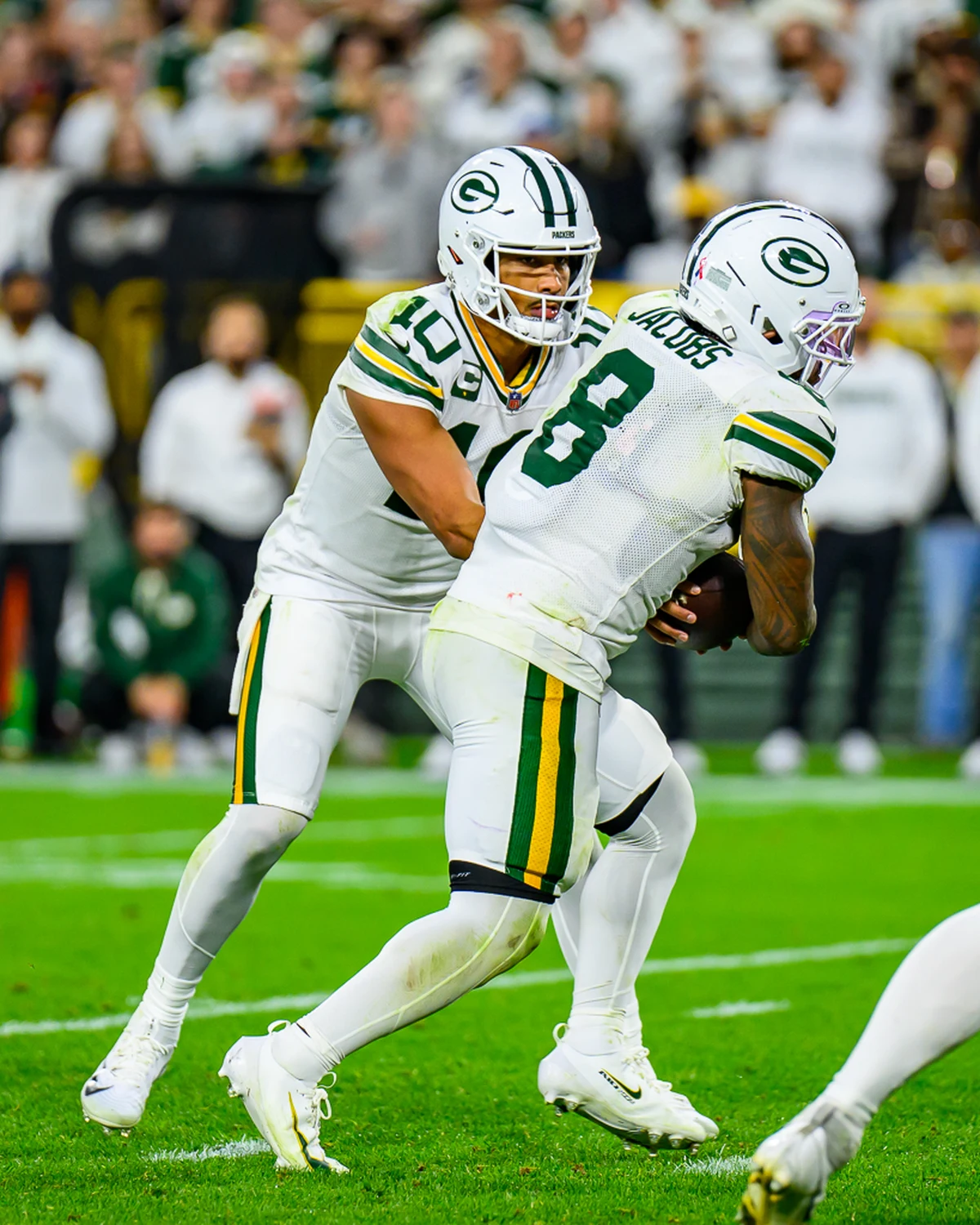
Jacobs’s two scores gave the Packers valuable production, but his rushing line was 21 carries for 39 yards. Green Bay finished with 66 rushing yards overall. His receiving touchdown illustrates why scoring contribution and rushing efficiency should be considered separately: a running back can decide important plays without his team consistently moving the ball through handoffs. A touchdown count alone cannot describe how reliably an offense gains ordinary first downs.
ESPN’s receiving totals also show the breadth of Love’s support. Christian Watson caught eight passes for 113 yards, Golden had seven receptions for 79 yards, and Kraft added six for 53. The ball therefore reached several productive targets rather than relying on one receiver to finish every possession. That distribution mattered on a night when Watson temporarily left the game for hospital testing before returning.
VIRVIB analysis: the contrast between productive passing and limited rushing explains why the victory offers both encouragement and work to do. Passing can create a lead quickly, but protecting a lead still requires converting enough possessions to keep the opponent from getting repeated opportunities. Green Bay’s late difficulty ending the game is more informative about that remaining task than the mere fact that a running back scored twice.
The pregame questions were also about consistency. Green Bay had entered Thursday after a narrow loss in Detroit; Carolina was coming off a 43–13 defeat to Tampa Bay. Thursday reversed the Packers’ immediate result while extending the Panthers’ losing run to two games. It did not erase the problems that had brought each team into the short week.
For Green Bay, the next useful comparison is whether its passing success can be accompanied by steadier early-down rushing and fewer possessions surrendered through mistakes. For Carolina, the relevant question is how to prevent an opponent from separating before its own offense finds a late response. These are conclusions drawn from the verified game record, not predictions that either team will necessarily repeat this performance.
Sources: ESPN — final game statistics, original data feed ↗ · Packers — pregame questions about rushing and finishing drives ↗ · Panthers — official 2026 schedule ↗ · Packers — official 2026 schedule ↗
Carolina changes its defensive staff, with injuries and protection still unresolved
Carolina’s Friday announcement changes who will lead the response to this defeat. Wash, who joined the Panthers in 2023, takes over the defensive play-calling role on an interim basis. Outside linebackers coach and run game specialist AC Carter adds responsibility for the defensive line. Renaldo Hill continues overseeing the defensive backs. Those are the assignments the club has confirmed; the announcement does not name a permanent successor to Evero.
Wash brings previous experience in the same job. He coordinated Jacksonville’s defense from 2016 through 2020, including the 2017 season when the Jaguars ranked second in total defense and reached the AFC Championship Game. His appointment therefore puts an experienced coordinator in charge of the immediate transition. That history does not establish what scheme changes he will make in Carolina, and the club’s initial notice provides no detailed plan for altering coverages or personnel.
Independent reporting from Pro Football Rumors places the decision in a wider season context: Carolina was 30th in rushing defense and had allowed the fifth-most points per game through seven games. The same report notes ninth place in passing yards allowed and ten takeaways. Those different measures describe a mixed defensive record; none is a complete explanation for the dismissals. The official announcement confirms the decisions without offering a detailed evaluation of either departing coach.
Thursday itself shows why a single number can be misleading. Carolina held Green Bay to 66 rushing yards after allowing Tampa Bay 258 four days earlier. But the Packers converted nine of 16 third downs, according to the Panthers’ postgame defensive report. The improvement against the run did not prevent Love from sustaining possessions through the air. VIRVIB analysis: Wash inherits a defense whose immediate problem cannot be reduced to repeating the previous opponent’s rushing total. Getting off the field after successful early downs will matter too.
The personnel available to do that remains a concern. Rookie cornerback Will Lee III suffered a hamstring injury and did not return Thursday. The Panthers had already placed Akayleb Evans on injured reserve that day, while Jaycee Horn and Mike Jackson were also on injured reserve. The club’s postgame account described the resulting shortage in the secondary. A coaching change does not itself establish a return date for an injured player; subsequent practice reports and roster decisions will determine who can play.
Watson’s status also changed during the game. The Packers reported that he went to a local hospital for testing after a chest injury and subsequently returned to play. Carolina’s recap corroborated the visit and second-half return. His eight catches for 113 yards describe his contribution to this victory, without supplying a medical prognosis for the following week.
Carolina’s offense has work of its own. WBTV documented Young’s six sacks and the failure to capitalize sufficiently on Green Bay’s turnovers. Hubbard contributed 81 rushing yards and a touchdown on 22 carries, plus seven receptions for 38 yards. Those individual gains did not overcome the disrupted drives. VIRVIB analysis: appointing a new defensive play-caller addresses one part of the organization, while the protection problems remain a separate task for the offense.
Both teams next play on Sunday, November 8. Carolina’s official schedule lists a home game against Denver at 1 p.m. Eastern; Green Bay’s lists a visit to New England at 4:25 p.m. Eastern. The longer interval after Thursday gives the Panthers time to implement Wash’s assignments before their next game. The useful evidence to watch is concrete: confirmed staff responsibilities, injury reports and the defense’s performance under its interim coordinator. The Friday decision is established; its effect on results is still to be tested.
Sources: Packers — official final report and scoring chronology ↗ · ESPN — final game statistics, original data feed ↗ · Panthers — official final recap and injury updates ↗ · Panthers — October 29 injured-reserve and roster moves ↗ · WBTV — independent reporting on Carolina’s defeat and protection problems ↗ · Panthers — official 2026 schedule ↗ · Packers — official 2026 schedule ↗ · Panthers — October 30 official defensive coaching announcement ↗ · Pro Football Rumors — independent coaching-change and season-context report, October 30 ↗ · Panthers — October 30 defensive game analysis and third-down figures ↗
Why this story is in the editionGoogle Trends U.S. Trending Now reviewed October 30, 2026 included Ejiro Evero and Packers vs Panthers. The official coaching announcement supplies the substantive reason to update this existing game report. No search ranking or volume claim is made.
Prepared with AI assistance. Source-based reporting checked on 2026-10-30. This article does not update automatically. Read our editorial standards.