New NFL CTE study estimates a burden among deceased players
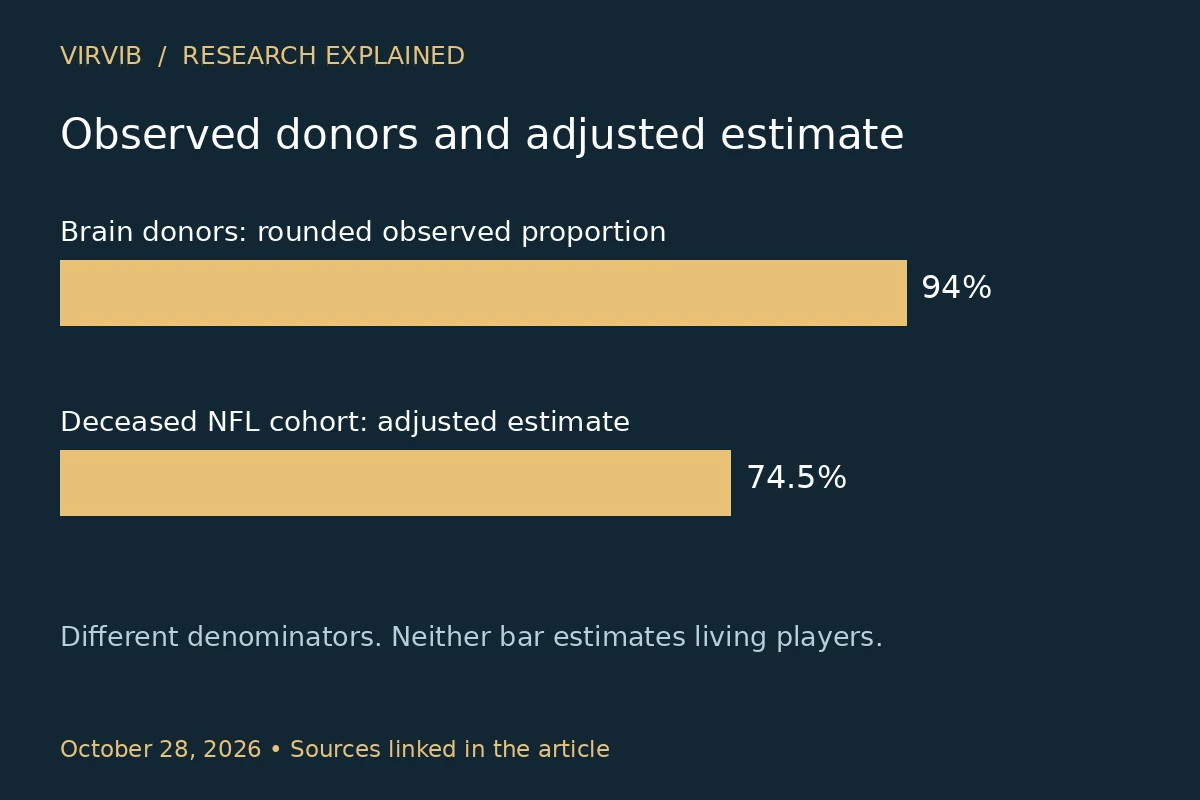
A study released on October 28, 2026, estimates that 74.5% of former NFL players who died between 2008 and 2023 had chronic traumatic encephalopathy neuropathology. That is a statistical estimate for a defined deceased population. It is not a diagnosis of three out of four current players, and it does not establish that three out of four youth football players will develop the disease.
The distinction is the story. The research, published in JAMA Network Open, tries to address a longstanding problem: brains donated for examination may not represent everyone who played professional football. Families who observed cognitive problems may be more motivated to donate. A high disease proportion in that selected group therefore cannot simply be applied to all players.
The Boston University research release, distributed by Medical Xpress, describes 2,362 deceased former NFL players in the population examined. Among 387 brain donors, 362 had some degree of CTE neuropathology. Researchers used death-certificate information and factors including cognitive symptoms, age, position and years played to investigate donation patterns. Their analysis estimated that players with cognitive symptoms were about five times more likely to have their brains donated. Adjusting for that selection produced the 74.5% estimate.
The journal’s announcement characterizes the research as cross-sectional. It says selection bias substantially raises donor-based prevalence figures but is unlikely to explain away the population’s high burden of CTE pathology. It also says more research is needed to understand the clinical impact. Those qualifications belong beside the headline number rather than buried beneath it.
VIRVIB analysis: observing disease in donated tissue and estimating disease among people whose tissue was not examined are different kinds of evidence. The adjustment makes the finding more informative, but it does not turn unexamined brains into directly confirmed cases. Readers should ask which population a percentage describes, whether it comes from observation or modeling, and what assumptions connect the two. A headline that drops “deceased” or “estimates” changes the meaning of this study.
The term “cte” appeared in the Google Trends U.S. trending-search RSS feed checked on October 28. That provided a timely reader-interest signal alongside the research release. It does not establish a national number-one ranking, and this article makes no claim about total searches or which audience generated them.
Sources: JAMA Network — October 28 study announcement ↗ · Boston University research release via Medical Xpress — methods and findings ↗ · Google Trends — U.S. trending-search feed, checked October 28 ↗
Why the new estimate differs from the earlier CTE figures
Boston University’s August 25 account described an earlier study of 1,712 former NFL players who died between 2016 and 2021, including 338 brain donors. It reported CTE in 93.2% of donated brains and a possible prevalence range of 24.5% to 97.7% for the wider deceased group. The university identified uncertainty about the relationship between donors and the whole population as central to interpreting the result.
The October work aims to narrow the uncertainty by studying selection into brain donation. Its population also covers a longer period. An August minimum near one quarter and an October estimate near three quarters should therefore not be read as evidence that the disease rate tripled in two months. They come from different analyses and different time windows, rather than repeated examinations showing a sudden change in the same people.
ABC News reported the new estimate and discussed donation bias with senior author Yorghos Tripodis. Its reporting also relayed the researchers’ caution that the findings need not represent living NFL players. That independent account supports the central distinction in the university release: the research estimates a burden after death, not an individual’s future outcome.
A numerical example helps explain selection without pretending to reproduce the study’s model. Imagine two groups with different reasons to volunteer for an examination. If people worried about symptoms volunteer more often, the resulting sample can contain a larger share of illness than the population from which it came. Correcting that imbalance requires evidence about participation, not merely a larger list of volunteers. This is an explanatory example, not a new calculation of CTE prevalence.
The earlier BU report also discussed the difficulty of diagnosing CTE during life and the importance of support for affected families. Its wide range was an expression of uncertainty. A narrower estimate can represent progress in measurement without eliminating uncertainty altogether. It would be equally misleading to dismiss all donated-brain evidence because selection exists or to ignore selection because the observed disease proportion is high.
VIRVIB analysis: the next useful questions concern the model’s assumptions, how results hold up under alternative assumptions and whether future research reaches similar conclusions in other groups. A deceased NFL cohort is not interchangeable with all retired athletes, college players or children. Exposure histories and the people included in a study matter. The responsible conclusion is that this research adds evidence about a specific population while leaving important questions open.
Sources: ABC News / Good Morning America — independent reporting and league response ↗ · Boston University — August 25 study and earlier prevalence range ↗
CTE pathology, symptoms and player safety are not the same measure
The CDC describes CTE as a brain disease associated with long-term exposure to repeated head impacts. Such impacts can occur without recognizable concussion symptoms. It says there is no strong evidence that an occasional hit or one or more concussions alone leads to CTE. This is why counting diagnosed concussions and measuring a lifetime of repeated impacts are related but different tasks.
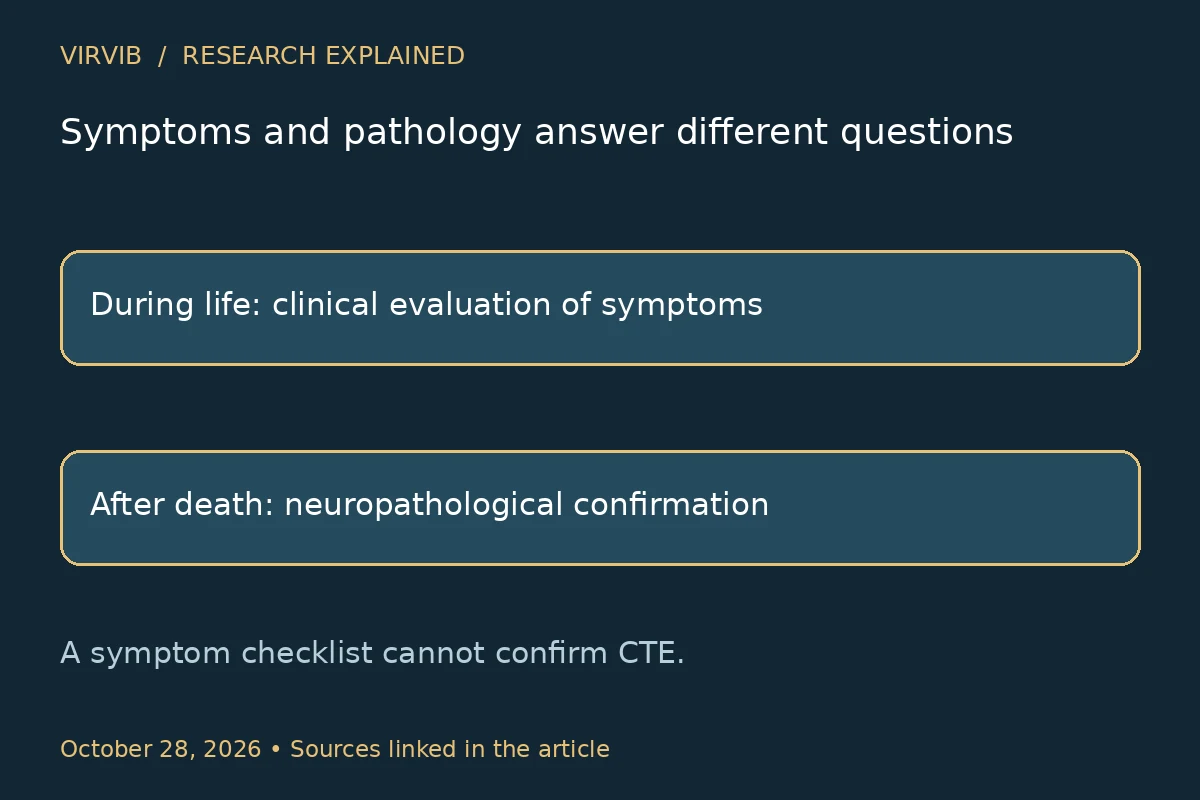
The CDC also says confirmation currently requires examination of the brain after death. Problems with thinking, mood or behavior do not by themselves establish CTE, and several diseases can coexist in a brain. A person experiencing symptoms can seek clinical assessment and treatment without first obtaining a CTE label. The uncertainty about the label should not be confused with an absence of care for the symptoms.
Research reported by NIH on January 27 offers another important distinction. Investigators analyzed 614 donated brains from people exposed to repeated head impacts, excluding several major competing neurodegenerative diseases. Severe CTE, stages III and IV, was associated with dementia risk. The analysis did not find a measurable association between stages I and II and impaired thinking or daily functioning. NIH also reported no association with mood and behavioral symptoms in that particular analysis.
That earlier study addresses clinical relationships, not the same prevalence question answered by the October analysis. Putting the studies together does not justify a claim that everyone with neuropathology had dementia, or that every difficult behavior in a former athlete was caused by CTE. A pathological finding, its severity and a person’s experiences during life require separate examination.
The published Neurology consensus criteria for traumatic encephalopathy syndrome were designed primarily to facilitate research. They call for substantial repetitive-head-impact exposure, specified clinical features, progression and exclusion of other explanations. Research criteria for a clinical syndrome should not be presented as a simple self-test proving the underlying pathology. They support systematic investigation while scientists work on better ways to detect disease in living people.
ABC News reported the NFL’s statement that it is working to reduce concussions and head impacts and expand health resources. It also reported the players’ union’s emphasis on safety and lifelong support. Those statements identify institutional positions. They do not demonstrate that a particular helmet, practice rule or equipment change prevents CTE; evaluating such claims requires its own evidence.
VIRVIB analysis: the October finding strengthens the case for asking precise questions about exposure, long-term health and support. It does not identify which living player has CTE, establish an individual prognosis or measure the effect of a current safety intervention. Future work on diagnosis during life and on the consequences of different stages will be crucial. For now, the documented development is a bias-adjusted estimate of a substantial disease burden among deceased former NFL players, with clear limits on what that number can tell anyone else.
Sources: ABC News / Good Morning America — independent reporting and league response ↗ · CDC — repeated head impacts and CTE ↗ · NIH — January 27 study distinguishing severe CTE and dementia ↗ · Neurology / PubMed — research criteria for traumatic encephalopathy syndrome ↗
Prepared with AI assistance. Source-based reporting checked on 2026-10-28. This article does not update automatically. Read our editorial standards.