Miyoko’s butter recall: which salted product to check
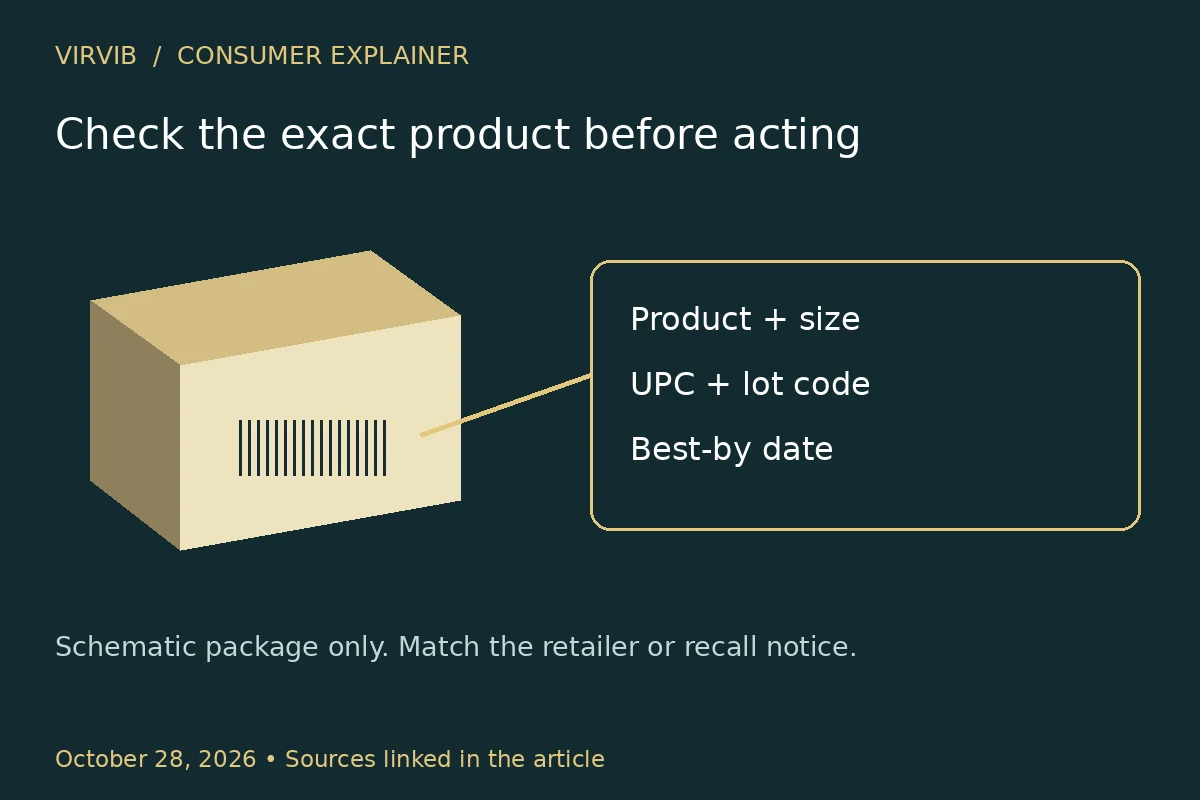
A specific batch of Miyoko’s Creamery European Style Salted Plant Milk Butter is the subject of renewed recall coverage on October 28, 2026. Consumers should compare the product name, package size, UPC, lot information and best-by date with the notice that applies to their purchase. The story concerns identified production, not a recall of every butter product or every item carrying the brand.
ABC7 reports that the action covers 1,304 cases of 8-ounce packages distributed by Prosperity Organic Foods Inc. of Boise, Idaho. Its account identifies UPC 857554005773, retail lot 07871 and a November 5, 2026 best-by date. The reported distribution includes Connecticut, Florida, Georgia, Iowa, Illinois, Indiana, Maryland, New Jersey, New Hampshire and Wisconsin. The stated concern is potential contamination involving yeast, mold and E. coli.
A direct retailer notice provides an additional way to check the story. Wegmans’ September 13 notice names the salted 8-ounce product, gives the same UPC with hyphens, 8-57554-00577-3, and lists lot code 1007871. It says the reason is potential E. coli and offers a full refund at its Service Desk. Sprouts’ notice also pairs the UPC with lot 1007871 and the November 5 date. Retail notices and news accounts may display the longer case code rather than the shorter retail-carton code.
That is a reason to keep the packaging and check carefully, rather than deciding that a longer code automatically rules the product out. Photograph the product name and all printed codes so a retailer can compare them with its notice. If the code is unreadable or the outer carton has been discarded, ask the seller to help identify the purchase. This is a practical verification step, not an expansion of the published recall to unrelated lots.
The broad term “butter” appeared in Google Trends’ U.S. trending-search view when checked on October 28, with related queries referring to recalled butter and Miyoko’s Creamery. That explains the timely consumer interest. It does not establish that every search concerned this specific batch, and this article does not describe the item as America’s number-one search.
VIRVIB analysis: the most useful answer is a product match, not a dramatic description of an entire refrigerator category. A photograph of an unbranded spread cannot identify a recalled item. The hero image here is expressly a generic archival photograph; the source notices supply the identifiers readers need.
Sources: ABC7 — salted-butter recall identifiers and reported classification ↗ · Wegmans — September 13 salted-butter recall and refund notice ↗ · Google Trends — U.S. trending searches, checked October 28 ↗ · Sprouts — retailer notice with matching UPC and November date ↗
Why September and October dates appear in the same story
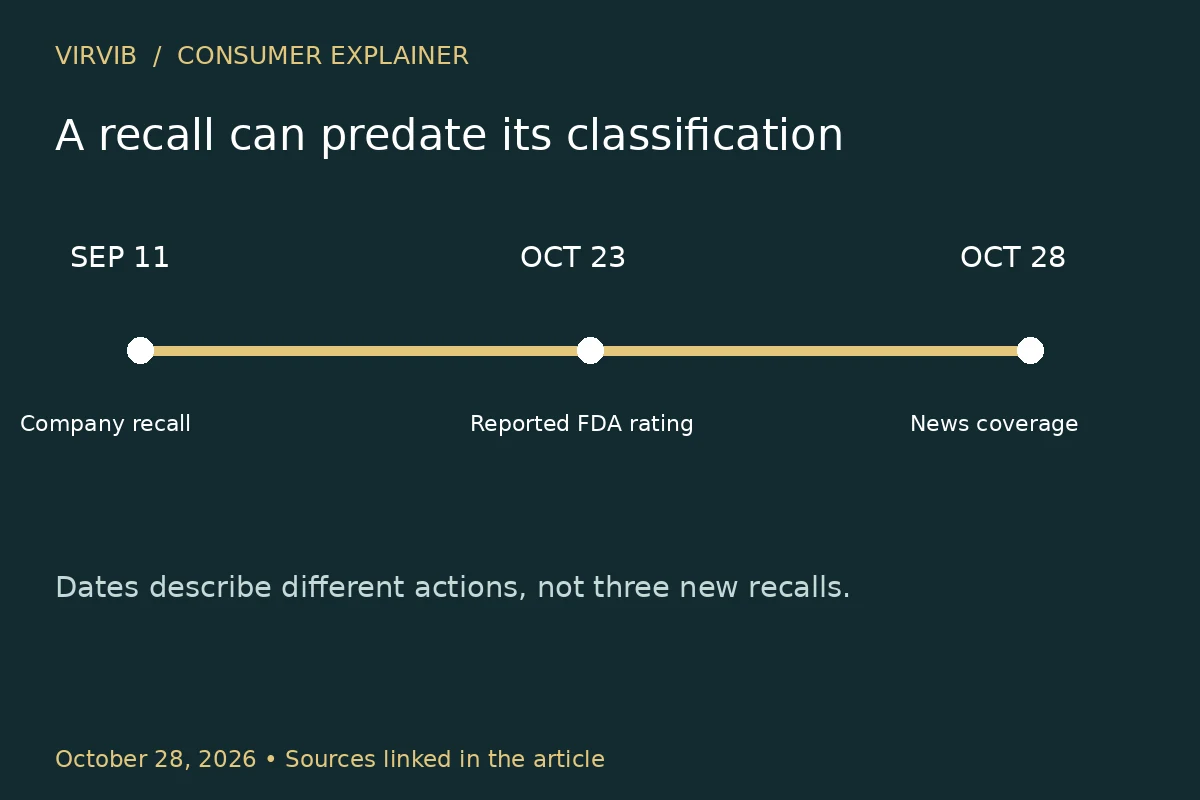
The chronology matters because a recall can become a new headline without beginning that morning. ABC7 reports that the company initiated the salted-butter action on September 11 and that the FDA classified it as Class II on October 23. Wegmans’ dated September notice independently establishes that customers were being alerted before the late-October coverage.
The FDA’s explanation of Enforcement Reports describes this sequence in general. Firms may start voluntary recalls and notify customers before the agency completes its hazard assessment. The classification and its appearance in an enforcement report should not, by themselves, be treated as an expansion or change to the firm’s earlier warning. The agency also tracks changes to classification, reasons, codes and product descriptions, which is why the date and type of update both matter.
Under the FDA’s definitions, Class II covers circumstances in which exposure may cause temporary or medically reversible health consequences, or in which the probability of serious consequences is remote. That is a regulatory risk category. It is not permission to eat a recalled item, proof that an individual will become ill or a measurement of how many customers have been affected. This article attributes the salted product’s reported Class II status to current news coverage; the FDA definition explains what the category means.
There is also a separate notice that readers should not merge with the salted-butter batch. Wedge Community Co-ops’ October 26 announcement concerns Miyoko Creamery Unsalted European-Style Plant Butter, 8 ounces. It lists UPC 857554005995, lot 1008243 and a November 27, 2026 best-by date. The retailer describes a voluntary withdrawal of one lot while mold complaints are investigated and directs customers to Wedge Lyndale or Linden Hills Customer Service for a full refund.
The words salted and unsalted, the different UPCs and the different November dates are essential. One notice does not automatically establish the scope, reason or regulatory classification of the other. The Wedge announcement uses the term withdrawal; this article preserves that description rather than assigning it the salted product’s reported FDA category.
VIRVIB analysis: compare the event, the source and the date together. A September retailer warning, an October classification and another product’s October withdrawal are distinct records. Combining their dates, state lists and codes can create a nonexistent larger recall. Keeping them separate makes the information more useful for a shopper standing in front of a refrigerator with one actual package to identify.
Sources: ABC7 — salted-butter recall identifiers and reported classification ↗ · Wegmans — September 13 salted-butter recall and refund notice ↗ · FDA — recall classifications and definitions ↗ · FDA — Enforcement Reports and classification timing ↗ · Wedge Community Co-ops — separate October 26 unsalted-butter withdrawal ↗
What to do with a matching package and how to check updates
FoodSafety.gov says a recall is specific to the identifying details in its notice. If those details match food in your possession, do not open or consume it. Follow the instructions for returning or disposing of it. For Wegmans customers with the matching salted product, the retailer explicitly offers a Service Desk refund. The separate Wedge notice provides its own return instructions for the identified unsalted lot.
The FDA’s food-recall guidance advises reading product-specific instructions before acting. It says recalled food should not be passed to another person, a food bank or a pet. If disposal is the appropriate option, contaminated food should be securely wrapped. Returning or discarding a package is different from assuming that removing a visibly affected portion makes the rest usable; the published recall instructions should guide the decision.
If recalled food has contacted a kitchen surface, the cleanup matters too. FoodSafety.gov explains that contaminated food can leave germs on utensils, countertops and refrigerator shelves or drawers. Its guidance calls for washing cookware and surfaces with hot soapy water and then using the specified sanitizing procedure. The linked government instructions provide the details. This article does not invent a product-specific cleaning method or recommend mixing household chemicals.
Consumers who believe a recalled food made them ill should contact a health-care provider, according to the FDA. Its product-recall guidance also provides a route for reporting product issues to the agency and the company. Keep identifying information available when seeking help: a product name without a lot or date may be insufficient to determine which item was used. Symptoms alone cannot establish that this butter was their cause.
There are limits to what the records reviewed here establish. The news coverage describes a contamination concern and a defined quantity of cases. The retailer notices establish their stated product identifiers and customer instructions. They do not supply a verified count of illnesses attributable to the batch, identify a particular bacterial strain in this article or demonstrate that all packages from the brand are unsafe. Those claims would require additional evidence.
VIRVIB analysis: a useful next update would document a change in the affected codes, distribution, official status or consumer instructions. A new headline repeating the same details is not necessarily a new development. Before deciding that an item has been cleared or that a recall has widened, look for the actual revised notice. For now, the practical task is to match the package to the appropriate salted or unsalted notice, follow the seller’s return or disposal instructions and keep the distinct dates and codes intact.
Sources: Wegmans — September 13 salted-butter recall and refund notice ↗ · Wedge Community Co-ops — separate October 26 unsalted-butter withdrawal ↗ · FDA — food recalls and consumer actions ↗ · FoodSafety.gov — checking recalled food and cleaning affected areas ↗ · FDA — product-recall consumer guidance and reporting problems ↗
Prepared with AI assistance. Source-based reporting checked on 2026-10-28. This article does not update automatically. Read our editorial standards.