What happened in Detroit on Halloween 1926
Harry Houdini died in Detroit on October 31, 1926. October 31, 2026 marks the centenary, bringing fresh attention to a death often remembered through the language of his stage act: the escape artist confronting a final restraint he could not overcome. The historical record offers a more concrete starting point. The Library of Congress identifies his cause of death as peritonitis resulting from appendicitis. He did not die inside a water-torture escape apparatus.
The centenary is the reason to revisit the story now. NPR's October 31 report examines Houdini's continuing presence in Detroit's cultural memory, while the Library of Congress published its own anniversary essay on October 28. These are contemporary reassessments of an extensively documented life, rather than announcements of a newly discovered cause of death. That distinction matters when an anniversary headline can make an old account sound like a fresh revelation.
NPR describes Houdini arriving in Detroit in pain after an encounter in Montreal in which a student struck his abdomen. He nevertheless performed before being taken to Grace Hospital. The familiar sequence has encouraged an apparently simple explanation: a punch caused the fatal illness. But the Library's anniversary essay, drawing on biographer Adam Begley, cautions against treating that causal chain as settled. The encounter and the later death are documented parts of the story; a precise medical reconstruction a century later requires more caution.
Contemporary newspaper clippings preserved by the Library show how quickly death became another Houdini narrative. Its obituary scrapbook includes accounts from the San Francisco Chronicle and Long Beach Press-Telegram. Their descriptions framed the event around secrets, shackles and an extraordinary performer meeting an ordinary human limit. They are evidence of the language surrounding his death as well as records of the event itself. A metaphor in a headline should not be confused with a clinical finding.
For Detroit, the anniversary also concerns places that have disappeared. NPR reports that the theater, hotel and hospital associated with Houdini's final days are gone. The surviving story therefore depends on collections, recollections and later interpretation. A vanished building can remain central to a city's memory, but an archival photograph of Houdini elsewhere cannot honestly be relabeled as his final Detroit performance.
Sources: Library of Congress — October 28, 2026 centenary essay ↗ · NPR via KUAR — October 31 centenary reporting from Detroit ↗ · Library of Congress — 1926 obituary scrapbook and death record ↗
How an escape became a public spectacle
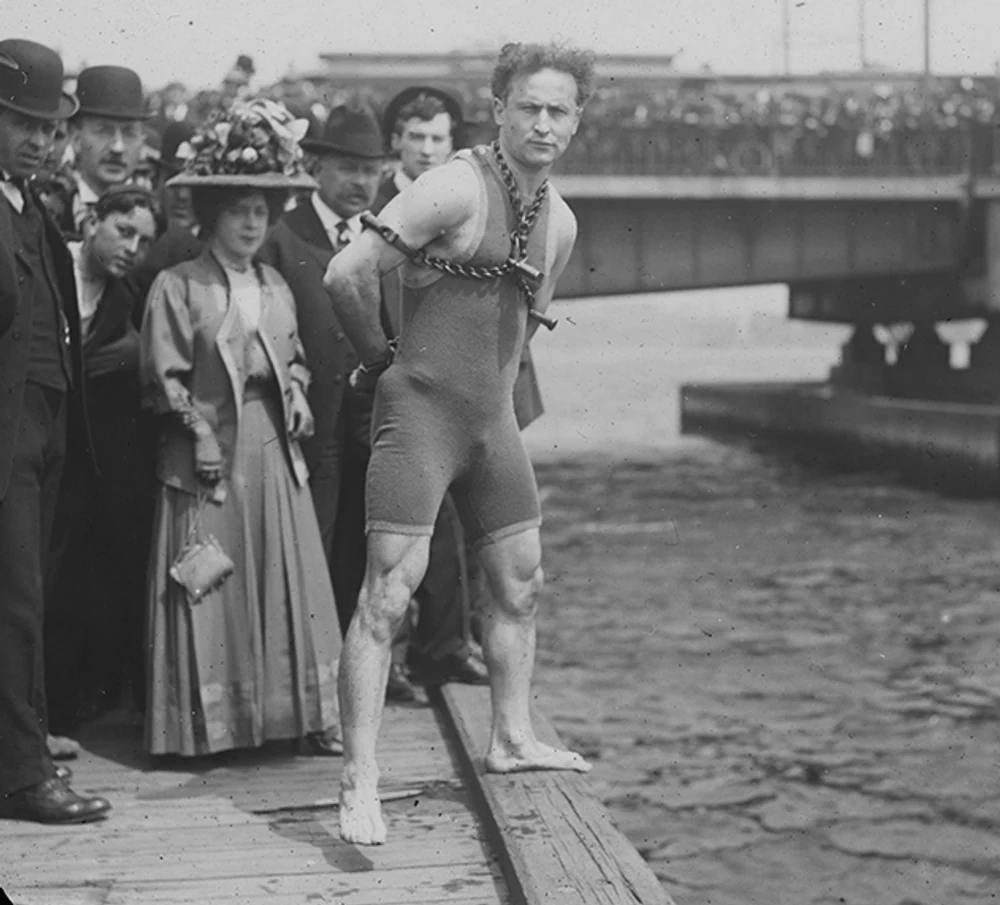
Houdini's fame was built in settings much larger than a magician's table. The Library of Congress catalogs a photograph by John H. Thurston dated April 30, 1908, showing him beside the Charles River in chains and handcuffs. Its title identifies the Harvard Bridge escape in Boston. The image captures the preparation, with spectators close around him, rather than supplying a complete visual record of the underwater escape that followed.
That distinction helps explain his publicity. According to the Library's description, manacled jumps and upside-down straitjacket escapes drew crowds and advertised theater appearances. In Boston in 1908, Houdini was appearing for two weeks at Keith's theater. The outdoor spectacle and the paid engagement belonged to the same professional operation. Someone could witness the preparation on a riverbank without knowing how the escape worked, then encounter the same famous name on a theater bill.
Another Library photograph, dated approximately January 1922, records a crowd outside the Treasury Building in Washington for a straitjacket escape. Its catalog explicitly says Houdini is not visible. The crowd remains revealing: the attraction was not only an individual feat but also a shared wait for its outcome. It would be misleading to point to an unidentified figure in that photograph and call it Houdini, or to describe it as an image of his death.
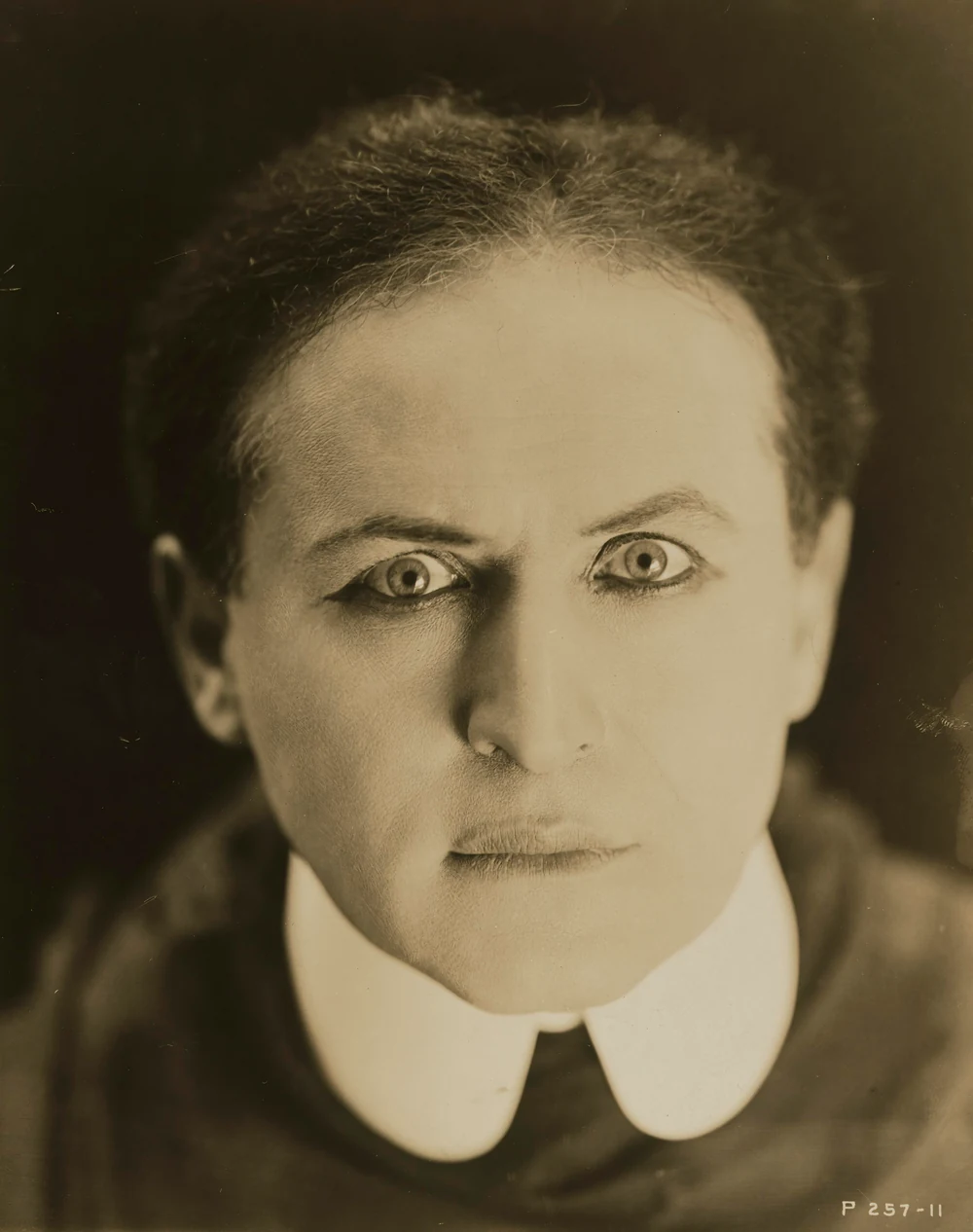
The Smithsonian's National Portrait Gallery holds a different kind of evidence: an approximately 1920 gelatin silver portrait. In it, Houdini looks directly toward the camera. The museum identifies the artist as unknown. Beside a performance photograph, the portrait shows another side of the same business of recognition. A face, a stage name and an apparently impossible predicament could travel separately through publicity and still lead an audience back to one performer.
PBS's American Experience chronology traces the later expansion of his stage work. His 1925 Broadway show combined illusions, escapes and an exposure of spiritualist methods. The different acts brought together abilities that can look contradictory from a distance: creating a convincing mystery for an audience and explaining why another person's supposed supernatural power was a trick. His career was not restricted to one famous container, one restraint or one type of illusion.
These records do not require a modern writer to invent a spectator's thoughts or reconstruct a particular crowd's reaction. The surviving photographs, dates and theater references already establish the scale of the presentation. The suspense was part of a deliberately organized performance, and the archive lets readers examine its public form without pretending that every method has been newly uncovered.
Sources: Library of Congress — John H. Thurston’s April 30, 1908 performance photograph ↗ · Library of Congress — Washington escape audience, approximately January 1922 ↗ · National Portrait Gallery — circa 1920 portrait, NPG.2000.15, CC0 ↗ · PBS American Experience — Houdini career chronology ↗
The skeptic who left a library of mysteries
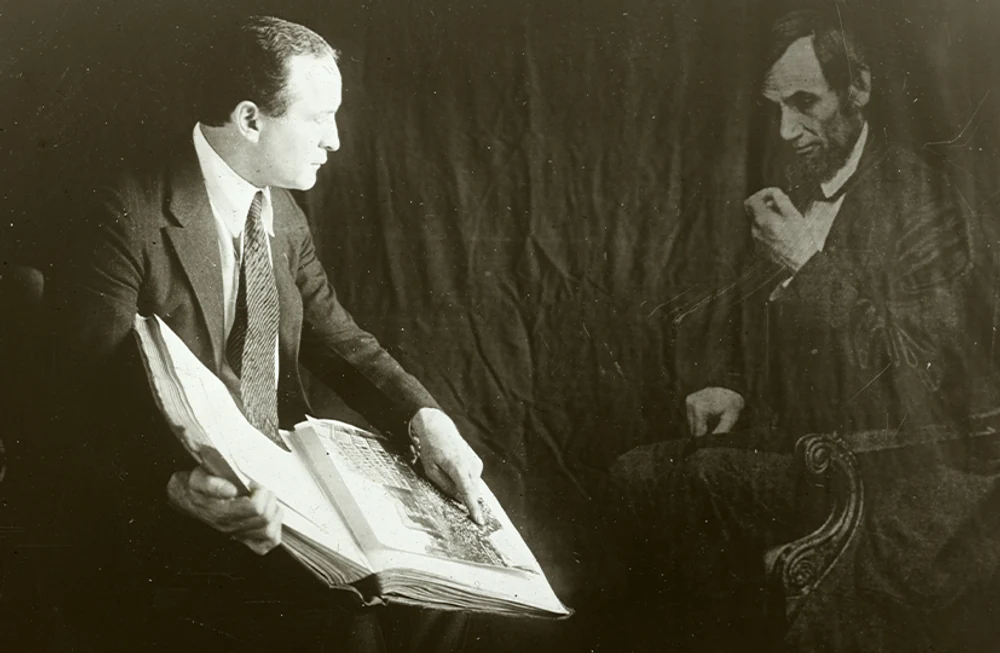
Houdini's campaign against fraudulent spiritualists is essential to understanding why people still associate him with Halloween. The Library preserves a historic composite showing him apparently sharing a book with Abraham Lincoln. It was made to demonstrate photographic deception, not to document an encounter with a spirit. The catalog dates the surviving item broadly between 1920 and 1930; its image should not be assigned a more exact creation date without additional evidence.
The Library's account of spirit photography explains the disagreement that divided prominent public figures. Arthur Conan Doyle supported spiritualism, while Houdini denounced fraudulent mediums and photographic claims of supernatural contact. The Lincoln image makes that argument visually. The seemingly impossible meeting is the point of the demonstration: a photograph can be persuasive while still being deliberately constructed. The image is a historical illusion, not a new digital reconstruction produced for this article.
His interest in these subjects extended well beyond a stage denunciation. In a letter dated July 31, 1925, now held by the Library, Houdini described his collection of spiritualist letters and documents to Mrs. M. M. Soule of Boston. He offered to send duplicates of autographs she wanted. The correspondence records the practical work of a collector: gathering, comparing and exchanging materials, including documents from a movement whose claims he challenged.
The Library's account of his collection also preserves an early postcard to his mother and the promotional scrapbooks he maintained. Those materials allow a reader to compare the developing performer with the public figure he later promoted. His collection was not simply a box of escape secrets. It included records of his own career and evidence about the history and practice of illusion, making it useful for studying entertainment as well as belief.
After his death, Bess Houdini continued efforts to contact him through séances. NPR recounts her decision to end that personal search on the tenth anniversary, in 1936, while noting that other people continued the tradition. Those later rituals are part of his cultural afterlife. They do not establish that contact occurred, and this centenary should not turn a reported séance into evidence of a supernatural event.
A hundred years after Houdini's death, the most durable legacy may be the opportunity to look closely. The portrait preserves a real face; the riverbank image records the preparation for a real performance; the Lincoln composite demonstrates how an image can mislead. Letters, catalogs and dated reporting let readers distinguish those categories. The anniversary returns attention to Houdini's fame, but the surviving evidence makes the story richer than a single explanation of how he died.
Sources: NPR via KUAR — October 31 centenary reporting from Detroit ↗ · Library of Congress — Lincoln trick-photograph catalog and rights ↗ · Library of Congress — 2017 explanation of spirit photography ↗ · Library of Congress — Houdini’s original July 31, 1925 letter ↗ · Library of Congress — Magical Momentos collection overview ↗ · Library of Congress — Great Escapes exhibition account ↗
Why this story is in the editionThe fresh Google Trends U.S. RSS feed reviewed October 31 included “harry houdini,” linking to centenary coverage. This supports topic discovery; no search rank, search volume or claim of being America’s most searched subject is made.
Prepared with AI assistance. Source-based reporting checked on 2026-10-31. This article does not update automatically. Read our editorial standards.