October 30: officials argue for hikes after the rate hold
Federal Reserve officials made a fresh case for further interest-rate increases on October 30, 2026, two days after the central bank left its target range unchanged. Dallas Fed President Lorie Logan said her current outlook called for at least two additional quarter-point increases, followed by a pause to assess developments. Her prepared Davidson College remarks also explain why she supported this week’s hold: market volatility made a more gradual adjustment useful. She expressly presented the assessment as her own, rather than a commitment by the full committee.
St. Louis Fed President Alberto Musalem separately argued that further tightening would be needed soon. His prepared remarks to the Shadow Open Market Committee emphasize the case for moving in smaller steps before inflation becomes entrenched. But his speech also considers a less likely scenario in which inflation eases without additional tightening, potentially through lower energy and shipping costs, higher productivity or weaker demand. His preference for higher rates therefore rests on an economic assessment, not certainty about the future.
Reuters independently corroborated both officials’ positions. Neither speech changes the policy rate. The October 28 statement remains the operative decision, retaining a 3.75%–4% target range. VIRVIB analysis: the new remarks help explain why a pause can coexist with an intention to tighten later. They should not be read as a completed vote for two increases, a guaranteed December move or a fixed schedule for borrowers. The distinction is between policymakers’ individual arguments and action approved by the Federal Open Market Committee.
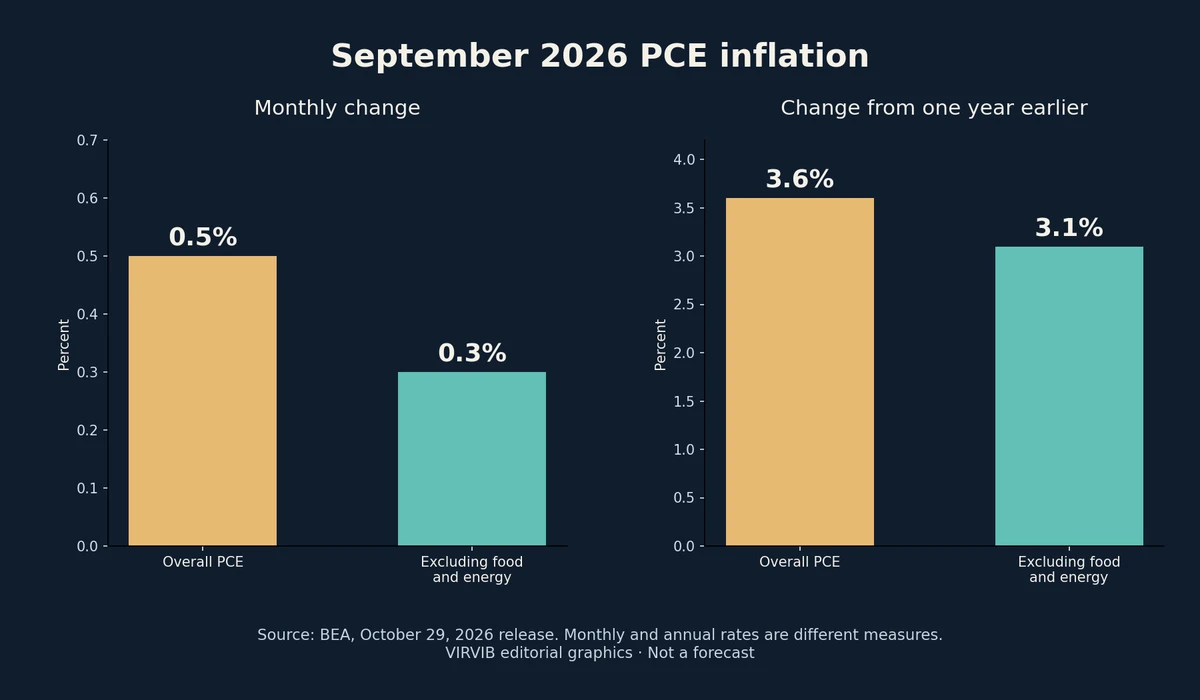
U.S. PCE inflation rose to 3.6% in September from a year earlier, according to the Bureau of Economic Analysis release published October 29, 2026. The monthly increase was 0.5%. The new data arrive a day after the Federal Reserve held its target range at 3.75%–4%, adding a fresh inflation reading to the debate over the central bank’s next move. They do not constitute another interest-rate decision.
Excluding food and energy, the PCE price index increased 3.1% from September 2025 and 0.3% from August 2026. Those are different comparisons: the first measures twelve months of price changes, while the second measures one month. The chart separates them so a monthly figure is not mistaken for an annual inflation rate. Reuters independently corroborated the headline and core readings in its October 29 report.
The spending figures show why the distinction between dollars and purchasing power matters. Current-dollar personal consumption expenditures increased 0.5% in September, following a 0.9% increase in August. Inflation-adjusted spending rose by less than 0.1%, which BEA’s summary table rounds to 0.0%. Households collectively spent more dollars, without a comparable increase in the inflation-adjusted quantity of consumption captured by the measure.
Personal income and disposable personal income each increased 0.2% in current dollars. Real disposable personal income fell 0.3%, while the personal saving rate was 3.8%. Disposable income means income after personal current taxes. These national aggregates describe the economy; they do not establish the change in a particular household’s pay, taxes, spending or savings.
The October 28 FOMC statement had identified inflation as an unfinished problem and called for additional information before determining the appropriate policy stance. September’s newly published figures provide one more dated observation. The statement remains the source of the actual rate setting: a 10–2 vote for no change, with Lisa Cook and Beth Hammack preferring a quarter-point increase at that meeting.
VIRVIB analysis: higher measured inflation strengthens the case for scrutinizing the next releases, but it does not automatically determine the December vote. The weak monthly real-spending reading also deserves consideration alongside prices. Treating either figure as a complete forecast would go beyond the evidence. BEA schedules its next Personal Income and Outlays release for November 25 at 8:30 a.m. Eastern Standard Time, supplying another checkpoint before the next scheduled FOMC decision.
Sources: BEA — October 29 Personal Income and Outlays release for September 2026 ↗ · Reuters — independent October 29 inflation and spending report ↗ · Federal Reserve — October 28 policy statement ↗ · Federal Reserve — meeting calendar and minutes timetable ↗ · Dallas Fed — Logan’s original October 30 Davidson College remarks ↗ · St. Louis Fed — Musalem’s full October 30 prepared speech ↗ · Reuters via Yahoo Finance — October 30 independent report on officials’ views ↗
October 28 Fed rate decision: a hold, with two votes for a hike

The Federal Reserve kept its federal funds target range at 3.75% to 4% on October 28, 2026. The decision was approved by a 10–2 vote. Lisa Cook and Beth Hammack dissented because they preferred a quarter-percentage-point increase. For readers searching for the Fed rate decision, the immediate answer is a hold, rather than a cut or another hike.
The statement describes economic activity as strong, with resilient domestic spending, robust capital investment and little change in unemployment. It also says inflation remains elevated and that additional information will help determine the appropriate policy stance. The combination matters: leaving the rate unchanged does not amount to declaring the inflation problem solved.
September provides the comparison. On September 16, the committee voted 12–0 to raise its target range by a quarter point to the level retained on October 28. That earlier statement described growth as solid. October’s pause leaves the September increase in place; it does not reverse it. The change in the vote also shows that agreement about how to proceed is less complete than it was at the previous meeting.
Reuters independently reported the unchanged range and the two dissents, placing the decision ahead of the November 3 midterm elections. The official statement itself supplies the policy action and the members’ stated preferences. This report does not infer from the election calendar that a political instruction determined the vote, and it does not turn market expectations about a later hike into a decision already taken.
VIRVIB analysis: the split concerned the appropriate action at that meeting. A member who favored a hike and a member who favored waiting may both be concerned about inflation while disagreeing about timing. The statement establishes which action prevailed and how the two dissenters wanted it changed. It does not give a complete account of every participant’s reasoning. Those details belong in subsequent official communication and the meeting record.
The terms “fomc” and “fed rate decision” appeared in Google Trends’ U.S. trending-search view checked on October 28. That is evidence of current search interest, not a claim that this was the country’s largest trend. The article focuses on the released decision so readers can distinguish confirmed policy from the forecasts that circulated before the announcement.
Sources: Federal Reserve — October 28 policy statement ↗ · Federal Reserve — September 16 policy statement ↗ · Reuters — independent reporting on the October decision ↗ · Google Trends — United States trending searches, checked October 28 ↗
The target range is not every interest rate in the economy
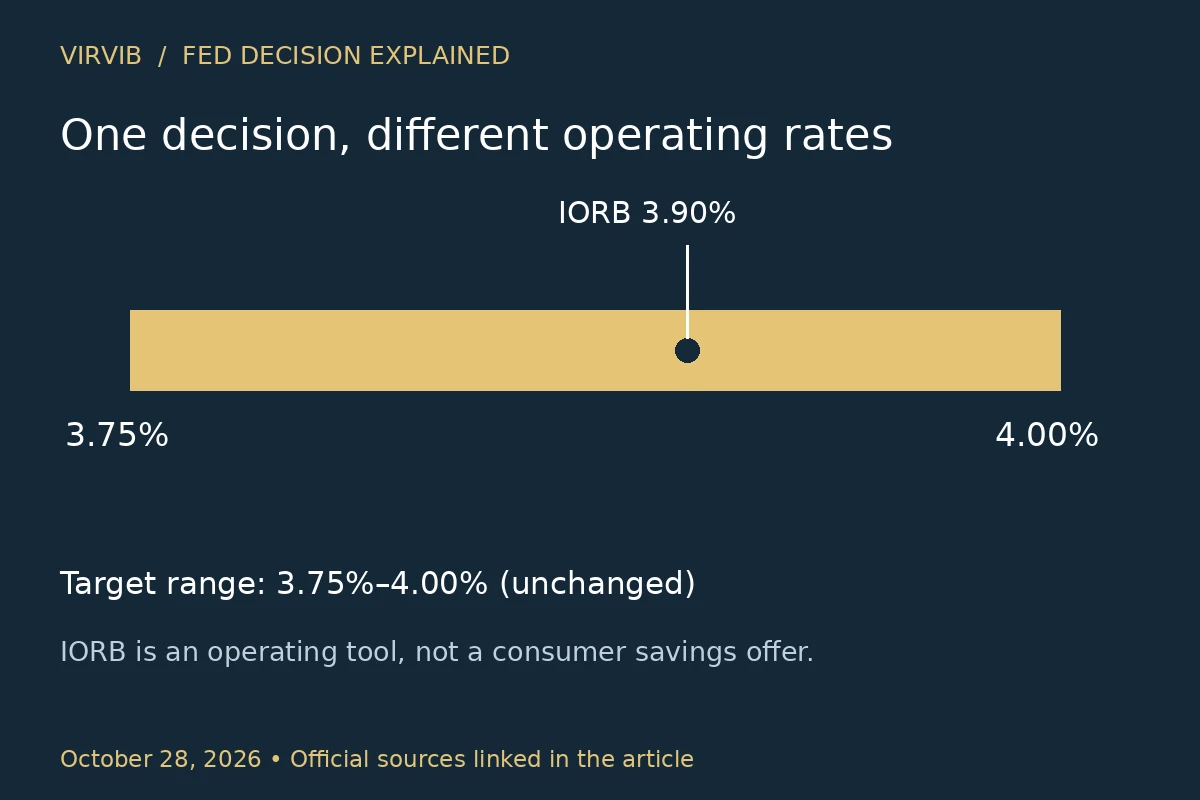
The federal funds rate concerns overnight borrowing of reserve balances by banks. The committee sets a target range, then uses operating tools to keep market rates consistent with that stance. The Federal Reserve’s explanation of implementation describes how the interest paid on reserve balances helps influence the rates banks are willing to accept when lending. The target is therefore a policy setting supported by operations, not one advertised borrowing rate offered to everyone.
The October 28 implementation note retains interest on reserve balances at 3.90%, effective October 29. It directs the New York Fed’s trading desk to maintain the 3.75%–4% target range, with standing overnight repurchase operations at 4% and reverse repurchase operations at 3.75%. It also retains a 4% primary credit rate. These numbers identify different facilities and functions. They should not be presented as competing versions of the headline decision.
The note continues an ample-reserves approach. It allows purchases of Treasury bills and, if needed, other Treasury securities with three years or less remaining maturity to maintain an ample level of reserves. It also describes reinvestment arrangements for principal payments. An operational instruction to maintain reserves is not a consumer loan offer, and its wording should be read alongside the unchanged target range.
The Fed’s broader monetary-policy explainer connects short-term rates and financial conditions to decisions made by households and businesses. Policy aims at maximum employment and stable prices. The transmission works through credit costs, spending and investment rather than by instructing every seller what price to charge. That distinction is especially relevant when the decision is described as a pause: a pause refers to the October 28 policy change, not to every price or financial contract standing still.
VIRVIB analysis: compare like with like. A 3.90% operating rate, a 3.75%–4% target band and a bank’s quoted annual percentage rate answer different questions. Comparing them without their labels can make a legitimate difference look like a contradiction. For a household, the relevant follow-up is the actual contract or quote. For policy observers, it is whether the operating framework is delivering the overnight-rate conditions the committee intends.
Nor does a hold lock in the next meeting’s outcome. The October statement calls for more information. This account therefore makes no promise about a December increase, a subsequent cut or the return on a particular investment. Those are future outcomes, not components of the decision just published.
Sources: Federal Reserve — October 28 policy statement ↗ · Federal Reserve — October 28 implementation note ↗ · Federal Reserve — monetary policy goals and implementation ↗ · Federal Reserve — monetary policy explained ↗
What the hold means for mortgages, credit cards and the next meeting
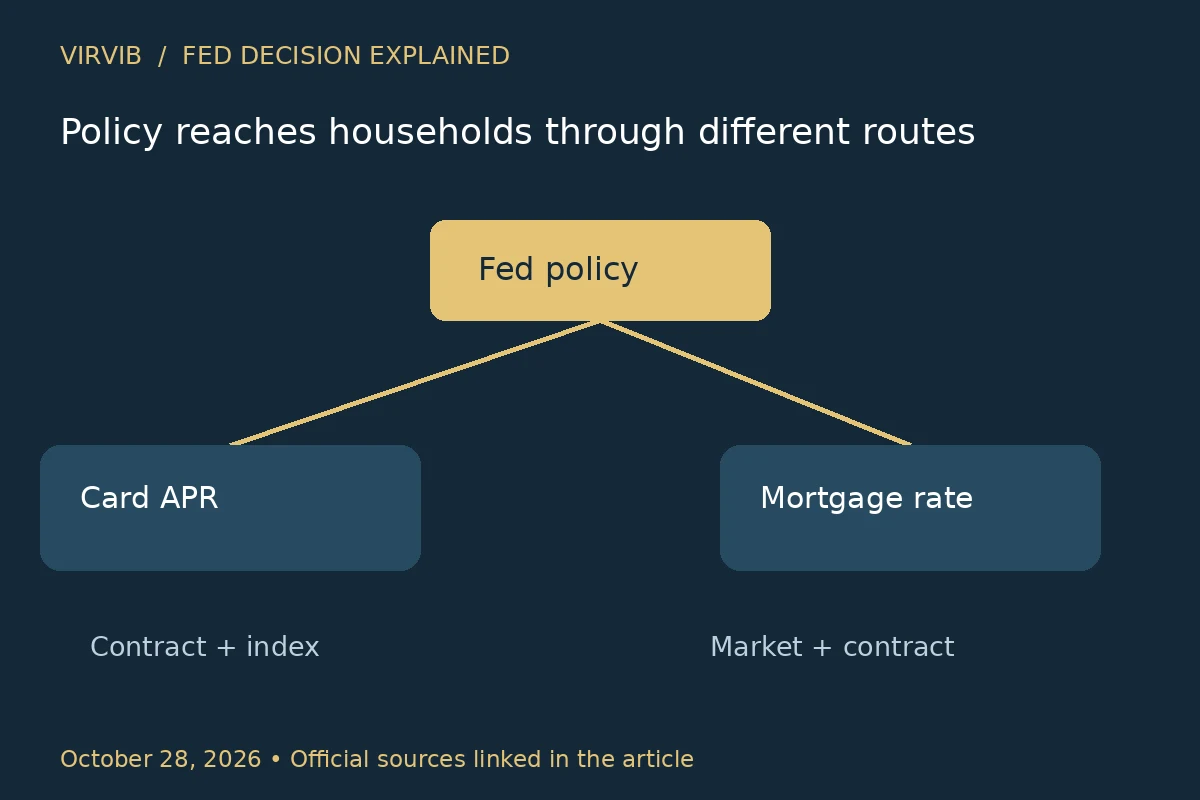
A homeowner with a fixed-rate mortgage should not expect the contract’s interest rate to reset solely because the Fed meets. Federal Reserve Consumer Help explains that mortgage rates are established by lenders under the loan agreement. A fixed rate is locked for the loan’s duration, while a variable or adjustable rate can change according to its terms. The agreement identifies the mechanism; the policy headline does not replace it.
For a new mortgage quote, market conditions still matter. A May 2026 Dallas Fed research article emphasizes that there is no direct one-for-one link between the overnight policy rate and mortgage rates. Its analysis examines longer-term Treasury yields, the yield curve and interest-rate volatility, among other influences. The authors’ research helps explain why mortgage pricing can move differently from the latest Fed action. It is not a prediction of the rate any borrower will receive after the October 28 announcement.
Credit cards have another transmission path. The Consumer Financial Protection Bureau distinguishes a fixed APR, which does not fluctuate with an index, from a variable APR, which changes with its benchmark. The cardholder agreement explains how the rate may change. A fixed APR is not a guarantee that an issuer can never change a rate; applicable notice and account rules also matter.
The Fed’s prime-rate FAQ adds that individual banks determine the prime rate. Many use the federal funds target as one input, and prime serves as a reference for products including credit-card and small-business loans. The Fed does not directly set each bank’s prime rate or each card’s APR. For a cardholder, the index, the margin and the account’s terms remain more useful than treating 4% as the price of personal borrowing.
VIRVIB analysis: the practical comparison is between your current agreement and the new statement or quote you receive. A rate decision alone does not establish a revised monthly payment. It also does not tell a borrower whether refinancing would save money after fees, or a saver which account pays the highest return. Those decisions require product-specific information that this policy report does not supply.
The official calendar lists the next scheduled FOMC meeting for December 8–9. The Fed says minutes of regularly scheduled meetings are released three weeks after the decision. The minutes can add detail to the October deliberations, while new economic releases can change the outlook before December. A calendar date is a scheduled opportunity for another decision, not a commitment to move rates.
The confirmed result on October 28 is narrow but consequential: the committee retained the current range, two voters sought a higher one, and the inflation objective remains unfinished. Borrowers and businesses now have a dated policy baseline against which to assess subsequent information. Further claims about the next step should be tied to new evidence rather than assumed from the word hold.
Sources: Federal Reserve — October 28 policy statement ↗ · Federal Reserve Consumer Help — mortgages and policy rates ↗ · CFPB — fixed and variable credit-card APRs ↗ · Federal Reserve — prime rate FAQ ↗ · Federal Reserve Bank of Dallas — how mortgage rates respond ↗ · Federal Reserve — meeting calendar and minutes timetable ↗
Why this story is in the editionGoogle Trends United States reviewed October 29. The original FOMC article recorded October 28 search interest; this update is selected for the new BEA release, not a claim that PCE appears in Trending Now or has a particular rank or volume. Google Trends U.S. RSS reviewed again October 31. This substantive follow-up covers new official speeches in an existing policy article; no current rank or search-volume claim is made.
Prepared with AI assistance. Source-based reporting checked on 2026-10-31. This article does not update automatically. Read our editorial standards.