A closed school discharge lawsuit challenges denied relief
A new federal lawsuit challenges the Education Department's handling of loan relief for borrowers whose colleges closed, arguing that the government has failed to apply an expanded eligibility decision announced in January 2025. Student Defense filed the case on behalf of Kendrick Gaussoin and a proposed class of similarly situated borrowers. The corrected complaint was filed October 28, 2026, in the U.S. District Court for the District of Columbia, under case number 1:26-cv-03784.
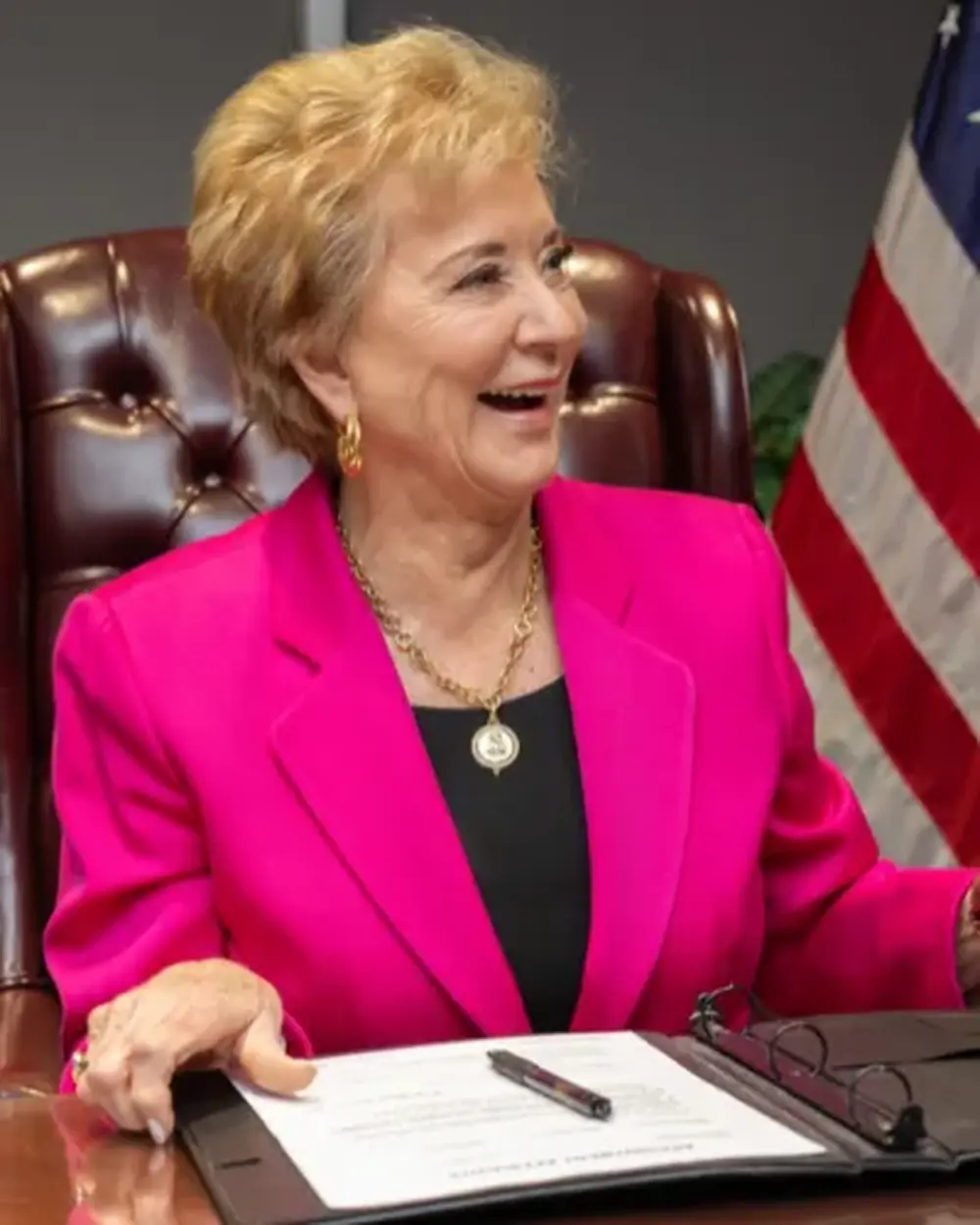
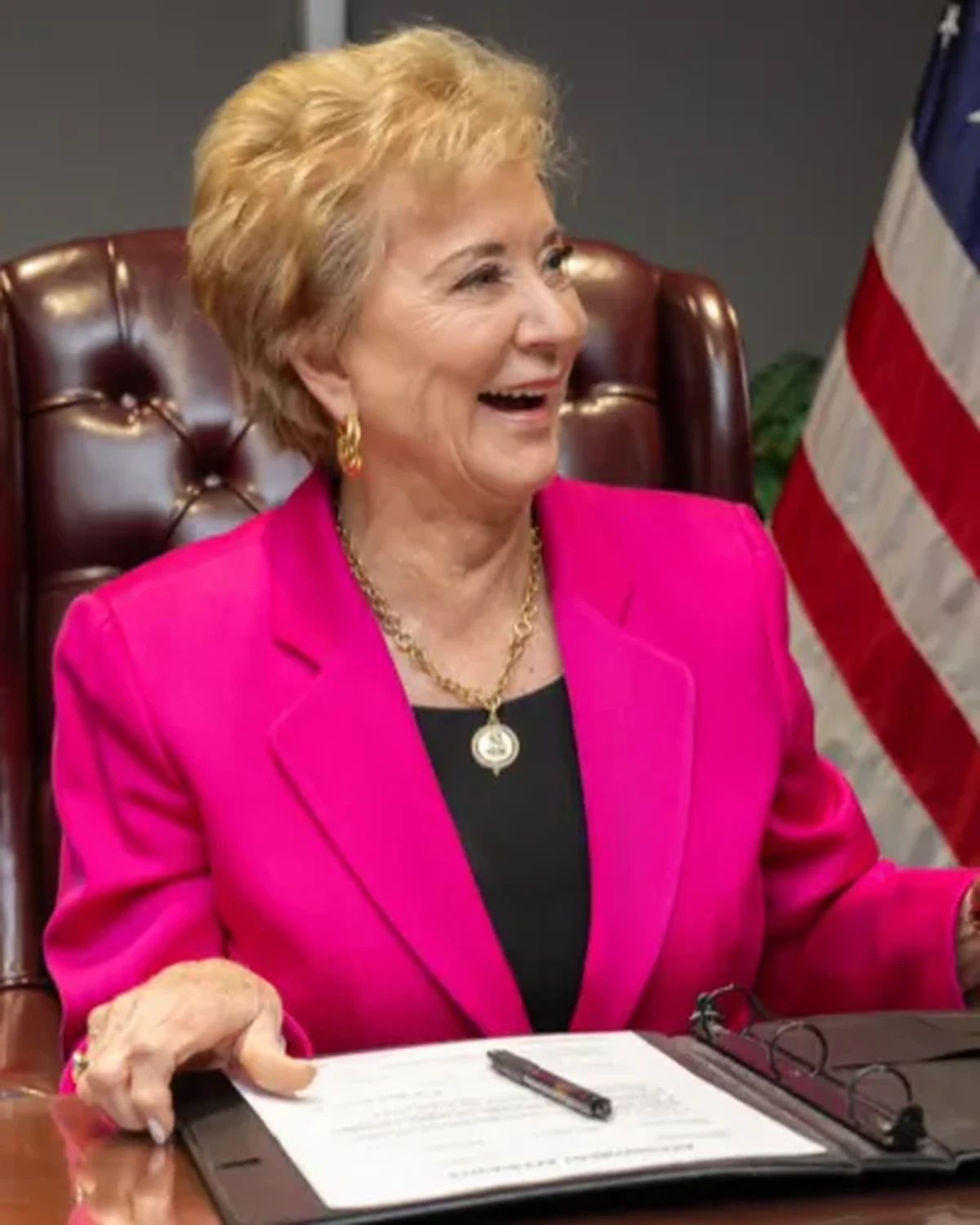
The defendants are Education Secretary Linda McMahon, in her official capacity, and the Department of Education. The complaint asks the court to require implementation of the earlier decision. It is a request for judicial relief, not a ruling that the plaintiff has won or that every former student at a closed college will have a balance erased. Student Defense announced the lawsuit October 29; the filing date and the public announcement date describe different steps in the same case.
Gaussoin attended Brooks Institute, a visual arts college that closed in 2016. Independent reporting by NPR describes how his photography studies were interrupted and how his earlier departure placed him outside the standard discharge window. He applied for relief in August 2026 after learning about the expanded window, but received a denial. NPR also obtained a response from the department, which defended its implementation and disputed the legitimacy of the late Biden-era expansion.
Student Defense says the 2025 decision covered schools associated with Career Education Corporation, Education Management Corporation and Education Corporation of America, as well as Bay State College. The organization argues that thousands of borrowers have not received relief to which they are entitled. That is the plaintiffs' position about the affected group, not a court-certified count. Business Insider independently reported the lawsuit and its claim that borrowers remain responsible for balances while the dispute continues.
VIRVIB analysis: the central issue is not simply whether a school closed. It is whether an earlier administrative decision extended the relevant eligibility period and what obligations follow from that decision. A borrower whose dates fall outside an ordinary window may have a different argument if a valid extension covers that school. The lawsuit puts implementation of that extension before the court; it does not resolve every other eligibility requirement or every borrower's individual circumstances.
Sources: Student Defense — October 29 announcement and plaintiffs’ position ↗ · Corrected class action complaint — filed October 28, 2026, case 1:26-cv-03784 ↗ · NPR via KEDM — independent reporting and Education Department response ↗ · Business Insider — independent coverage of the lawsuit ↗
Why the look-back period matters—and why one deadline does not fit every loan
Closed school discharge is a specific federal loan program. Federal Student Aid identifies Direct Loans, Federal Family Education Loan Program loans and Federal Perkins Loans as potentially eligible when a school closes during enrollment or soon after withdrawal. Its broader forgiveness guidance distinguishes this pathway from borrower defense, which concerns certain school misconduct. A school closure and an allegation of deception can arise in the same history, but they are different grounds for relief and should not be treated as interchangeable applications.
The Education Department's school-closure application explains an important timing distinction. It describes a 120-day look-back period and notes that the period increases to 180 days for loans disbursed on or after July 1, 2020. It also describes extensions based on exceptional circumstances. The document identifies such circumstances as accreditation or authorization problems and other events related to a school's closing. An account that reduces all borrowers' eligibility to one universal number can therefore obscure the significance of loan dates and applicable extensions.
The complaint's chronology illustrates the dispute. It says Gaussoin's last attendance at Brooks was December 17, 2015, while the expanded look-back date for the school was May 6, 2015. He applied August 23, 2026, and the denial letter was dated August 31. The complaint says the denial relied on withdrawal more than 180 days before closure without addressing the expanded window. Those assertions explain his legal claim; the complaint is not an independent judicial finding that the denial was unlawful.
VIRVIB analysis: three records answer different questions. Attendance records establish when someone studied. Loan records establish which borrowing financed that education. A discharge determination explains how the department applied the eligibility rules. A mismatch between a denial's reasoning and an alleged school-specific extension is something a court can examine, but the filing alone cannot establish the outcome. Readers should distinguish the dates presented in a pleading from a final adjudication of their legal effect.
The official guidance also recognizes that Parent PLUS loans may be discharged when the student could not complete a program because the school closed. That does not mean that every parent loan is automatically canceled. The useful distinction is between the program's possible coverage and an actual approval for a particular account. This case does not replace the federal application process or supply an individual determination for readers who attended one of the schools mentioned.
Sources: Corrected class action complaint — filed October 28, 2026, case 1:26-cv-03784 ↗ · Federal Student Aid — discharge pathways and parent borrowers ↗ · Federal Student Aid — official school-closure application and timing rules ↗
What the historical evidence shows and what remains unresolved
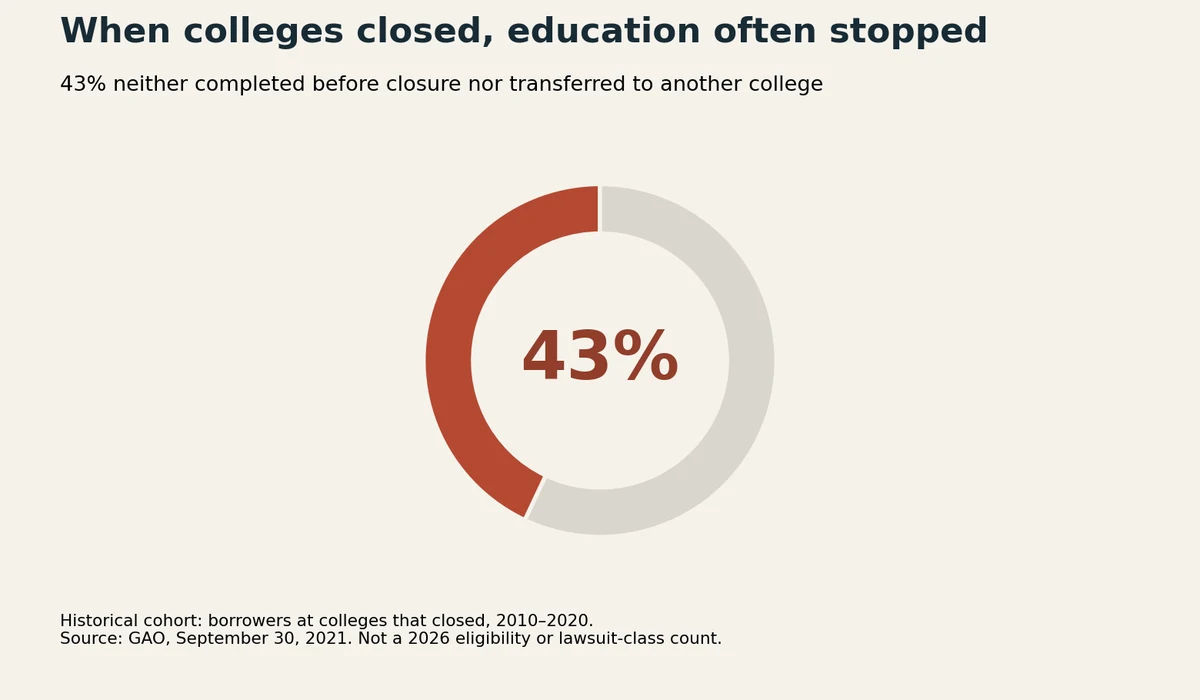
The scale of earlier college closures helps explain why implementation matters. A September 2021 Government Accountability Office publication reported that about 246,000 borrowers had been enrolled at more than 1,100 colleges that closed from 2010 through 2020. That figure describes affected enrollment, not a finding that all 246,000 qualified for cancellation. GAO said 43% of impacted borrowers neither completed their program before closure nor transferred to another college.
GAO also reported that more than 80,000 borrowers had received closed school discharges. More than 27,600 received relief through the automatic process that began in 2018, and over 70% of those eventual automatic recipients had been in default or past due. These are historical findings with defined periods and groups. They are not a count of the proposed class in the October 2026 lawsuit and should not be used to manufacture a current total of unlawfully denied applications.
The accompanying chart isolates the 43% educational-outcome finding. It does not measure current debt balances, demonstrate eligibility or predict how a judge will rule. The distinction between educational disruption and loan relief is substantive: a college closing may interrupt a student's plans immediately, while the records and decisions governing a discharge can remain consequential years later. The lawsuit concerns that later administrative stage.
NPR's reporting includes both the borrowers' challenge and the government's objection to the earlier expansion. The department's position and the plaintiffs' legal argument should be assessed against the relevant administrative records and the court's eventual decisions, rather than converted into a settled conclusion by a headline. VIRVIB has reviewed the publicly linked complaint and official program materials; it has not interviewed the family, inspected private account records or obtained confidential government communications.
The next meaningful developments are the government's court response, any ruling on the proposed class and any order addressing the challenged decision. Until then, the verified news is that the dispute has reached federal court. There is no basis in the filing itself to promise a payment refund, erase a reader's balance or say that a particular repayment obligation has been suspended. Those outcomes require their own documented determinations.
Sources: NPR via KEDM — independent reporting and Education Department response ↗ · GAO — September 30, 2021 historical college-closure findings ↗
Why this story is in the edition“closed school discharge program lawsuit” appeared in Google Trends U.S. RSS checked October 29, with an entry dated 15:30 PDT. No national ranking or search-volume claim is made.
Prepared with AI assistance. Source-based reporting checked on 2026-10-29. This article does not update automatically. Read our editorial standards.