The $150 million figure needs its full context

New York’s Department of Financial Services announced a $150 million Deutsche Bank penalty in July 2020. The resolution covered compliance failures connected with Epstein as well as correspondent-banking relationships involving Danske Bank Estonia and FBME Bank. Describing the whole amount as a penalty exclusively for Epstein would be misleading.[S15]
This is why the total alone is not the story. The scope of the proceeding, the identified failures and the remedy must be read together.
A regulator’s findings are not a criminal verdict
The consent order is an administrative enforcement record. Its Epstein-related findings concern deficiencies in risk assessment, communication and transaction monitoring. It gives readers a documented basis for examining the bank’s controls, but it is not a criminal conviction of the bank or every employee involved.[S16]
A strong financial explanation follows the chain of responsibility: what warning existed, who received it, what control should have responded and what action followed. A suspicious transaction is a reason to investigate its purpose, not permission to invent that purpose.
Do not confuse financial totals
Keep five categories separate when reading the records: fees paid, assets held, transfers processed, penalties imposed and settlement amounts. They are not interchangeable. Adding them together can produce a striking number that has no coherent meaning.
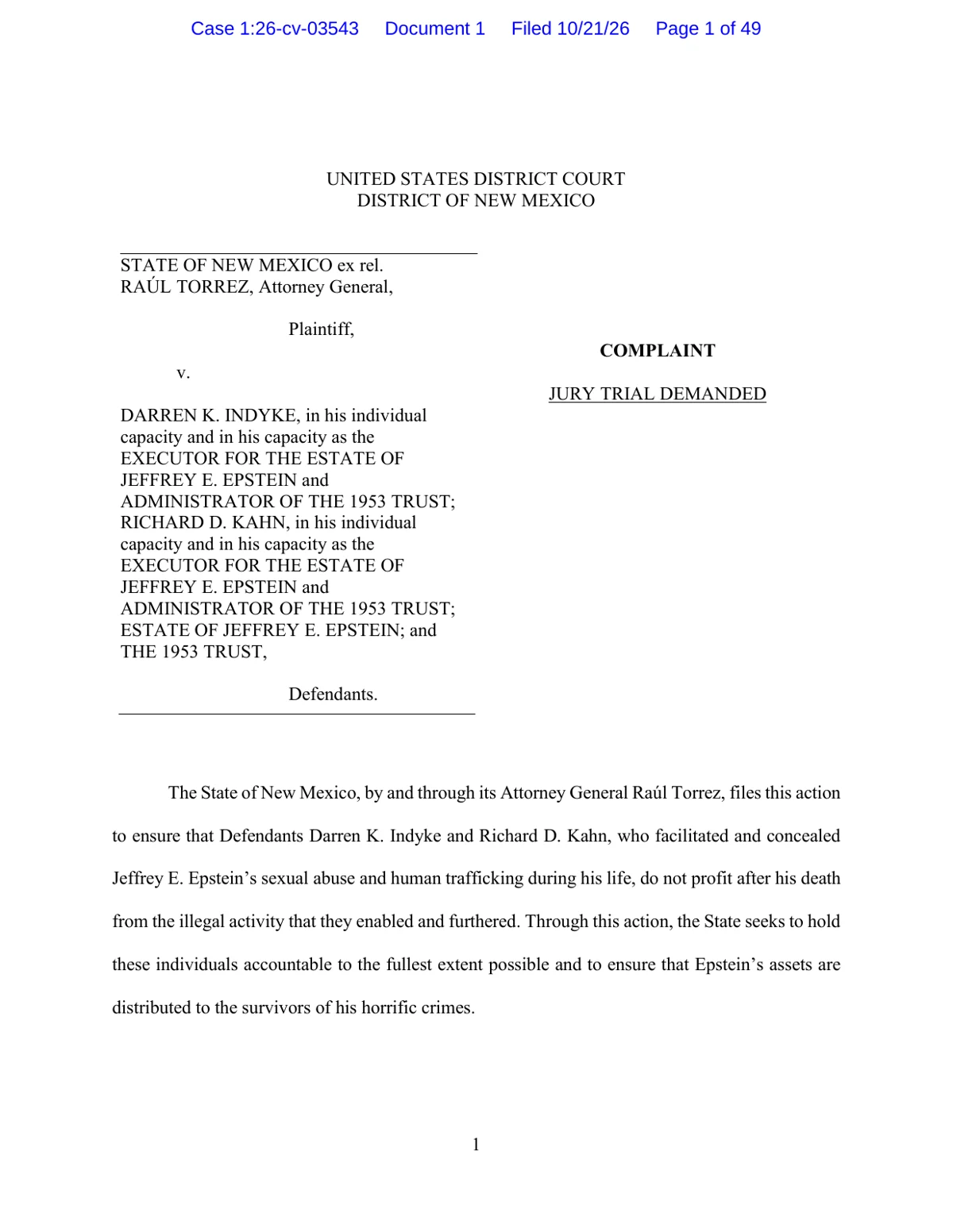
For example, a transfer can move the same money between accounts. Counting both sides as new wealth would double-count the funds. Similarly, an estate payment and a bank’s regulatory penalty may go to different recipients and resolve different claims. These are analytical distinctions, not assertions about an unexamined transaction in this case.
What further evidence would add
To make a specific accusation, a report would need to connect a named person to conduct supported by records: an authorization, instruction, warning or transaction with established context. The conclusion should be no broader than that evidence.
This dossier links the regulator’s announcement and the original consent order so readers can compare an official summary with its underlying findings. It does not claim to have audited every Epstein account or independently reconstructed the entire flow of funds.
The estate and New Mexico chapters follow separate proceedings. Their inclusion broadens the accountability picture without converting a civil allegation into a bank finding or a regulatory finding into a criminal verdict.