What the committee published
The House Oversight Committee announced on March 2, 2026 that it had released videos of Hillary Clinton’s February 26 deposition and Bill Clinton’s February 27 deposition. This edition links that official release. It does not claim to have reviewed or transcribed the complete recordings.[S19]
The release confirms that the depositions occurred. Without checking a particular answer, it would be wrong to attribute a detailed statement, admission or denial to either witness from the release alone.
Selected passages from Gates’s interview
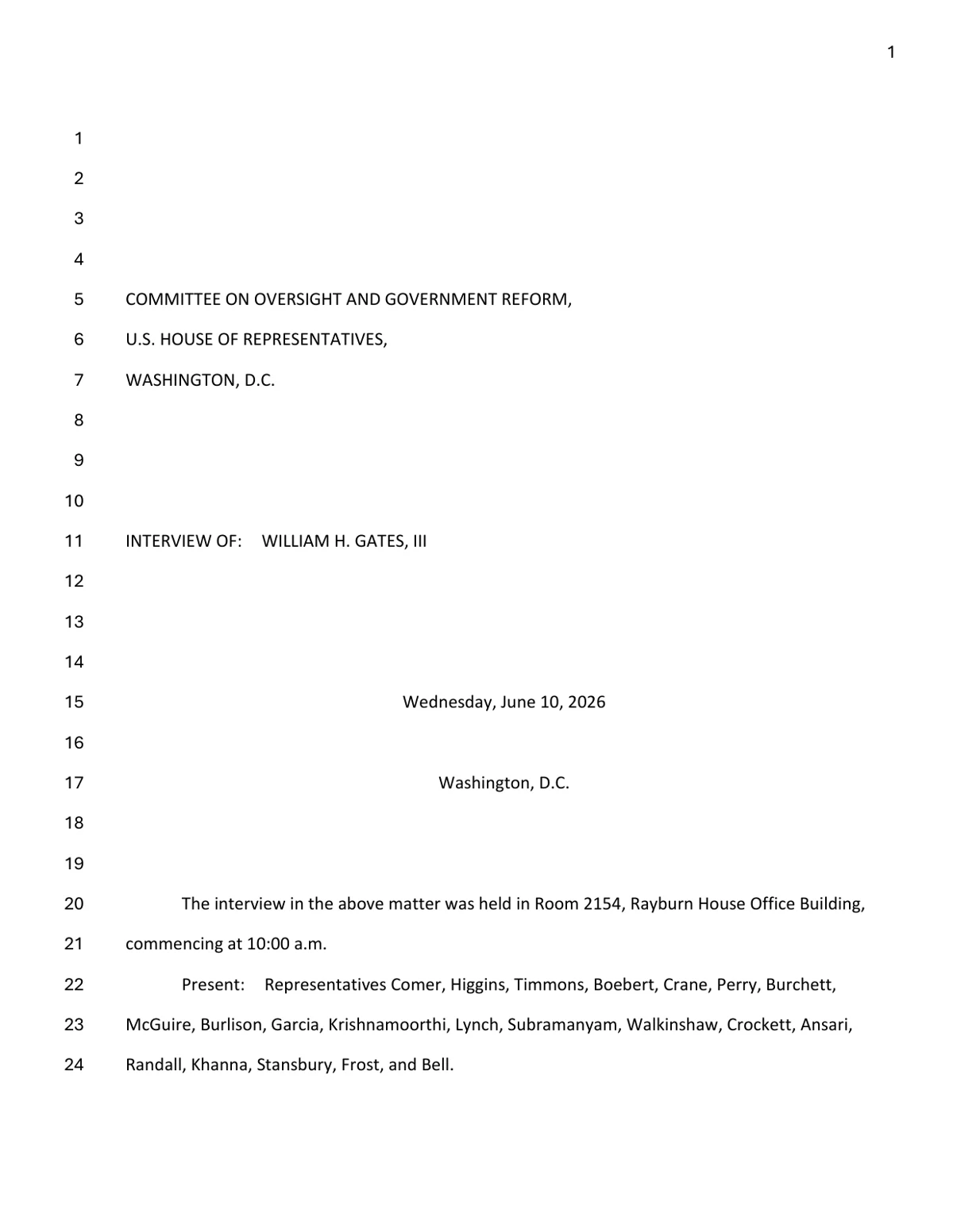
The committee’s June 10, 2026 transcript identifies a voluntary interview with William H. Gates III. On printed page 81, Gates discusses first meeting Epstein in 2011 and regretting how he weighed Epstein’s criminal history. On page 57, he says illegal activities were not discussed or occurring when he was present and expresses regret that his association helped Epstein’s reputation. These are Gates’s statements, not independent findings.[S20]
The attribution belongs in the sentence. Replacing “Gates said” with an unqualified assertion would overstate what a transcript can establish by itself.
Read the question, answer and exhibit separately
A question can contain assumptions the witness rejects. An exhibit can be introduced without every assertion in it being authenticated. A witness may describe direct observation, memory, an inference or something heard from another person. For each passage, identify which of those is involved before drawing a conclusion.
Our page references allow a reader to inspect the surrounding exchange. They do not imply that every page of the transcript was independently verified or that the entire congressional investigation has been summarized here.
An index should not imply an accusation
The person cards use a testimony label for these entries. They do not present the witnesses as convicted defendants or assert a criminal charge based on their appearance before the committee.
A later article could examine a specific statement against another authenticated record. That would require identifying the exact statement, locating the comparison evidence and giving the person’s relevant response. A headline built only on a famous name would not do that work.
For readers following the larger dossier, this chapter is a method for handling a document category that often attracts attention. The court outcomes, civil complaints and congressional testimony remain linked, but they remain distinguishable.