What replaces the floppy disks, and where the rollout starts

The Federal Aviation Administration plans to replace information systems that still depend on floppy disks at 435 sites by the end of 2028. The Department of Transportation announced the initial rollout on November 5, 2026, identifying three airports and two data-processing hubs among the first locations. The change targets the information controllers use to understand weather, airspace restrictions and equipment conditions while directing flights.
The new Enterprise Information Display System, or E-IDS, is intended to bring that material onto one platform. Atlantic City International Airport, Nashville International Airport and Greater Rochester International Airport are among the first five locations named, alongside processing hubs in Atlanta and Salt Lake City. That is the opening group in a multiyear deployment. The announcement does not say that all 435 sites have already been converted or that every part of the country's air traffic technology will be replaced through this one program.
The FAA's program description identifies four legacy systems E-IDS will replace: Information Display System 4, the Automated Surface Observing System Controller Equipment Information Display System, the NAS Information Display System and the En Route Information Display System. Their names reflect different operating settings and information functions. A common platform is meant to reduce the fragmentation that comes with maintaining separate systems, while addressing equipment that has reached its technical end of life.
The program is also designed to connect with the FAA's System Wide Information Management infrastructure. Its stated benefits include exchanging information across the National Airspace System, managing local and national static information, and making new capabilities easier to deliver. These are information-management functions. E-IDS should not be mistaken for a new radar network, an aircraft's cockpit computer or a system that takes the controller's place in directing traffic.
The practical importance becomes clearer with pilot weather reports, known as PIREPs. The FAA's controller procedures emphasize collecting and distributing those reports so pilots can learn about conditions encountered by other aircraft. They can describe turbulence, icing, wind shear and other hazards. The procedures also note that reports of an expected hazard not occurring can be valuable to forecasters and pilots. The information matters because conditions in flight do not always match what was expected before departure.
Timeliness is part of the same problem. The procedures distinguish urgent and routine reports, and require operationally significant information to reach the relevant positions and facilities. E-IDS's program overview identifies PIREP capabilities and timely distribution of Notices to Airmen information as safety issues it is intended to address. A newer display is useful not just because its hardware is newer, but because information needs to move between the people who can act on it.
Reuters independently reported the November 5 plan and placed it within the wider replacement of aging FAA technology. Its report also described a different vulnerability: fiber-optic cable cuts that interrupt communications between facilities. The agency had warned airports about coordination on construction projects, according to an October 23 memo reviewed by Reuters. That reporting illustrates why an information-display upgrade and dependable communications links are related requirements, rather than interchangeable fixes for every kind of outage.
The 2028 deadline sits inside a larger modernization challenge
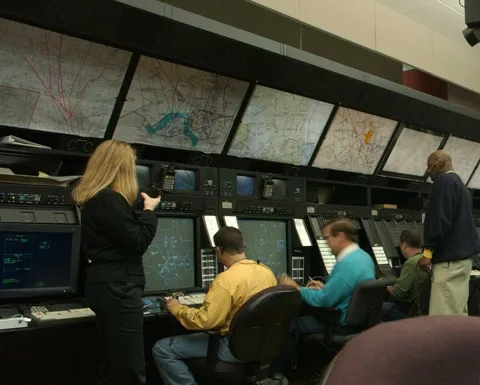
The longer record helps explain why an apparently simple change of storage medium has become national news. In September 2024, the Government Accountability Office published an assessment of the FAA's aging systems. Drawing on an agency risk review, it reported that 51 of 138 air traffic control systems were unsustainable and another 54 were potentially unsustainable. Those were the categories in that assessment, not a new count of facilities affected by this week's announcement.
GAO also found that 58 of the 105 systems in those two categories had critical operational impacts on safety and efficiency. It identified 17 systems as especially concerning when factors including age, sustainability, operational impact and modernization timing were considered together. Some replacement efforts were years away. The report's focus was the agency's ability to prioritize and oversee modernization, not an assertion that every old system was failing on every flight.
A later oversight report, released on September 14, 2026, examined the broader Brand New Air Traffic Control System initiative. Its first phase aims to modernize communications, surveillance, weather and training systems, among other areas, by December 2028. GAO said Congress had appropriated $12.5 billion in July 2025 and that most of the money was being used for that first phase. The funding is for the larger initiative, not a stated price tag for replacing floppy disks alone.
GAO found that the overall effort lacked a comprehensive lifecycle cost estimate and an integrated master schedule. Instead, it described 11,389 individual project schedules that had not been integrated. That creates a coordination problem when different installations are planned at the same facilities. GAO recommended prioritizing both a reliable cost estimate and an integrated schedule. The recommendations remained marked open on the report page when reviewed on November 6. Those findings concern the wider modernization initiative and should not be presented as a separate audit finding that E-IDS itself has missed its deadline.
VIRVIB analysis — the common 2028 target makes coordination more important, not less. Replacing an information display, updating communications and changing other equipment can place demands on the same operational workplace. A site can receive one new capability while other parts of its technology remain in transition. The number of completed installations is therefore useful evidence of progress, but it answers a different question from whether the whole network has a coordinated, affordable path to completion.
The November 5 announcement describes intended improvements in access to flight alerts, restricted-airspace schedules and pilot reports. It does not quantify a reduction in delays or provide a measured change in accident risk from the first installations. Those outcomes cannot be calculated from the 435-site target. AVweb's independent aviation coverage likewise describes the rollout as one part of a broader effort that also encompasses telecommunications, radios, radar and surveillance equipment.
For passengers, the immediate significance is work beginning on the infrastructure behind everyday flight operations. Controllers still need current information, functioning links to other facilities and equipment that can be maintained. Removing dependence on obsolete storage addresses one part of that chain. It does not remove bad weather, construction damage to cables or the need to manage traffic around operational constraints.
The next meaningful measures are the pace of installations beyond the initial five locations, evidence that the new information-sharing functions are working, and progress on the cost and scheduling concerns raised by GAO. The November announcement establishes a specific deployment plan and a deadline. Whether that plan delivers its intended operational improvements will depend on implementation across the network through the end of 2028.
View sources
Source publication or schedule date: Rollout announced November 5, 2026. GAO reports dated September 23, 2024 and September 14, 2026.
- Department of Transportation — November 5, 2026 rollout announcement
- FAA — E-IDS program and four replacement systems
- Reuters via Investing.com — November 5 independent reporting
- FAA — controller weather-information procedures
- GAO — September 23, 2024 legacy-system risk findings
- GAO — September 14, 2026 modernization cost and schedule findings
- AVweb — November 5 independent aviation report
Prepared with AI assistance. Source-based reporting checked on November 6, 2026. This article does not update automatically. Read our editorial standards.