- State
- South Carolina
- Office / race
- U.S. Senate
- Party
- Democratic
- Reviewed
- October 30, 2026
Career timeline
Annie Andrews and Darline Graham: what the latest polls show
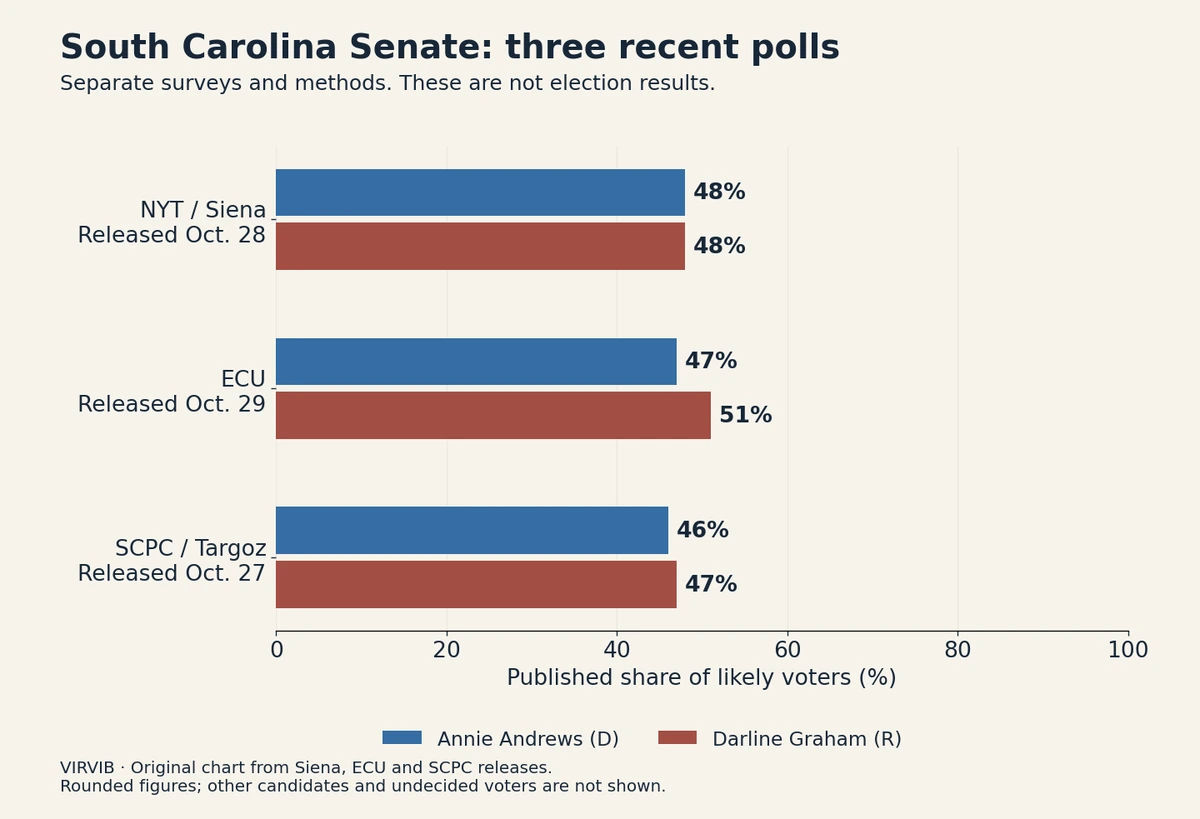
Annie Andrews and Republican Senator Darline Graham are level at 48% each in a New York Times/Siena survey released October 28, bringing fresh attention to South Carolina’s November 3 Senate election. A second university poll, released by East Carolina University on October 29, gives Graham a four-point advantage, 51% to 47%. Those findings describe a competitive contest with differing estimates of support. They do not establish that either candidate has secured the seat.
Siena’s own announcement adds an important qualification to the rounded tie: Graham’s advantage before rounding was less than one percentage point. Readers should therefore understand 48%–48% as the published rounded result, rather than a claim that the underlying estimates were identical. WCIV independently reported the poll and described Andrews’s appeal to independent voters, while identifying Graham as the appointed incumbent seeking a full term.
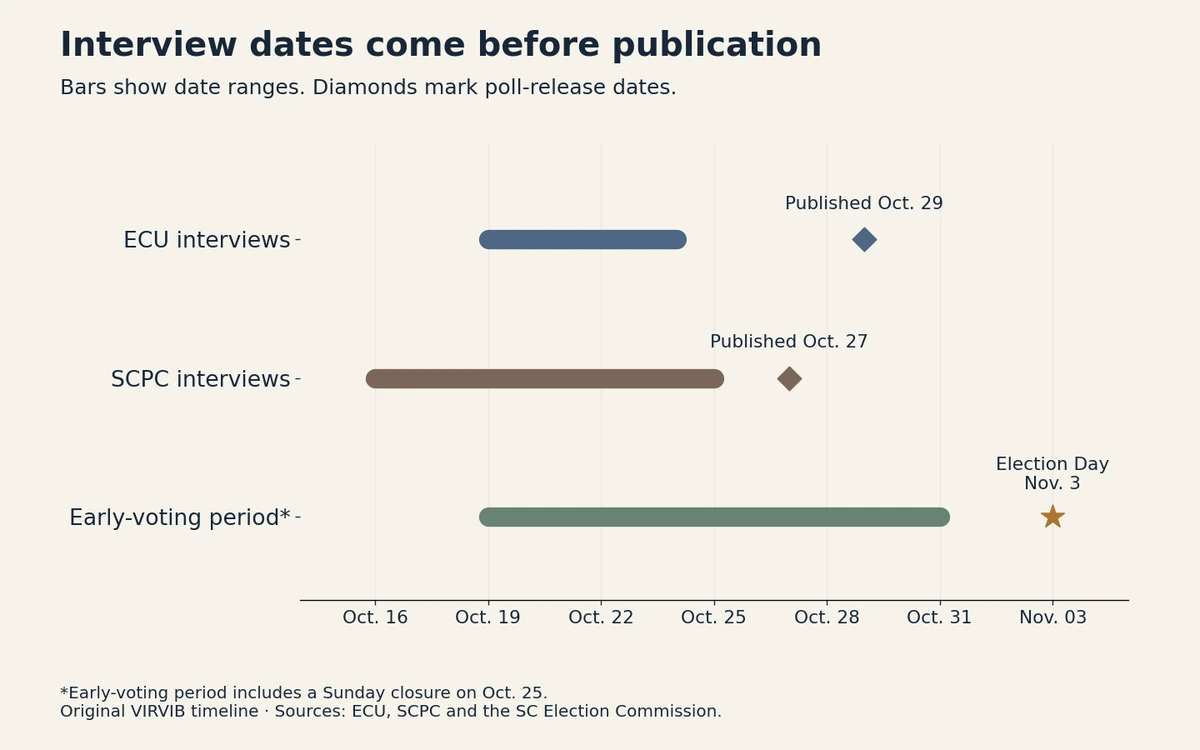
ECU interviewed 955 likely South Carolina voters from October 19 through October 24. Its published methodology combines text-to-web responses, landline interviews and an online panel supplement. The university reports a credibility interval of plus or minus 3.7 percentage points, with wider uncertainty for subgroups. The release date is later than Siena’s, but the interviews ended earlier than the October 29 announcement. A new publication date should not be mistaken for an entirely new measurement taken that morning.
Another primary source, the South Carolina Policy Council’s October 27 release, puts Graham at 47% and Andrews at 46% among 895 likely voters. Targoz Market Research conducted that survey from October 16 through October 25. Libertarian Kasie Whitener received 2%, Constitution Party candidate Mark Hackett 1%, and 4% were undecided. The council discloses text-to-web recruitment and additional panel interviews, as well as weighting and data-quality checks.
VIRVIB analysis: the useful comparison is the spread of published estimates, alongside their methods and interview periods. These are separate polls, not successive readings from a single instrument. Presenting them together gives readers more context than selecting only the tied result or only Graham’s largest lead.
Sources: Siena Research Institute — October 28 original poll release ↗ · ECU Center for Survey Research — October 29 results and methodology ↗ · South Carolina Policy Council — October 27 Targoz results and disclosures ↗ · WCIV — independent reporting on the poll, candidates and race ↗
The medical career behind Andrews’s health-care campaign
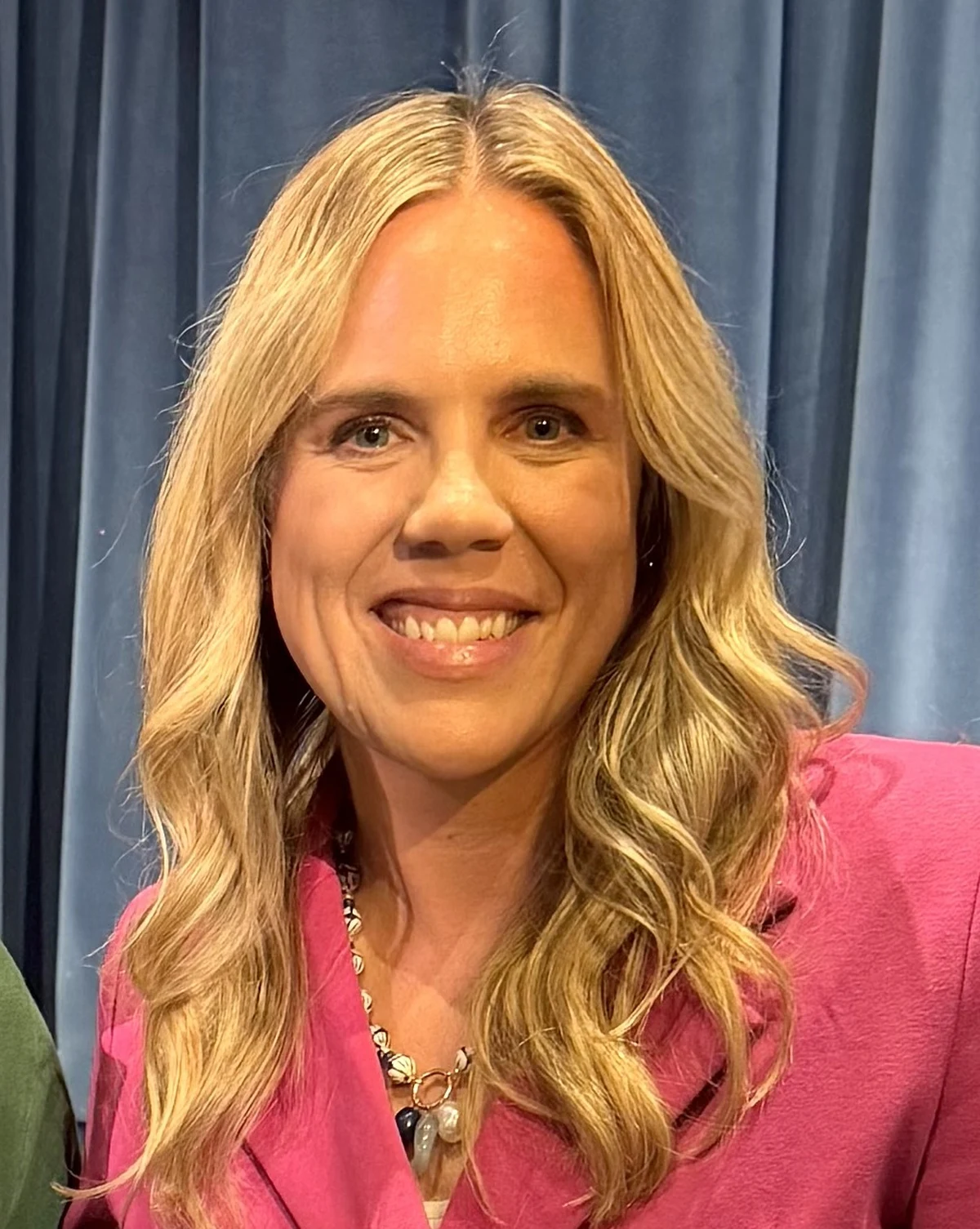
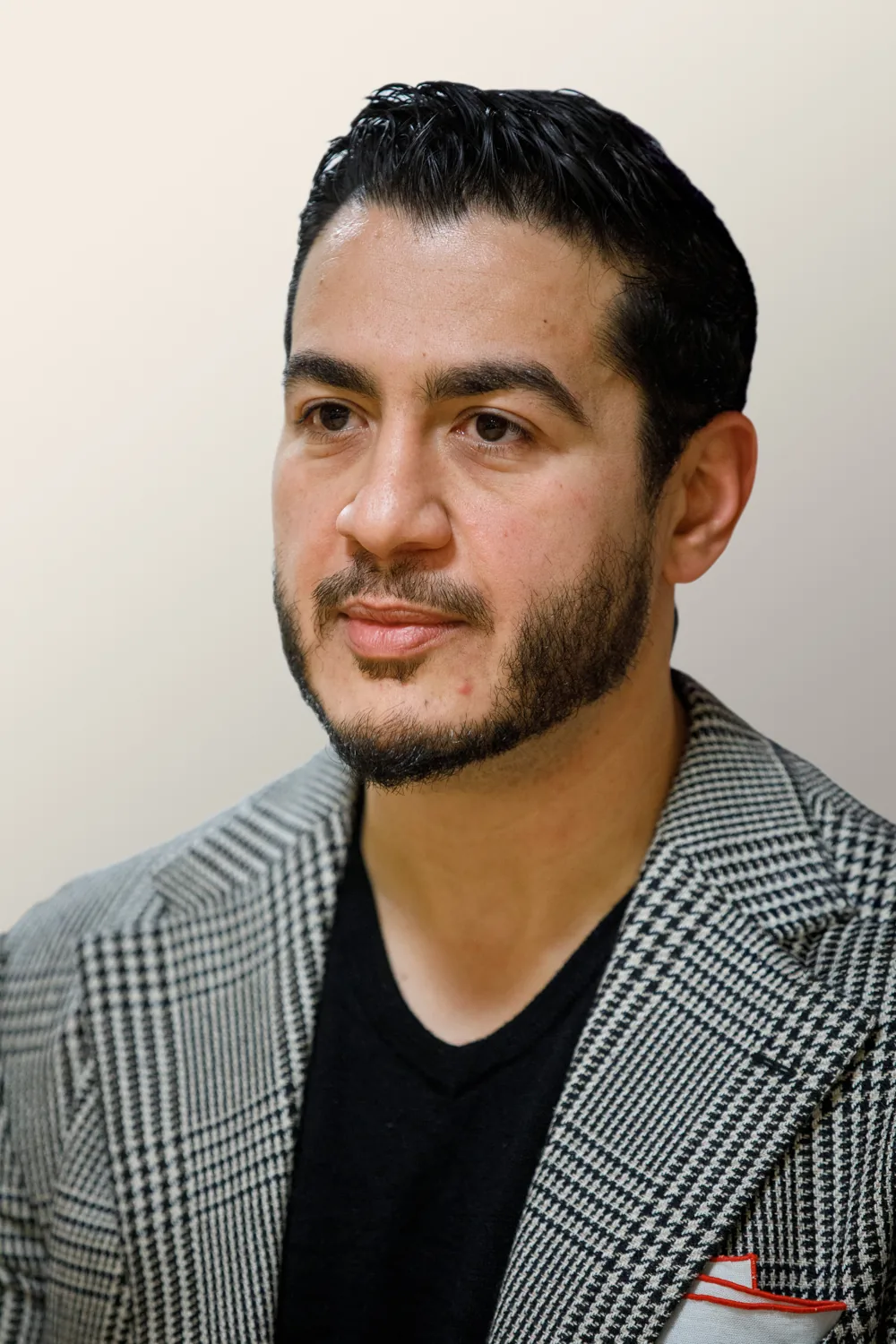
Andrews’s candidacy grows out of a career in pediatrics and advocacy about children’s safety. A July 2022 Charleston City Paper profile traced her move to the Lowcountry in 2009 after medical school and a pediatric residency in Cincinnati. It listed a bachelor’s degree from the University of Dayton, an M.D. from the University of Cincinnati and a master’s degree in clinical research from the Medical University of South Carolina.
That account described her work treating children at MUSC and her growing involvement in gun-violence prevention after the 2018 Parkland school shooting. It also recorded her earlier campaign for South Carolina’s 1st Congressional District. Those details explain the professional and political background she brings to the Senate contest. The article’s descriptions of her employment belong to 2022; they are not confirmation of her current hospital position.
In an October 28 interview with WIS, Andrews identified preventing Medicaid budget cuts and protecting rural hospitals as her leading priority. She argued that losing local care can make emergencies more dangerous and place greater pressure on remaining hospitals. These are the candidate’s arguments about the consequences of policy, rather than a VIRVIB finding that a particular hospital will close on a specified date.
Andrews also advocated temporarily suspending the federal gas and diesel tax to reduce immediate costs. On health insurance, she described a public option that people could choose to purchase while retaining the ability to use private coverage. Her argument is that an additional public plan would put competitive pressure on private insurers. Whether legislation would deliver the savings she anticipates would depend on its eventual design, financing and implementation.
Her campaign biography says she will refuse corporate political-action-committee contributions and emphasizes affordable health care, public schools and economic security. Those are campaign commitments, distinct from an audit of donations or a legislative accomplishment. Taken together, the interview and biography show how she connects her medical background to her political pitch: access to treatment, household costs and the conditions affecting children outside the hospital.
Sources: Charleston City Paper — July 2022 education and career profile ↗ · WIS — October 28 original Andrews interview and transcript ↗ · Andrews campaign — biography and stated commitments ↗
Graham’s appointment and the Republican case for continuity
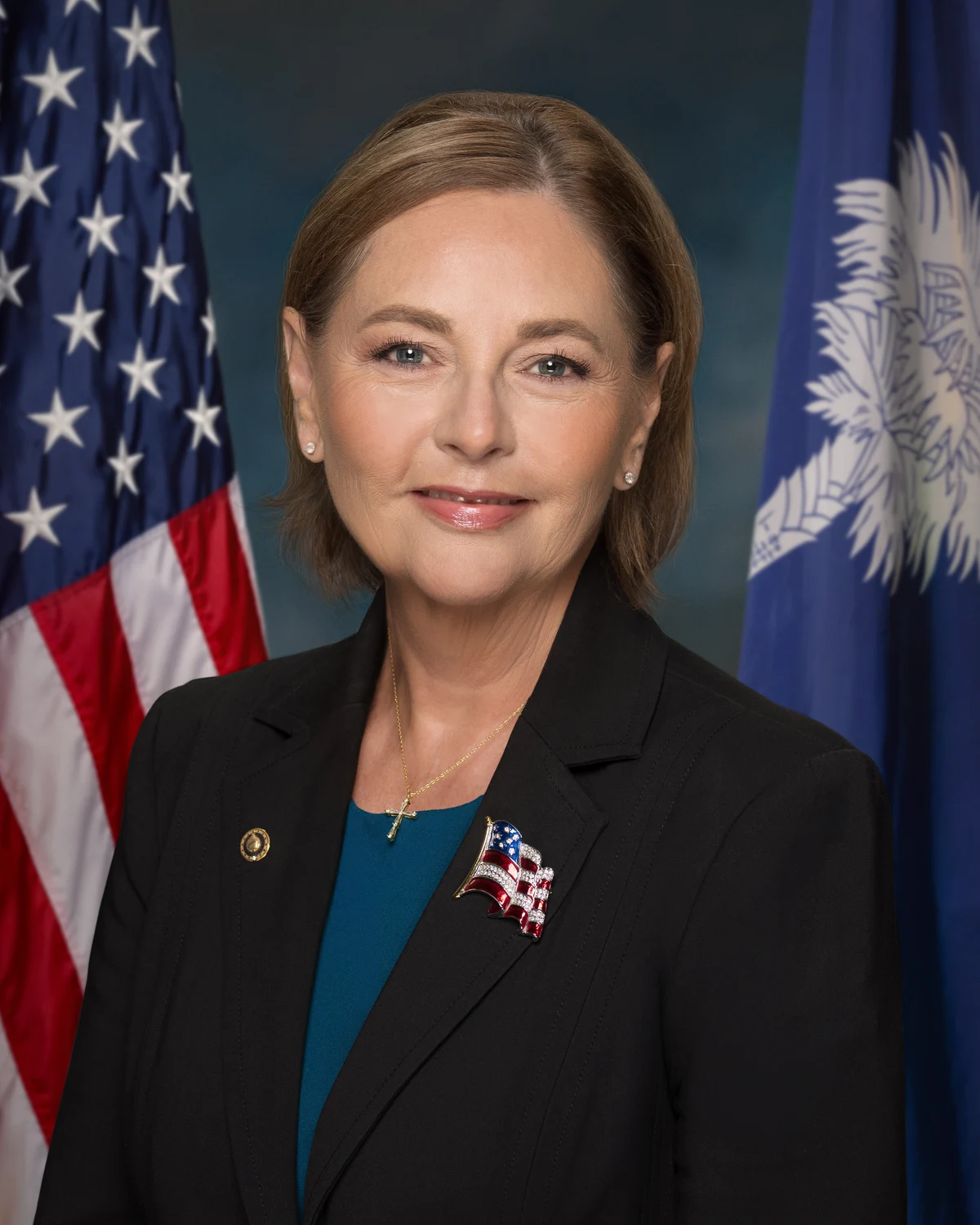
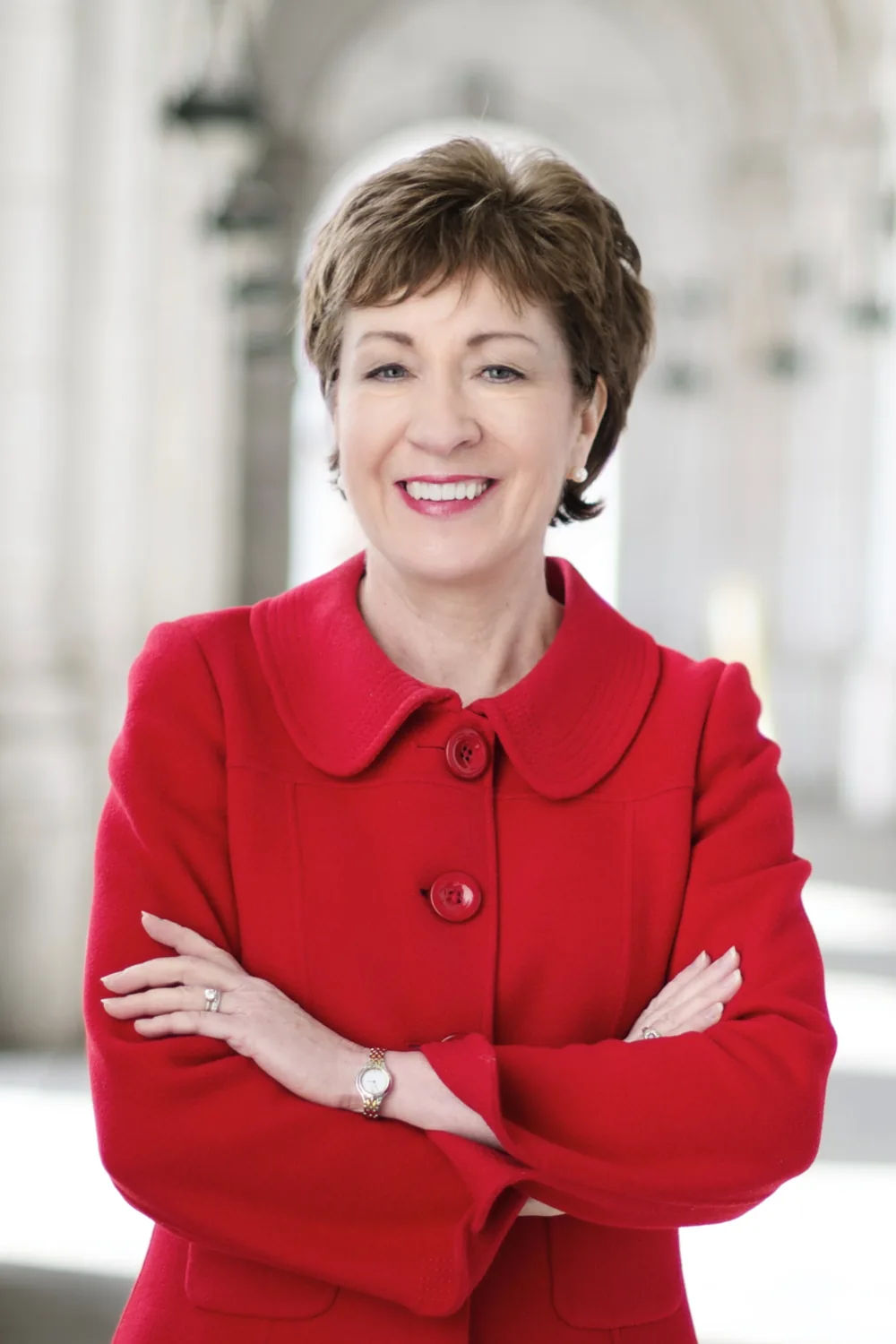
Graham’s route to this election began with an appointment. Governor Henry McMaster announced on July 13 that she would fill the vacancy created by the death of her brother, Senator Lindsey Graham. The governor’s original statement identified her service as commissioner of the South Carolina Commission for the Blind since 2019, along with earlier roles involving vocational rehabilitation, workforce development and Clemson University.
That is a public-administration record, while the Senate appointment is a separate federal role. The same announcement set out the process for a replacement Republican nomination and confirmed that the general election would proceed on November 3. WCIV’s October reporting records her subsequent victory over Representative Ralph Norman for the nomination and President Donald Trump’s support for her candidacy.
Graham has acknowledged the contest’s closeness. At an October 22 news conference covered by WIS, she said she was taking the polling seriously and campaigning as though she were behind. That statement is evidence of how she describes her approach, not proof of the private calculations inside either campaign. It also undercuts the idea that South Carolina’s established Republican reputation by itself settles this particular election.
WCIV reported that Trump carried South Carolina by nearly 18 points in 2024. The comparison supplies political context, but a presidential result and a Senate survey measure different choices at different times. VIRVIB analysis: Andrews’s challenge is to turn support across party lines into votes, while Graham’s is to consolidate a Republican electorate that has previously delivered large statewide margins. Neither task can be measured simply by the attention a rally or a search query attracts.
Sources: South Carolina governor — July 13 appointment announcement ↗ · WCIV — independent reporting on the poll, candidates and race ↗ · WIS — October 22 Graham news conference ↗
How to read the uncertainty—and where to check voting details
The main statistical trap is treating a reported error margin as an automatic test of a candidate’s lead. The American Association for Public Opinion Research explains that the familiar sampling margin applies to an individual estimate. Assessing the difference between candidates requires more care. Pew Research Center’s methodological guidance likewise explains why uncertainty around the gap is generally larger than uncertainty around either candidate’s share.
AAPOR also distinguishes probability samples from polls that use nonprobability recruitment. ECU labels its uncertainty measure a credibility interval and discloses its online-panel component; that terminology should be preserved. Different recruitment methods, weighting choices and likely-voter definitions help explain why two surveys may produce different estimates. Sampling uncertainty does not capture every possible problem, including nonresponse or an inaccurate picture of who will actually vote.
This is why a four-point advantage in one release should not be described as a guaranteed victory, and why a rounded tie does not establish equal chances of winning. Nor do polls from different organizations, on their own, demonstrate that voters moved by a particular number of points. A stronger claim about change would require a defensible comparison over time. Search interest supplies even less electoral information: it cannot tell whether a person searching a candidate’s name supports that candidate.
For South Carolina voters, the immediate dates are established by the State Election Commission. Its October 14 notice says early voting runs October 19–31, with centers open from 8:30 a.m. to 6 p.m. Monday through Saturday during that period. Election Day is Tuesday, November 3. The commission directs voters to scVOTES.gov or their county election office for locations, sample ballots and photo-identification information, and warns that early-voting sites can differ from assigned Election Day polling places.
The next decisive evidence will come from ballots and official results. Until then, the verified picture is a Senate contest in which several recent polls show limited separation between the major-party candidates. This profile will be updated when new evidence materially changes that picture.
Sources: AAPOR — guidance on interpreting election polls ↗ · Pew Research Center — uncertainty in candidate leads and poll comparisons ↗ · ECU Center for Survey Research — October 29 results and methodology ↗ · South Carolina Policy Council — October 27 Targoz results and disclosures ↗ · South Carolina Election Commission — official early-voting dates and guidance ↗
Why this story is in the editionGoogle Trends U.S. RSS retrieved October 30, 2026 at approximately 02:05 UTC included the query “dr annie andrews” (feed timestamp October 29, 18:50 PDT). Search interest informed selection; no national rank, search volume, voter preference or election probability is inferred.
Prepared with AI assistance. Source-based reporting checked on 2026-10-30. This article does not update automatically. Read our editorial standards.