What was discovered—and when the evidence became public
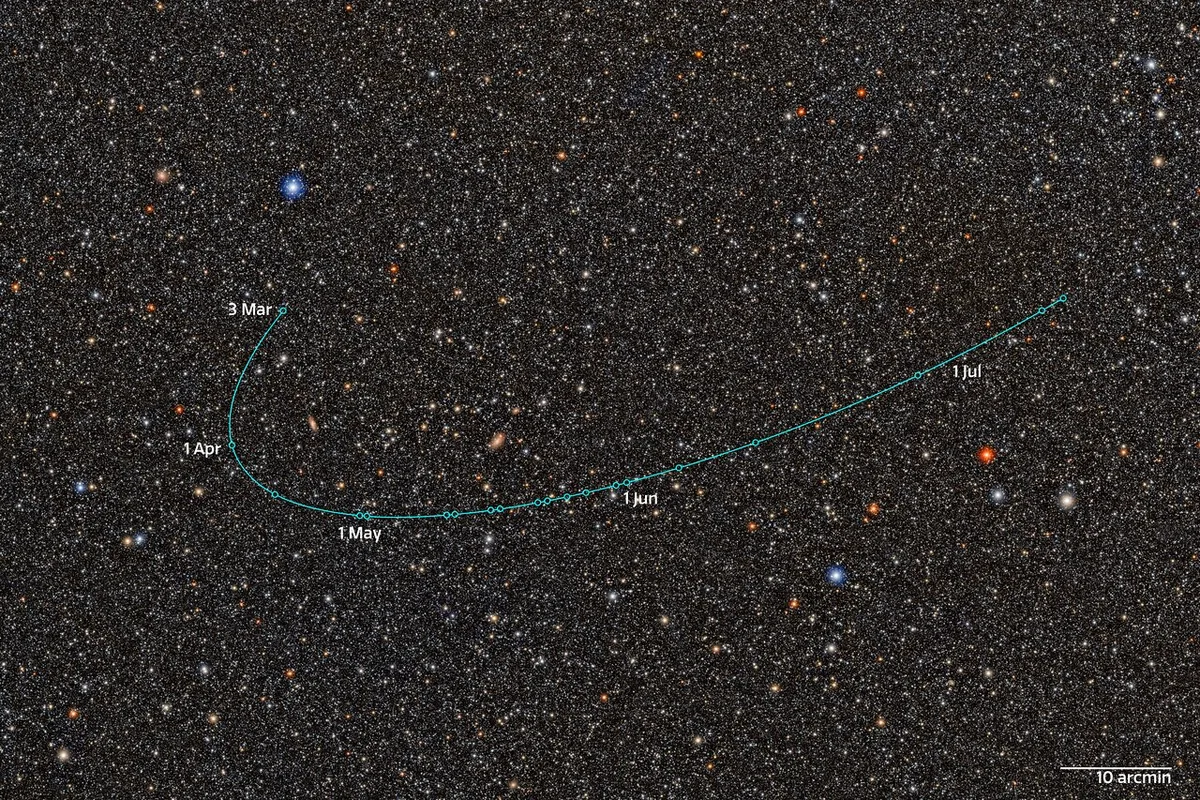
Astronomers have identified 2026 ED138, a distant object that may qualify as a dwarf planet, using observations from the NSF–DOE Vera C. Rubin Observatory. The discovery was announced on October 27, 2026, rather than today. It is newly attracting attention, but its classification remains provisional: finding the object and demonstrating that it meets the dwarf-planet definition are separate scientific steps.
The public record provides a precise announcement time. Minor Planet Electronic Circular 2026-U85 was issued on October 27 at 18:17 UT. It lists observations under the designation 2026 ED138, including detections from February 2016 and March–July 2026, together with orbital elements and predicted sky positions. Those dated entries make clear that the object was present in older images long before its discovery was announced. This was a recognition of an existing world, not the appearance of a new one.
According to Rubin’s discovery account, Matthew Holman of the Center for Astrophysics | Harvard & Smithsonian identified the object while processing earlier observations on October 13. He used search software developed with colleague Kevin Napier. Further checks linked additional Rubin detections, and archival images extended the observational history back to 2016. The announcement describes 30 Rubin observations on 20 nights. National Geographic independently reported the discovery on October 29, including the need for follow-up before a dwarf-planet classification can be confirmed.
Distance figures need their own labels. Rubin’s announcement describes an approximate distance of 46 astronomical units, with one astronomical unit representing the average Earth–Sun distance. The MPC circular’s dated ephemeris gives a Sun distance of about 47.22 astronomical units on October 27. Those published figures differ; this report does not silently treat them as identical measurements. Both place the object in the distant solar system. The circular also lists an orbital inclination of about 24.47 degrees and a period of approximately 281 years.
The discovery pictures offer another useful distinction. A turquoise track across a crowded star field records the object’s apparent movement between observations, not a photograph of its entire journey around the Sun. Enlarged image cutouts show a small detection among other points of light. Neither image is a close-up portrait of a landscape. The evidence is compelling because positions can be connected across observations and years, while questions about the body itself remain open.
Sources: Rubin Observatory — original discovery announcement, October 27, 2026 ↗ · IAU Minor Planet Center — MPEC 2026-U85, issued October 27 at 18:17 UT ↗ · National Geographic — independent reporting, October 29, 2026 ↗
Why 2026 ED138 is a dwarf planet candidate
NASA’s account of the International Astronomical Union’s definition explains why the word candidate matters. A dwarf planet orbits the Sun, has enough mass for its own gravity to make it nearly round, has not cleared its orbital neighborhood, and is not a satellite. Size alone is therefore not the complete classification. A catalog designation establishes an object’s identity; it does not automatically settle its physical shape or give it formal dwarf-planet recognition.
The distinction also answers the familiar Pluto question. Under the IAU framework adopted in 2006, a planet must have cleared its orbital neighborhood. Pluto belongs to the dwarf-planet category because it does not meet that condition. NASA lists Pluto, Ceres, Eris, Haumea and Makemake as the recognized dwarf planets. Confirming another member of that category would not, by itself, restore Pluto’s earlier status or change the current count of eight planets.
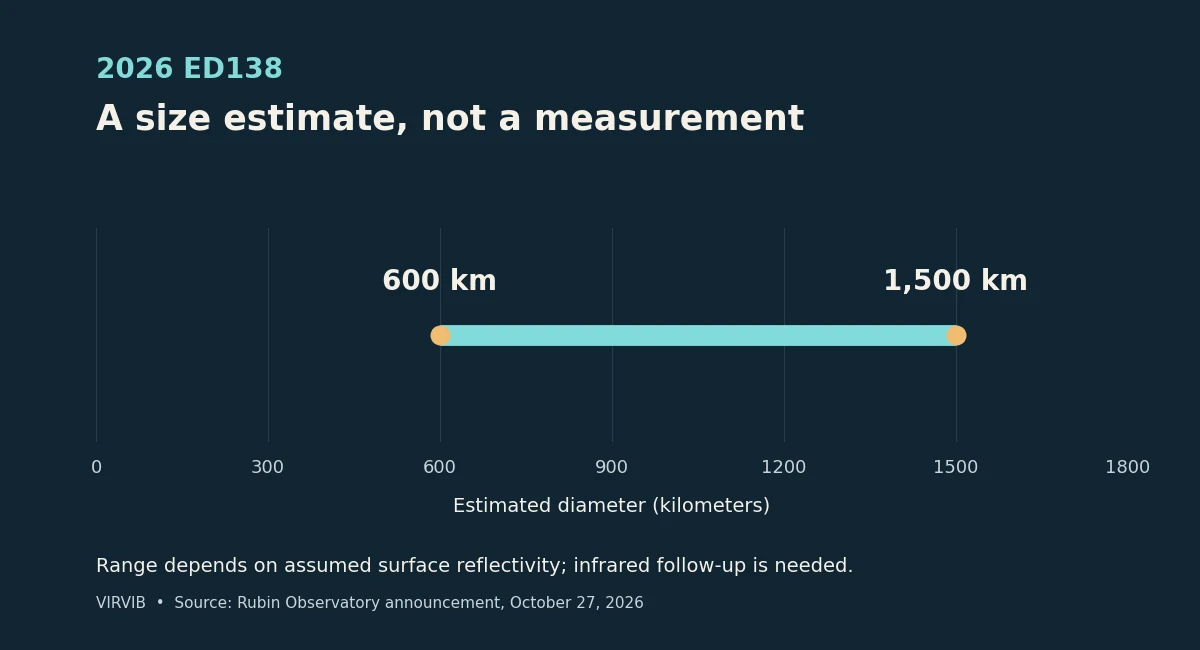
For ED138, the Rubin team estimates a diameter between 600 and 1,500 kilometers, based on distance, brightness and assumptions about surface reflectivity, or albedo. That broad interval explains why an exact size in a headline would be misleading. National Geographic’s independent account similarly emphasizes how little is established about the body’s physical properties. It identifies additional telescope observations as the route to narrowing the uncertainty, rather than presenting an already completed measurement.
The underlying problem is straightforward: a bright-looking distant object could be relatively reflective or relatively large. An observation of reflected light does not, on its own, separate those possibilities. The range graphic accompanying this section shows the published bounds without selecting a midpoint as the preferred answer. Its line is not a probability curve, and the two endpoints do not mean astronomers have measured two different diameters. They describe the uncertainty in an initial estimate.
Infrared observations are needed to constrain the size and help establish whether the candidate meets the physical requirements. Until those results are available, the scientifically useful description preserves both parts of the story: a real, identified object with a documented orbit, and an unresolved classification. A claim of a confirmed sixth dwarf planet would run ahead of that evidence. So would a detailed description of oceans, active geology or a photographed surface; none is established by the observations reviewed for this article.
Sources: Rubin Observatory — original discovery announcement, October 27, 2026 ↗ · National Geographic — independent reporting, October 29, 2026 ↗ · NASA — IAU planet and dwarf-planet definitions ↗
What the discovery reveals about the outer solar system
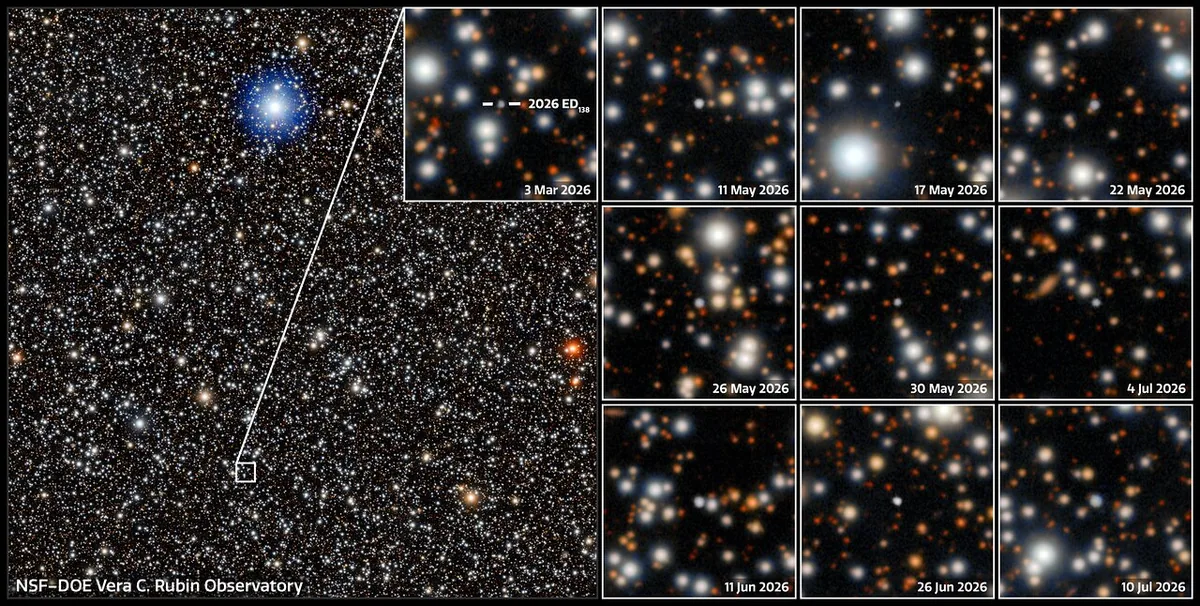
The National Science Foundation attributes the object’s previous obscurity partly to its position near the Milky Way’s crowded plane. Against so many background stars, finding a moving point requires more than a visually striking single exposure. Repeated monitoring and software that connects detections allowed the team to distinguish ED138 from the surrounding field. The discovery mosaic illustrates that challenge: the marked object is a tiny part of the scene, even though its potential physical scale is considerable.
This is the kind of work Rubin was built to support. NSF announced the start of its ten-year Legacy Survey of Space and Time on June 30, 2026. The U.S.-funded observatory operates in Chile and is jointly run by NSF NOIRLab and the Department of Energy’s SLAC National Accelerator Laboratory. Its survey revisits the southern sky every few nights, building a record of change over time. The June start date also explains why some of the discovery observations precede the formal survey: early data and the full campaign are different stages of the observatory’s work.
The wider setting matters as much as the individual detection. NASA describes the Kuiper Belt as a broad region of icy bodies beyond Neptune, with its main part extending from roughly 30 to 50 astronomical units from the Sun. It is not an empty boundary at Pluto. Objects there have diverse shapes, colors and orbital paths, and those paths help astronomers reconstruct how the giant planets influenced the early solar system.
NASA’s account connects that population to material left over from planetary formation. In models of the solar system’s evolution, Neptune’s gravity helped redistribute small icy bodies as the giant planets’ orbits changed. Studying an additional object therefore contributes to a larger history: which populations survived, where they ended up and how their orbits differ. It is evidence about a population of worlds, rather than merely another name to memorize beside Pluto.
VIRVIB analysis: the most consequential next result would reduce uncertainty about ED138’s physical nature. More precise orbital information and better size constraints answer different questions and should be reported separately. The record already supports an October 27 discovery announcement and a long observational history. It does not yet support declaring the classification complete. Rubin’s success is that it has supplied a new, testable object for further study; the next announcement will matter for what additional evidence it actually brings.
Sources: NSF — discovery announcement and crowded-field detection ↗ · NSF — Legacy Survey of Space and Time begins, June 30, 2026 ↗ · NASA — Kuiper Belt facts, structure and origins ↗
Why this story is in the editionThe Google Trends U.S. Trending view checked October 30 included “dwarf planet beyond pluto”. Selection reflects editorial judgment and verification, not a claimed national search rank, exact search volume or discovery occurring today.
Prepared with AI assistance. Source-based reporting checked on 2026-10-30. This article does not update automatically. Read our editorial standards.